Let me rephrase. I finished a major revision a couple of weeks ago. It's now in the hands of an editor, and once that's done, I intend to try to find a traditional publisher.
In the meantime, I had four copies of the book printed and bound, just as souvenirs for my family and me. It's not for sale anywhere, nor will it ever be. It's still an unpublished manuscript. And someday, I hope that it will be published for real.
And because this was just for me, it's not just any version, but the version that is the most blue-sky, the most ... mine. If I could have whatever I want, this is what I'd include:
A nice, large 11-point font, with a wide 1.2 line spacing (the extra space between lines makes it more pleasant to read, but it adds to the page count).
All 160,000 words of the story, before anyone makes me cut it down by 20k-30k words
A full-length afterword (all 3K words or so)
Letter from my grandfather to his commanding officer, written after he immigrated
Essay written by my grandfather about the day he became a US citizen
Glossary
List of foreign phrases and their translations.
A metric-imperial conversion table.
Anyway, I got my copy, and it makes my heart go pitter-patter. Almost five years of work went into it, and it's looking good. It feels great, and I'm proud of it.
Magical Realism (500 Words): Think of a fantastical image or episode, and incorporate it into a story, which is told in a completely realistic, matter-of-fact, non-magical way. This will have the effect of making the magical appear real. Bring the reader into your world of magical realism by tapping into their senses, fusing the sights, sounds, smells, tastes, and touch of the gritty real world with the magical. For example: “Gita’s skin caught the gnarled cedar bowl as she handed him the ten rupees. Smoked ground turmeric and specks of her blood rained on the Punjabi street-market floor and turned into gold.”
***
Robert and Miss Turska climbed out of Papa’s taxicab, the big Peugeot 402. Robert could tell that Mama didn’t want him to get out because they might get lost in the traffic jam, or run into German soldiers or something. But they were driving so slowly, Papa thought it would be okay.
Miss Turska bent down and picked something up off the road. “Do you know the game, ‘kick the pebble’?” she asked Robert. She held out her hand and showed him a white pebble about the size of his favorite shooter marble, but not as smooth and not as round.
“No,” Robert said, staring at the pebble, which kept changing color from white to gray and back.
“Well, I played it as a little girl.” She dropped the pebble, and it turned gray when it hit the road, sending a spray of black sparks that turned white as it skittered forward.
Miss Turska caught up to the pebble and gave it a little kick. “See? You kick the stone just a little distance, then do it again.”
She gave another kick, and it tumbled forward ksh-ksh-ksh until it hit a little bump in the road, which sent it flying, where it giggled and sent out more sparks, until it hit —BONK—the back of a man’s calf.
The pebble fell to the ground and lay quietly.
The man put down the handles of his wheelbarrow, which was piled high with suitcases, turned, and glared at Miss Turska. He said something to her in Flemish, but Robert didn’t understand Flemish very well, yet. Then he turned and stomped forward again.
“I’m sorry, sir.” Miss Turska called after him, snatching up the pebble. “Well,” she said to Robert, “you must be careful not to hit anyone. Do you think you can kick this pebble all the way to France, without doing so?”
Robert grinned. “Yes, ma’am!”
Miss Turska handed him the pebble.
Robert looked at the lumpy white kicking stone, then gently drop-kicked it like a football. It shot forward, but stopped just shy of hitting the wheelbarrow man again. Tiny white flower-sparks bounced out of it.
“Very good! The only rule is to never allow the stone to hit anyone. If you do that, you lose.”
Robert smiled at Miss Turska. She was okay.
There was a big open space ahead of them, so Robert gave the pebble a really solid kick, but instead of giggling and sending flowers, it just made regular sparks. He looked up. Two men shoved a woman out of their way as they left one of the houses along the road, carrying a lumpy bag. She got up and wailed, “How will I feed my children?!”
“Are they stealing her food?” Robert asked Miss Turska. “Shouldn’t we fetch the police?” Papa always said that a good man never hurt women, children, or dogs.
“Oh, yes, my young man,” Miss Turska replied. “But you see, there are no police to help her. They’ve all fled, too.”
--January 18, 2026
***
Hopefully, the setting is clear, but in case it's not: It takes place in Belgium, around May 15, 1940. They are heading west toward France, refugees escaping the Nazi invasion of western Europe, and caught up in what was probably the greatest population movement in European history. Think apocalypse-lite crossed with a traffic jam from hell.
Robert and Miss Turska were real people, though their actions in this story are fiction. Robert was the son of the taxi driver my grandfather hired to take his family to Calais. I don't know his real name or his age, though I imagine him as an eight-year-old. Félicie Turska was my great-grandfather Herman's housekeeper, and later, his second wife. She would have been about 46 when the story takes place.
As I mentioned earlier, the taxi my grandparents used to escape the invasion of Western Europe might have been a Volvo PV 802, which, according to an internet source I found somewhere, was the more likely candidate out of the two possible models, so planned for the taxicab to be a Volvo.
Well, I've changed my mind. I've decided that the other possible model, a Peugeot 402 Longue (long), also called a "familiale," is the one I'm going to go with. Here is why:
Peugeot 402 Familiale retrofitted with a wood-gas generator.
In 1939 Peugeot were already investigating the adaptation of petrol/gasoline engines to run on gas created by the controlled burning of charcoal. The technology would prove particularly suitable for the long bodied Peugeot 402 ... On the car it was possible to fit the necessary components without excessive modification of the bodywork. A charcoal burning boiler, able to accommodate 35 kg of charcoal, was mounted on a stout platform at the back of the car. This provided sufficient power for approximately 80 km (50 miles) before more charcoal needed to be taken on board. The controlled burning of the charcoal produced carbon monoxide, known as gazogène, which was captured and transferred in a stout pipe mounted on the outside of the right-hand C-pillar to a roof mounted gas tank. From there another stout pipe mounted on the outside of the right hand A-pillar drew the gazogène down to the engine. Between 1940 and 1944 more than 2,500 Peugeots were equipped with a gazogène fuel system.
My grandfather helped develop that very fuel system! On a memorial page to him, it says, "Before World War II he worked on the development of devices generating motor fuel from coal," and I took that to mean he worked on Coal Liquefaction technology. But when I looked back at a copy of his CV, I found the following: "In his first job, he worked on the development and manufacturing of a gas generator used in wartime for the propulsion of civilian buses, trucks, and cars. Gas, produced in the generator from coal, charcoal, or wood, was used in conventional internal combustion engines."
Gazogène fuel systems, also known as wood-gas generators, burned wood or charcoal, which creates a producer gas, a mixture of nitrogen, carbon monoxide, hydrogen, and methane. It's filtered and then piped into an internal combustion engine. But you could run a car for about 50 miles with 80 pounds of charcoal. Not very efficient, but better than nothing in a world without gasoline.
When writing stories, you try to reuse characters and themes as much as possible to create an interconnected world. This model of car was particularly well-suited to a wood-gas fuel system, and when installing the system, Arthur would recognize the car where he spent two miserable weeks of his life. It's a connection, not between people, but between artifacts
Anyway, here's a video that thoroughly explores a 1936 model (it's in German, so if you don't speak the language, you can leave the sound off). Just skim through it to see the interesting bits, including how the jump seats fold down from the back of the front seats. You'll also notice there's a lot of leg room without them, but almost none when they are in use. It shows the gas tank, the trunk space, and even how you access the engine compartment (the panels lift up on either side of the engine like gull wings).
I rented a taxicab – and in the taxicab, big taxicab: Roma and myself and the baby Lillian, a few days old, and my father and my mother, and Felicie, who was like family, and in addition, the cab driver and his wife and a child, were all squeezed in one big taxicab.
--Arthur Lubinski, 1988
During the 1940 Exodus, my grandparents escaped the invasion of Western Europe in a taxi, traveling from Brussels to Montreuil-sur-mer, a trip that normally took three hours, but took them 2 weeks. Most refugees were on foot or bicycles; cars, while there were enough of them to clog the roads (particularly after being abandoned due to lack of fuel), they were comparatively rare. However, my grandfather had several serious issues to deal with: his wife was one week postpartum, his father was elderly, and his mother was late middle-aged and had tuberculosis. I imagine that he felt there were only two choices: either stay in Brussels as it fell to the Nazis, or find transport that would allow them to ride. They took the second option, but probably should have taken the first, given that they ended up returning to Brussels six weeks later.
Anyway, they needed an eight-seat taxi: seven adult passengers and one child (plus a newborn, but she rode on my grandmother's lap). There weren't that many taxis in 1940 that carried 8 passengers. There were a few American models that did, and a few of them were imported (primarily to southeastern Europe), but they were uncommon in Belgium and France. I did find two eight-seat European models, though: the Volvo PV 802 and the Peugeot 402 Familiale. Both are essentially six-seaters, but with additional seating that could fold out as needed.
Of the two models, research suggests that the Volvo was perhaps the more likely vehicle. The pages I looked at didn't explain why it was more likely, but I'm going with it. (Added: I changed my mind and am going with Peugeot).
Click on any photo to enlarge.
The Taxi:
1938 Volvo PV802. Volvo Museum. Photography by Serhii. See the end of the article for more pics of the car.
It had two large bench seats (front and back). The foldable jump seats were situated between the two rows of seating, and could be tucked away when not in use (though the legroom surrounding the jump seats must have been minuscule). It was also designed to be a small ambulance - the right side of both bench seats could fold down, and a stretcher could be loaded through the trunk. (If you are interested, there are more photos of the taxi at the end of this article.)
Note: Belgium didn't have standard taxi colors in the 1940s. It could have been any color.
The Travelers:
This little band of travelers spent about six weeks together, first on the road, then as refugees on a dairy farm in Montreuil-sur-Mer, France.
First, we have the taxi driver, his wife, and their child. Their names have been lost. I know they existed, but I have no idea who they were or what happened to them after they returned to Brussels in June of 1940. I named them Marc and Violette D’Abruzzo, and their 9-year-old son Robert.
But the rest of the people in the car were my family (photos from their Belgian naturalization files):
Great-Grandfather Herman Lubinski, circa 1926.
The 63-year-old Herman was a businessman who owned his own agricultural commodities trading company. He was resourceful, but he did a poor job of planning for the future, spending money freely when he was flush with cash, only to face periods of complete financial hardship when he ran out of money. Eventually, (in 1941 or 1942), his business was seized, and he was imprisoned in Breendonk concentration camp, but he miraculously escaped (!?!) and survived the war by hiding in a retirement home.
Great-Grandmother Micheline (Mascha) Lubinski, circa 1926.
The 58-year-old Mascha Lubinski was a highly intelligent woman who led salons in her home, inviting philosophers, artists, and scientists to discuss the great topics of the day. My grandfather was very close to his mom and credited her with making him the generous, ethical, and hardworking man that he became. She contracted tuberculosis at some point and survived the occupation by feigning mental illness and hiding in an asylum.
Félicie Turska, circa 1931
Félicie Turska, aged 46, served as a housekeeper for Herman, who fell in love with her. He married Félicie after Mascha's death. I think she was a lovely woman, but she looks high as a kite in the photo. And my great-grandfather Herman must have had real chutzpah to travel with both his wife and his lover in the same taxi. Can we say tense and awkward?
Interestingly, Herman's sons (by his first wife), Arthur and Paul, had different attitudes toward Félicie. Arthur resented her for her relationship with Herman, while Paul seemed to have accepted her as his stepmother, and my cousins in Belgium tell me she was very kind and that she was the only grandmother they ever knew.
My grandparents, Arthur and Roma Lubinski at the time of their 1935 marriage
Ohmygod. My grandfather's hair!!! It's so ... tall! Even before he lost his hair, he kept it short and much neater than in this photo (according to the family album, anyway).
1938 Volvo PV802. Volvo Museum. Photography by Serhii.
1938 Volvo PV802. Volvo Museum. Photography by Serhii. Note the rear luggage rack (most didn't have that) and the dinky trunk.
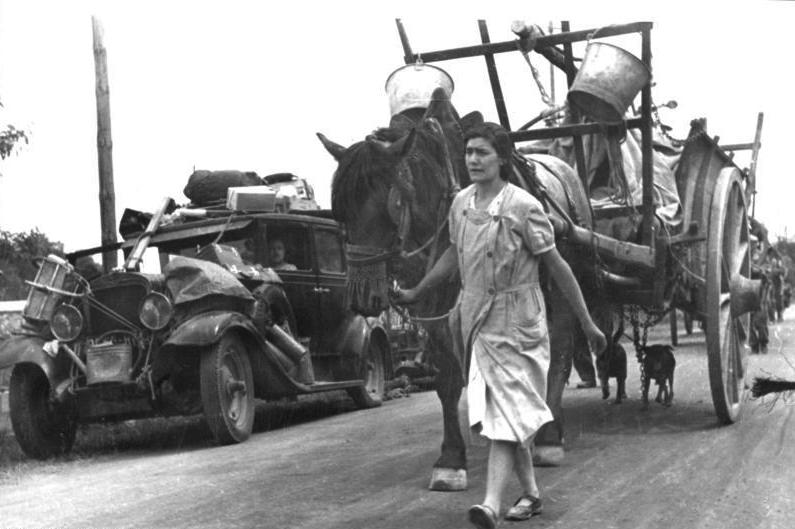
French refugees on the road of the Exodus, 19 June 1940, near Gien, France. CC-BY-SA 3.0. This photo was taken by a German soldier.
Between May 10, 1940 when the Germans invaded western Europe, and the end of June, when France surrendered, a massive migration, one so biblically enormous, it was given the name l'Exode (the Exodus) in France.
The 8-12 million affected people were a mixture of refugees from Belgium, Luxembourg, and the Netherlands, but also internally displaced persons (IDP) from within France itself, and they all had the same goal: to get farther from the front, to find safety.
Regardless of nationality, people sort themselves into three groups in tense situations: 1) the exceptionally good people who rise above the situation and try to help those around them; 2) the genuinely bad people who heartlessly take advantage of the desperation of others; and 3) everyone else, the desperate masses who just do what they can to survive. This last group is massive, usually comprising over 90% of the participants.
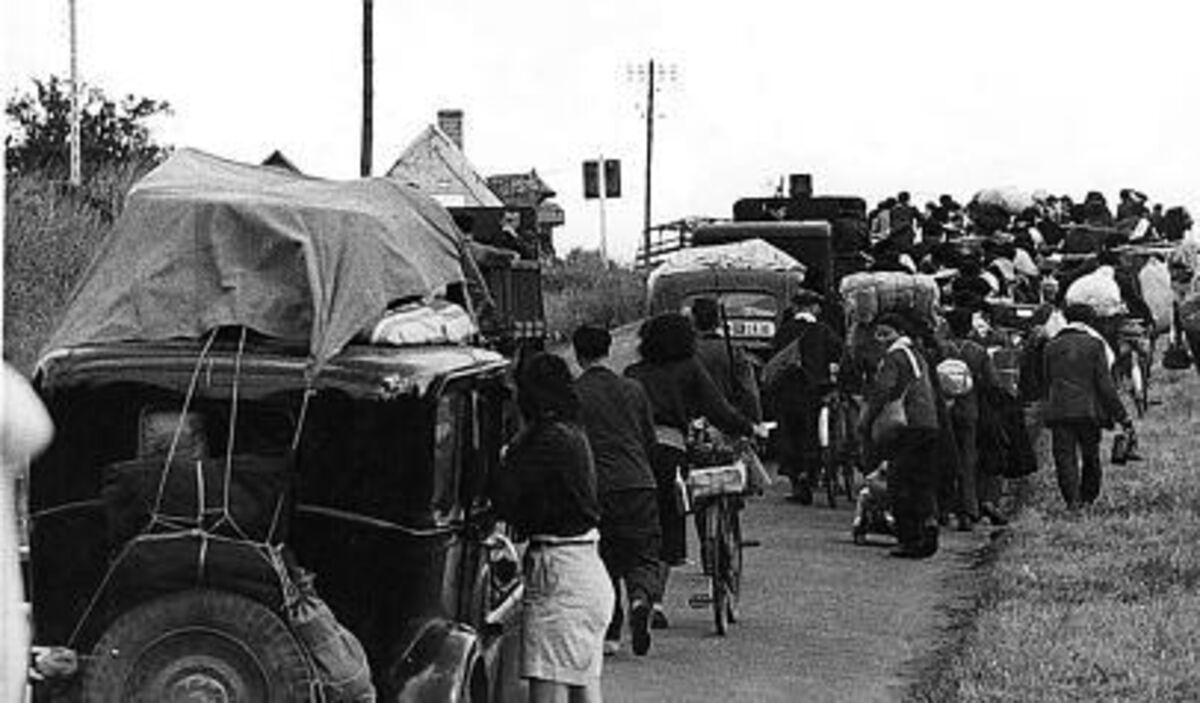
It's hard to capture what the Exodus in 1940 was like, and hell, it's hard to even imagine it. Millions of people were on the road, stuck in a traffic jam from hell that lasted not hours, but weeks. People were on foot, on bicycles, in horse-drawn carts, or in automobiles. But mostly, they were on foot. The average speed was 1-3 miles (2-5 km) per hour.
There was a heatwave, and there wasn't enough food, water, or fuel. There were no sleeping arrangements, showers, or even toilets. People were packed closely together with their dogs and horses, and surrounded by clouds of automobile exhaust. The smells must have been intense.
There were constant threats of crime, violence, and chaos. People were beaten for their food. Women were raped. Children were occasionally separated from their parents (sometimes permanently), and war profiteers charged people exorbitant fees for sips of water, and a simple sandwich might cost a week's wages.
And the Luftwaffe and their dreaded Stuka dive bombers made a habit of not just strafing Allied soldiers, but columns of refugees as well. There are a couple of scenes in the 2017 movie Dunkirk that show what it was like:
Note: that weird high-pitched whining sound that sounds like an anvil dropping on Wile E. Coyote's head (link to short clip that includes the sound) wasn't an air-raid siren, nor was it an artifact of the Stuka engine noise. Rather it was psychological warfare in the form of ram-air sirens mounted on the Stukas themselves. They were called "Lärmgerät" (noise devices) but despite popular myth, they were not really called "Jericho Trumpets" (which is what I think the whistles on bombs were called). Most common was probably "Stuka Siren".
My grandparents and great-grandparents joined the Exodus of 1940. And they did it with my newborn Aunt Lilly, my grandmother, who wasn't producing enough milk (probably due to terror and the deprivations of the trip itself), and my great-grandmother, who suffered from tuberculosis. My grandfather told me about the taxi he hired (but not how they avoided running out of fuel), about the traffic jam, but not how long they were on the road, about who he took with him, but not about their misery. He summed up the experience in a single word: pathetic. I think he was describing not just the stasis of the troops, but how he and his family felt.
So after Lillian was born, and as soon as we could move – I didn’t have any car at the time, so I rented a taxi cab – and in the taxi cab, big taxi cab: Roma and myself and the baby Lillian, a few days old, and my father and my mother, and Felicie who was like family, and in addition the cab driver and his wife and a child, were all squeezed in one big taxi cab. We started escaping from Brussels.
Well, you couldn’t do more than ten miles a day at most, because the highway was crowded and millions of people who remembered the war – the first World War, 1914 to 18 ... So they wanted to escape and be on part of France where the front would never arrive. So millions of them were moving; including fire trucks with people on it. And including ambulances with people on it; etcetera, etcetera. Completely packed by millions of people. And English and French and Belgian troops couldn’t move because of the civilians packing the highways.
It was pathetic.
--Arthur Lubinski, Oral Testimony, 1988
Source: https://www.odomez.fr/ Note the mixture of cars, bikes, and pedestrians
When I recorded him, Grandpa said they traveled ten miles (16 km) a day, and the route I think they took (which is admittedly a guess), from Brussels to the coast, and then along the coast to Montreuil-sur-Mer, France, taking them right past Dunkirk and Calais, was 180 miles (290 km). I think they also hoped to reach England, so a coastal route made sense. He also said:
And we arrived at the North Sea. In the … you would say “state.” In French, it is département, department – but that means state if you want – of Pas-de-Calais on the English Channel.
The North Sea comment also suggests a coastal route. I'm not certain if they stopped in the city of Calais or just the region of Pas-de-Calais, but in 1988, I got the impression he meant both, although I'm not entirely sure.
(Added: I now think they probably went to Lille first, then north to Calais)
My research suggests that a key route during the Exodus was from Brussels to Lille in France, and from there to Paris and then to Bordeaux. But we know they went to Pas-de-Calais, and Paris and Bordeaux were in the wrong direction for that. It's possible they went to Lille first, and then turned north, but that route and the stops they must have made (they stopped every night in a town with a maternity clinic for my grandmother's benefit), and that would have added a day or two to the trip. So, I think they made a beeline for the coast.
Another problem is that if they traveled only 10 miles a day, then the dates don't work - it would have taken them 18 days to arrive in Montreuil, where they stopped for several weeks (a dairy farmer took them in). However, at 10 mpd, they would have encountered many of the areas after they had fallen to the Germans, whereas his story as a whole suggests that they encountered German soldiers only at the end of the trip.
So, I started researching the Exodus to see how far people typically traveled in a day:
On foot: 6-12 miles per day (10-20 km). This was the majority of the refugees.
Bicycle or horse-drawn cart: 12-18 miles per day (20-30 km)
Car: Up to 20 miles per day (32 km). Autos were less common, there were serious fuel shortages to contend with, and many cars were abandoned after they ran out of gasoline.
I also have the sense that the trip took less than 2 weeks, probably about 10 days, based on their departure date (May 15), the length of time they spent in Montreuil (3 weeks), and the approximate date they returned to Brussels (after the cease-fire went into effect in France on June 25, 1940). In those days, cars traveled nearly as quickly as they do today, and under normal conditions, they would have made that drive in about 3 hours.
The return journey to Brussels would have been tremendously easier. The roads had mostly cleared by then, and the French government offered fuel vouchers with short expiration dates to encourage people to fill their gas tanks as soon as possible and go back to where they came from.
Well, after three weeks France capitulated. There was no reason for going farther south. So we went back to Brussels, and found our beautiful apartment in town.
Grandpa's taxicab would have made the trip back to Brussels in only a few hours. He didn't tell me this outright, but given his complete lack of detail regarding the round trip (there was probably nothing to tell), I think it's a safe bet.
But, I do have to figure out how to capture my grandparents' Exodus, because it was miserable and integral to their story, but ... it was two weeks of boredom, punctuated with terror and misery. I want to convey that it was a boring experience, but without making it boring to read.
I know of eight places where my grandparents lived in Europe in the 1930s and 1940s. I've found the addresses in my grandfather's writing, in letters from his brother-in-law, from archivists who looked them up in city records, and historian friends who traced previous owners of properties (when I knew the actual names of the people they lived with, but not the location of the property). This doesn't count places my grandfather lived separately from my grandmother (when he was in the maquis, for example).
One Brussels address is almost certainly fake, or rather, it was a real address, but they never lived there. They supposedly moved into the apartment 5 months after they'd escaped Belgium. I'm guessing it was some sort of false forwarding address (and I have evidence they were in France when they moved in according to Belgian city records).
One early address in France is unknown, and I doubt I'll ever identify it. Grandpa told me they lived in three places in Beaumont-lès-Valence, but only ever described the one where they lived for several years. He refused to talk about the other two.
I identified one of the two Beaumont addresses Grandpa refused to discuss through letters he sent and received from an American consulate in Vichy, France. However, the address is incomplete by modern standards, identifying only the name of the homeowner and the town. In those days "Chez Mouriquand, Beaumont-lès-Valence, France," was enough to get a letter to the right person. My historian friend was able to identify that it was a farm and its physical location, but after the war, the farm was sold and developed into the Le Granges neighborhood, and we don't know which house is the one where they stayed.
The third Beaumont address is one where they lived for about three years. It had been a disused cottage on a farm, originally at 11 Rue des Faures. The cottage was torn down after the war, and the farm has also been developed into housing, but the stone well they used for water is still there (and is considered a historical landmark).
The first address in Valence where they moved not long after the liberation of France (probably in late 1944 - I have a letter dated from December of that year, mentioning that they had moved). It was a tiny apartment. I got that address from letters he received from his brother-in-law in America, and it's also listed on my mother's birth certificate. From other letters, I know they were still living there in May 1946, but I'm not sure when they moved out.
The final address in Valence where they were living when they immigrated to the US in early 1947. They lived there less than a year.
I don't know precisely when my grandparents moved into this apartment, but they moved out on August 24, 1937, in order to move to the apartment on Avenue de Mai, where they were living when WW2 broke out in western Europe.
There are family stories surrounding what I believe is this apartment: Arthur and Roma lived together before they got married, which I suspect was pretty scandalous for the time. Grandma had returned to Poland for a year (probably due to a lack of funds?), but she returned to Belgium in the fall of 1934 to complete her final year at University, and I think that's when she moved in with Grandpa. It made sense - he had graduated a few months earlier, and was presumably working and could afford the rent.
When they eloped on January 12, 1935, their landlady gave them a little reception when they returned from the Brussels Town Hall, with a nice spread of wine, cheese, and sausages, and as a further wedding gift, told them they could take as many hot showers as they wanted for a week (evidently she complained about my grandmother's overly long showers as it was expensive to heat the water). Grandma graduated with a degree in accounting six months later.
Despite living together in this apartment to reduce expenses, they were quite broke when they got married. According to family lore, they couldn't afford rings, so their parents gave them some gold jewelry to be melted down to create their simple wedding bands.Grandpa had wanted to give Grandma a diamond ring, but that was just impossible, so she told him to never mind, that someday in America, he could buy her a big diamond.
Decades later, on a trip back to Belgium to visit family, they did buy a biggish diamond, and as a child, I was always fascinated by Grandma's ring. After she died in 1999, I inherited it, and I still wear it today.
After he immigrated to the US, Grandpa Arthur became an accomplished petroleum engineer. But before that, he had several different jobs:
Engineer working on Coal Liquefaction Technology (CTL), a process where coal is converted to synthetic liquid fuels that can be used in motorcars.
Foreman at a manufacturing plant that made defensive war materiel, galvanized tanks, and davits (specialized cranes that get lifeboats into the water when a ship is listing).
Farmhand - after he and his family escaped to France during the war, he deliberately settled in an agricultural region close to food sources. He worked as a farmworker and accepted food as payment for his work.
Structural engineer working for the French government, helping to rebuild the war-torn country.
Click to enlarge. Coal Liquefaction Technology Source: http://www.biofuelsacademy.org/
It makes sense that he worked on CTL. Europe is coal-rich and petroleum-poor, and fuel was essential to all nations, and Belgium was no exception. He probably began working on the technology when he graduated with his engineering degree in 1935. Germany was also very interested in CTL and it was an important part of Germany's wartime planning and economy in the 1930s and 1940s, and it continued to be important to the Nazi regime after the occupation of Western Europe began. In the fall of 1941 my grandparents and Aunt Lilly escaped from Belgium to Southern France (when he started working as farmhand), so he must have stopped working on CTL by that point.
I don't know for sure, but I strongly suspect he stopped working to improve CTL technology before that, perhaps as early as the Nazi invasion of Belgium in the spring of 1940. He wouldn't have wanted to help improve Hitler's access to fuel sources (Germany was producing 124K barrels of the stuff per day at the height of production, and it accounted for over 90% of fuel used by the Luftwaffe, and 50% of the automobile fuel in Germany). Arguably, it was the Allied bombing of synthetic fuel plants that ended the war.
The fact that it was used primarily as aviation fuel by the Germans is another link to my grandfather - someone in his division at the factory where he was a foreman was sabotaging the galvanized aviation fuel tanks, by putting abrasive powders into the tanks after inspection, but before shipping, in the hopes that the abrasives could damage Luftwaffe engines. Grandpa Arthur was certain the Gestapo suspected he was the culprit, or at least that he was involved. He wasn't, but he knew about it (I suppose turning a blind eye does indicate some level of involvement), and escaping when he did likely meant he was blamed in absentia, buying the real saboteurs some time.
Funny story - General Patton, in his rush toward Germany toward the end of WW2, overextended his supply lines and ran out of fuel. Rather than wait until fuel was brought to him, he decided to siphon fuel from German cars and Panzer tanks and used that in his armored division, and it worked just fine.
CTL isn't just a thing of the past - it is still being studied in the US, because we are rich in both oil and coal, and someday the oil may run out (the coal might as well, but that's another topic).
The head of the SOE recommended Paul for commendation for bravery in 1946 for events in the spring of 1945.
King George VI approved the King's Commendation for Brave Conduct medal to my uncle, and it was presented to Paul in 1948.
... and 76 year later ...
Cary Elwes plays the head of the SOE in an upcoming movie
The upcoming movie is The Ministry of Ungentlemanly Warfare, directed by Guy Richie and stars Henry Cavill. It's a movie version of the SOE's Operation Postmaster (link at the end, but warning - spoilers). Anyway at the 4 second mark in the preview below, Cary Elwes says, "Gus March-Phillips, I have a mission I want you to lead."
Here's the character, so you can get more than a short glimpse of him:
Cary Elwes as Brigadier Gubbins
IMDb states that Elwes's character is named Brigadier Gubbins "M." Well...as it turns out, that's Major-General Colin McVean Gubbins, the head of the SOE. This guy:
The real Colin Gubbins.
I don't know if Uncle Paul knew Major-General Gubbins personally or not, but in 1946, Gubbins did sign the paperwork recommending Paul for the commendation for bravery (click on the next two images to enlarge):
And in 1948, the British ambassador to Belgium awarded the medal to my uncle on behalf of King George VI:
Amusingly, the award ceremony took place on April Fools' Day, 1948.
My grandparents didn't own a car before WW2 started, and they didn't have one during the war, either. But, after the war ended, my grandfather started working for the French government, helping to rebuild France, and they provided him with a car for use in his job. It was probably this car:
Ok, I probably shouldn't say it was their car, as they didn't own it, but the family photos below give me reason to believe they were allowed to use it for personal use, to visit Grandpa's father and stepmother in Belgium.
He told me about the car in 1988 when I recorded his oral testimony about the war:
Arthur: The administration of France was restarting as an independent country, and we were a section of the department of rebuilding France. I became a, not a civil servant, but a temporary agent of the Ministry of Urbaine. Urbanism and reconstruction. You know what is urbanism do you?
Me: City.
Arthur: City, yes. Designing cities. And so I work as a, in charge of the city of Valence, of this as an agent of the ministry.
Arthur: Yes. I got a car and gasoline coupons. You say coupons [pronounced: “cue-pons”] or coupons [pronounced: “coo-pons”] ? How you say?
Me: Either one.
Arthur: I … gasoline coupons, in large numbers. Well, France was a country in a complete mess after the war. Gasoline was nearly in-existant and Roma could exchange those gasoline coupons against a lot of food and shoes and I don’t know what else. That’s the way it worked over there. And, ah … But I have a car, and to drive to the mountains, to take care of the workers.
He mentioned the car again when he told me about my mom's birth:
And the car I had, which was not mine, I was given because of the reconstruction, and used it as much as I wanted. It was difficult to start in cold weather. So every couple of hours, I went down and walked half a mile to where my car was parked in a porte cochère [carport], and started the car, heated the engine for five minutes, and go back ... So when it became apparent she was supposed to go to the hospital, I went and got the car and drove her to the hospital, and Paul remained with Lillian who was at the time, well, five-and-three quarter.
I didn't think much about the car, until I was re-reading my Aunt Lilly's autobiography Across the Ocean Bars which she wrote for school when she was 15:
During September 1945 we moved to Valence, a city of 50,000 inhabitants. Are (sic) home was a tiny apartment and through good fortune we obtained a car or a reasonable facsimile thereof. Our car was a two passenger vehicle named the “Simca Cinq.”
With a bit of digging (and the help of my historian friend in France), I found out that she was referring to a Simca 5, and she was right that it was a two-seater, and it is an absolutely adorable car:
Then, I remembered there were a couple of photos that included a car in the photo album:
May 1946, Antwerp, Belgium L-R, Arthur and Roma Lubinski, Felicie Turska, Lillian Lubinski (on car)
Note: I know the probable date and location from clues on other photographs.
Looking at the front of the Simca 5, it's clearly the same kind of car shown in the family photos. But ... it had no back seat! And the photos were taken in Antwerp, Belgium ... which means my grandparents drove about nine hours from Valence, France to Antwerp (about 850 km/528 miles) with their two children (my mother would have been about 5 months old at the time) all crammed into this tiny car!
I do wonder when Arthur learned to drive, though.
L-R: Lillian, Roma, Arthur May 1946, Antwerp, Belgium
L-R: Lillian and Roma Lubinski May 1946, Antwerp Belgium. This is the photo that allowed me to identify that it was 1946 (not '47) and Antwerp - it's written on the back.
Arthur Lubinski was my grandfather. He was a well-known petroleum engineer based in Tulsa, Oklahoma in the United States, but before that, he was a maquisard, fighting to rid France of the Nazis.
Grandpa was born 30 March 1910 in Antwerp, Belgium, the son of two Polish-born naturalized Belgian citizens. His parents took him to Poland to visit family in the summer of 1914, and when WWI broke out, they were stranded there for thirteen years. The war ended after four years, but my family waited another nine long years before returning to Belgium. My great-grandfather made his living through agricultural commodities, and he had to wait until enough infrastructure had been rebuilt before it made sense to return home.
My grandfather fell in love with my grandmother when they were teenagers in Poland. After he went back to Belgium in 1927, they continued their relationship via letters and the occasional visit. Eventually, my grandmother moved to Belgium to attend the university (unusual for the time - most women did not pursue higher education). They married in 1935.
In 1939, Grandma Roma fell pregnant with my Aunt Lilly, who was born May 8, 1940, two days before the Nazis invaded Western Europe. These articles contain my research into how they escaped the Nazis, hid in France for 4 years, joined the resistance, and eventually how they wound up in America.
Some of the articles are early drafts of chapters I wrote for the book. I've marked those with "(chapter)." I've since revised them, and the revisions are not reflected here. In some cases I had to change them significantly due to discovering new information about what happened after I wrote it.
Arthur Lubinski OTC Best Paper Award - a yearly engineering award named for my grandfather. I've seen the award called "a Lubinski." As in, "he has won a Lubinski."
Jake Neufeld Obituary (Grandma's brother) - contains some bizarre mistakes. Like the three grandchildren are Paul, Adam, and Margot (not Paul Adam Neufeld and his wife Margot). And the sister who died in the Holocaust was named Lola (Rachel was actually my grandmother Roma's Hebrew name, though she never used it. Her legal name was Romana but no one ever called her anything but Roma).
Bendy Tubes, A Brief Historical Sketch - a neat little article that shows that people are still discussing my grandfather's work more than 65 years later.