Showing posts with label Music. Show all posts

Thursday, July 18, 2024

House of the Rising Sun/Le Pénitencier (The Penitentiary)

    I'm really not sure how it happened, but my daughter introduced a new obsession to me: The song House of the Rising Sun.  I mean, what even is a "house of the rising sun"? I would guess it's some sort of euphemism, but for what?

    She first noticed the phrase in the song "The Devil Went Down to Georgia" (lyrics): 


    It's a great song about a fiddle duel between Johnny and the Devil.  If Johnny wins, he gets to keep his soul, and the Devil's golden hell-fiddle, but if Satan wins, he gets Johnny's soul (if you ask me, Johnny has more to lose).  Anyway, it was the chorus that caught my daughter's attention:

"Fire on the Mountain." Run, boys, run!
The Devil's in the house of the rising sun;
Chicken in the bread pan picking out dough.
Granny, does your dog bite? No, child, no. 

    She knew the song "House of the Rising Sun" -- which is about a life gone wrong in New Orleans -- the most famous version of which was released in 1964 by the British band The Animals (lyrics below):

    This version of the song has been covered by just about everyone (Dolly Parton, Bob Dylan, my beloved Joan Baez, Sinead O'Connor and many more modern bands as well). A group called Five Finger Death Punch released a particularly gravelly version in 2014. There are many others.

    What's funny, is that there is little consensus about what the House of the Rising Sun even is. It might be a brothel, a pub, a prison, a hotel, or even a hospital (for more possible real-life locations in New Orleans, see the Wiki article).  Since it mentions the city in Louisiana, that suggests it's a specifically American folk song (there is evidence that it was sung as early as 1905 by American coal miners in Appalachia), but it seems to have roots from long before that, based on much older ballads from England that also use similar phrasing.  

    But one folklorist has proposed a connection to France: the sunburst/rising sun motif was used as a decorative element in France, dating from the time of Louis XIV, who was also known as the "Sun King" (he styled himself after Apollo). The motif was brought to America in the early 1700s by early French colonists. That makes some amount of sense, given the historically strong French presence in New Orleans. Could the real-life building have had something like this decorating it?


   The song was translated from English into French (and many other languages as well), and the singer Johnny Hallyday released a popular version in France in 1964 called "Le Pénitencier / The Prison" (lyrics below):

    The tune is identical, but the lyrics are not a direct translation, though they are thematically very similar:

Original English lyrics
French lyrics / English Translation of French lyrics 
There is a house in New Orleans
Les portes du pénitencier / The jail's doors
They call the Rising Sun
bientôt vont se fermer / Will shut soon
And it's been the ruin of many a poor boy
et c’est là que je finirai ma vie / And that's where I end my life,
And God, I know I'm one
comme d’autres gars l’ont finie / Like lots of other men did 


My mother was a tailor
Pour moi ma mère a donné / For me, my mother has given away
She sewed my new blue jeans
sa robe de mariée / Her wedding dress
My father was a gamblin' man
Peux-tu jamais me pardonner? / May you ever forgive me?
Down in New Orleans
Je t’ai trop fait pleurer / I made you cry so many times already.


Now the only thing a gambler needs
Le soleil n’est pas fait pour nous / The sun isn't made for us
Is a suitcase and trunk
c’est la nuit qu’on peut tricher / (Because) we can cheat only during the night
And the only time he'll be satisfied
Toi qui ce soir a tout perdu / You, who lost everything this evening
Is when he's all drunk
demain tu peux gagner / Tomorrow you can win


Oh, mother, tell your children
Ô mères, écoutez-moi / Oh mothers, please hear me
Not to do what I have done
Ne laissez jamais vos garçons / Don't you let your boys
Spend your lives in sin and misery
seuls la nuit traîner dans les rues / Astray at night in the streets
In the House of the Rising Sun
ils iront tout droit en prison / Because they'll end up in jail


Well, I got one foot on the platform
Toi, la fille qui m’a aimé / You, my girl who loved me so
The other foot on the train
je t’ai trop fait pleurer / I've made you cry so much already 
I'm goin' back to New Orleans
Les larmes de honte que tu as versées / Those shameful tears you shed
To wear that ball and chain
il faut les oublier / Should be forgotten


Well, there is a house in New Orleans
Les portes du pénitencier / The jail's doors
They call the Rising Sun
bientôt vont se fermer / Will shut soon
And it's been the ruin of many a poor boy
et c’est là que je finirai ma vie / And that's where I end my life
And God, I know I'm one
comme d’autres gars l’ont finie / Like lots of other men did.

    Both versions are about regrets and the hope that your loved ones don't make the same mistakes, a wish for a better life for one's children.  And as I look at the lyrics, I can't help but be reminded of the song, "Mamas, Don't Let Your Babies Grow Up to be Cowboys (lyrics):

    I suppose the theme of wanting more for your children, of having regrets for a life not-so-well-lived, is universal across languages, cultures, and even musical genres.  

Wednesday, July 27, 2022

1960s: Anna Marly, My Grandparents, and the Tulsa Chapter of the Alliance Française

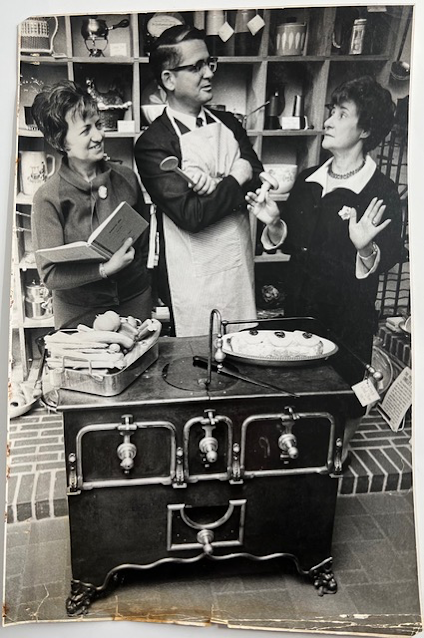
It all started with a photo.


Specifically, THIS photo:


L-R: Roma Lubinski, ?, and ?

It's a big photo, nearly 13" tall, and it was tucked in the back of my grandparents' photo album. It was too tall to fit in the album (which is probably why the bottom is damaged), and I recognize only one person in the photo: My grandmother, Roma Lubinski is the woman on the left. 

The photo looks almost like it was for a cooking show, and my grandmother was an excellent French cook. So I asked my mother and aunt, and they both told me the same thing. It was for a Tulsa World article about the Tulsa chapter of the Alliance Française (AF).

That caused my relatives to start reminiscing:  evidently a French folk singer named Anna Marly visited Tulsa as part of an AF program. She was very famous back in France because she was pretty much the voice of the French Resistance, and they played her songs on the radio in the 1940s, and she inspired a lot of people to resist the Nazis.  

That lead me to her most famous song from that era, Le Chant des Partisans (sometimes Complainte du Partisan) or Song of the Partisan, and it was so popular among the Resistance that after France was liberated and resumed its independence, many people proposed that it become the national anthem of France.  You can read the lyrics (French and English side-by-side) at the bottom of this post.  Here's a little bit more about the song, and how important it was: https://holocaustmusic.ort.org/resistance-and-exile/french-resistance/le-chant-des-partisans/ 

Anyway, my grandfather was really excited to meet her when she visited Tulsa, and she actually became pretty good friends with my grandparents.

Anyway, here's her song (in French).  


But here's where it gets personal for me... I discovered that it was translated and arranged for English by Leonard Cohen, and Joan Baez (one of my favorite American folk singers) did an English-language cover, and sang it when she visited France in the early 1970s:


I totally inherited my love of Joan Baez from mother, and in the early 2000s, Mom and I went to see Joan Baez live at The Blue Note in Columbia, Missouri.    

Here's a more modern interpretation (English at the beginning then in French) that I think is particularly lovely:


And finally, here are the lyrics in French with their English translation. Note: the English version of the song itself is slightly different, and I've included those lyrics below a well (in blue).  But I can see why my grandfather liked the song, and the singer.

Complainte du Partisan/Chant des Partisans (French lyrics)
Song of the Partisan (direct English translation)
The Partisan (English lyrics)

Les Allemands étaient chez moi
The Germans were at my house
When they poured across the border

On m'a dit résigne-toi
They told me resign yourself
I was cautioned to surrender

Mais je n'ai pas pu
But I could not
This I could not do

Et j'ai repris mon arme
And I picked up my gun
I took my gun and vanished.

Personne ne m'a demandé
nobody asked me
--

D'où je viens et où je vais
Where I come from and where I'm going
--

Vous qui le savez
You who know
--

Effacez mon passage
Delete my passage
--

J'ai changé cent fois de nom
I changed my name a hundred times
I have changed my name so often

J'ai perdu femme et enfants
I lost wife and children
I've lost my wife and children

Mais j'ai tant d'amis
But I have so many friends
But I have many friends

Et j'ai la France entière
And I have the whole of France
And some of them are with me

Un vieil homme dans un grenier
An old man in an attic
An old woman gave us shelter

Pour la nuit nous a cachés
For the night hid us
Kept us hidden in the garret

Les Allemands l'ont pris
The Germans took it
Then the soldiers came

Il est mort sans surprise
He died unsurprisingly
She died without a whisper

Hier encore nous étions trois
Yesterday again we were three
There were three of us this morning

Il ne reste plus que moi
Only me left
I'm the only one this evening

Et je tourne en rond
And I turn in circles
But I must go on

Dans la prison des frontières
In the border prison
The frontiers are my prison

Le vent passe sur les tombes
The wind blows over the graves
Oh, the wind, the wind is blowing

La liberté reviendra
freedom will return
Freedom soon will come

On nous oubliera
We will be forgotten
--

Nous rentrerons dans l'ombre
We will return to the shadows
Then we'll come from the shadows