Showing posts with label Book Review. Show all posts

Tuesday, May 6, 2025

Revolution, wars, rape, brutality, intrigue: 1980s romance novels were not for the faint-of-heart

"Revolution, wars, rape, brutality, intrigue, it was difficult to put the book down."
S-----, Goodreads reviewer.                     

    The year was 1983, and I picked up my first romance novel from a rotating wire rack near the check-out lane at Aldi. It was Highland Velvet by Jude Devereau, and while not the book reviewed above, the description is actually pretty spot on for Devereau's Velvet series.  

    I was 14 at the time, and loved the book despite a domineering, jealous hero who forces his bride (whom he's just met) to wear a different wedding dress, spanks her (and not the sexy kind), and beats her dog (who understandably doesn't appreciate someone hurting its person), then seducing her, taking her virginity while giving her a mind-blowing orgasm, all in one day, very early in the book.

    The book gets much better, though. The hero grows, overcomes his jealousy, and realizes she's a better leader of her clan than he is. Eventually, he steps into a role not unlike the King's Hand in the world of George R. R. Martin and follows her lead, acts in her stead, ensures her orders and plans are carried out, stuff like that. He remains an aggressive man, but rather like one of Elizabeth I's generals, loyal to his queen. 

    I was well into adulthood before I realized just how fucked up many romances were, and how most of the time, I'd just accepted it all and didn't question the tropes of the time. Later, I was able to recognize the brutality for what it was, not just because I was older and wiser, but also because modern trends in romance had mostly moved away from brutal heroes, which made it easier to recognize just how terrible many 1980s "heroes" and plots really were. 

    But in the 1980s, it was common for books to include:

  • Teenaged heroines (most commonly about 17). Seriously, they would have been considered too young for marriage even at the time. It is a myth that women typically married younger than about 20, at least in European households or colonial America.  A quick internet search suggests that other cultures were similar, but that there have always been exceptions where girls married younger.
  • Heroes who were about 30, give or take a couple of years.  Nice age difference, huh?
  • Paternalistic, controlling heroes who spank their wives, and we're talking domestic abuse here, not kink, and yeah, such abuse probably was realistic in the context of historical romances, but ... gross.
  • Drop-dead gorgeous main characters with perfect bodies and intact white teeth. Heroines had tiny waists and flat bellies, slender arms and legs, big boobs, perfect heart-shaped asses. Male characters were just as impossible. They had wide shoulders, narrow hips, good cheekbones, and a thick head of hair. Lots of heroes had dimples and cleft chins, but they all sported heroic-sized penises with excess length and girth. Their chests also rippled with muscle, and only rarely did they have lifestyles that would account for such bodies (medieval romances were an exception - knight-heroes had to train to manage fighting in 50 pounds of armor, and that did tend to build muscle). 
  • Sexual assault either by the villain, but foiled by the hero in the nick of time, or by the hero himself. A couple of decades later, I tossed one book aside when the heroine was almost raped for the third time (such lazy writing). I suspect rape was more common historically than it is today (though it's still far too common), but I don't really want to read about sexual violence in my romantic fiction. When I immerse myself in a book, I either become the heroine or she becomes a beloved friend, and it's painful to read about brutalization in either circumstance.  As a trope, sexual assault has thankfully become far rarer.
  • Sex trafficking.  I've read several books where the woman was sold into marriage or a harem, and several more where the man kidnapped the woman and forced her into a sexual relationship (and later marriage).
  • Forcible seduction.  She doesn't want it or like him, but he -- against her will -- aggressively kisses her, then grabs her butt to pull her in close enough to feel his erection, then she ... is overcome by lust and gives in.  Sexual assault with a happy ending, I guess?  
    Modern romances include heroines who are at least 20, but frequently in their mid-to-late 20s. They are less likely to be perfect and more likely to be quirky scholars, outcasts, or wallflowers. Heroes might still be dictatorial (at first), but are unlikely to assault their lovers. Fewer pure alpha jerks and more true partners and friends.  Heroes still have muscular physiques, though modern authors are slightly better about including training and exercise to account for their six-packs. They also still have hero-sized cocks. Some things never change, I guess?

    The first 80s trope to lose its sexiness was the aggressive-against-her-will kiss, because it actually happened to me, and the reality of it ruined the fantasy. I was 20, he was 18, and after walking me back to my dorm, I unlocked and opened my door. I turned back around to face him and say good night just as he dove toward my face.  It wasn't sexy or romantic; it was kind of scary -- it would have been easy for him to push me into the room, kick the door closed, and then ...? I reflexively shoved him away from me with both hands before his lips touched mine, though it was a close thing.  I'd pushed with enough force that he stumbled back a step, and I saw the surprise cross his stupid, drunken face.  He departed a few minutes later without attempting any further unwanted actions, and I was careful to pick only sober people to walk me home after that.

    Anyway, there was one book that was so egregious that I recognized its terribleness even when I was 15 or 16.  I did finish it, but I was so offended by one scene in particular that I took the unprecedented step of throwing the book away.  Decades went by, and I eventually forgot the title and author or the characters' names. What I did remember included:

  • Takes place in the 1700s or maybe 1800s.
  • Heroine is a Russian princess smuggled to the USA and raised in secrecy (presumably for her protection, maybe?). She has no idea of her background as she was an infant when smuggled out of Russia. (I now know that is a "lost princess" trope.)
  • I think she had blonde hair, and he had black hair, maybe?
  • Book cover was a pretty classic bodice-ripper, I think.   
  • Hero is a Russian prince (I think?) who comes to the US to fetch her back to Russia.
  • Their ship was attacked by pirates in the first half of the book, toward the beginning, I think.
  • She is taken prisoner/hostage by the pirates. All the women but her are raped by the pirates, and she is traumatized to the point of incoherence that it will happen to her.
  • When the prince rescues her and the surviving members of their party from the pirates, he, um rapes her with a belaying pin to teach her a lesson that rape is survivable, and to “help” her get over the trauma, that she is strong. To quote Resident Alien, "this is some bullshit."
  • At some point, they become intimate (in a non-rapey way), but she (I think?) returns to the USA to have their kid, and he has to find her again. That’s when the happily ever after part happens.


    I only rarely thought about the book (maybe every year or two or five), and occasionally I did internet searches to try and identify it, but was never successful until yesterday, when I hit upon asking AI the following question: 
I'm looking for a historical romance book published in the 1980s that features a lost Russian princess. It takes place in the 1700s or 1800s, and it includes an attack by pirates.
    It responded: 

"Based on your description—a historical romance novel published in the 1980s featuring a lost Russian princess, set in the 1700s or 1800s, and including a pirate attack—Yankee Princess by Maggie Osborne appears to be a strong match. Published in 1988, this novel follows Nicole Duchard, a young woman from colonial Boston who discovers her true identity as a Russian princess. During her journey to Russia, her ship is attacked by pirates, leading to a series of adventures involving court intrigue and personal transformation."

    Ding-ding-ding, we have a winner! 

    It was actually first published in 1982, not 1988 as it says above.  You can read the entire AI answer (along with several other suggested possible books) here.  My memory of the cover and the physical descriptions were spot on, though:
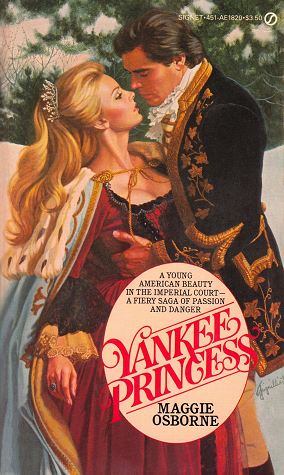
Note how she is leaning away from him,
and her arms are behind her, not around his neck.


    From reading the page on Goodreads (and the top review), I had forgotten a bunch of the plot after the pirate attack and its aftermath:

  • She was "forced to suffer the degradations and ravages of an auction-block marriage."
  • She was a "long-lost, secret royal love child," and her "lineage threatened the throne of Catherine the Great."
  • She landed in the midst of bloody serf uprisings and cruel Siberian exiles.
    I also didn't misremember the "for her own good" rape aboard the ship. More than one reviewer obliquely mentioned it, with phrases describing Dimitri as likable, "with the exception of one incident on board the ship."  Another reviewer said, "There are lots of wtf moments."  The quote at the top of this article was also from a review of this book, though I strongly disagree with her four-out-of-five-star rating.  That's all right, though - and I'll try to stop yucking her yum.

    It's worth noting that I don't recall thinking the book was poorly written, exactly. The author's prose must have been decent, or I wouldn't have bothered to finish it. I was more hardcore about finishing books when I was a teen (nowadays, I'm too impatient to waste my time finishing bad books) but bad prose, and scenes not properly leading to the next would have been enough to quit a book even then.

    In the end though, the plot contained too many invisible hypothetical exclamation marks: Secret love child! Catherine the Great and the Imperial court of Russia! Pirates! Auction-block marriage! Serf uprisings! Revolution! Brutality! Intrigue!  

    It's as if the author asked, "What's Going To Happen NEXT?!?"  instead of just, "so, what happens next?" 

    I can forgive a crazy plot (William Goldman did a wonderful job with his 1973 book The Princess Bride, because it was delightfully satirical, funny, and didn't take itself seriously), but I couldn't accept a "hero" that rapes the heroine, and I just couldn't believe that the heroine would forgive him.  Stockholm syndrome aside, how does someone forgive that? 

    And his actions are not heroic; they are violent and perverted. We (rightly) lock people up for doing what he did.

    I know that women do sometimes love men who mistreat them, readily forgiving even the most brutal of treatment, but usually it takes a fair amount of grooming, isolation, and abuse.  But the book doesn't bother with the necessary long-term manipulation that would allow for that forgiveness. He kidnaps her from the only life she's ever known, assaults her, and then they fall in love.  I'd more readily believe she'd ... Stab him in the eye with a fork!  Or slip some poison into his brandy! but that would shorten the story considerably.  In the end, I suppose that grooming, isolation, and abuse just aren't romantic enough.

Wednesday, March 5, 2025

Romance Challenge: Includes LGBTQ Couple

  "Read a book that includes an LGBTQIA+ couple."

    When I started researching candidates for this category, one book came up over and over (plus some online friends recommended it):  Red, White, and Royal Blue by Casey McQuiston, first published in 2019, and it's won a bunch of accolades including:

  • NYT bestseller 
  • Goodreads choice award winner for Best Debut and Best Romance of 2019.
  • 2020 Alex Award Winner
  • Best Book lists in 2019 for: Vogue, Vanity Fair, NPR, Bookpage, Kirkus, Shelf Awareness
  • Best Romance lists for 2019 for: Entertainment Weekly, Library Journal, She Reads
    It's even been made into a movie, with a sequel in the works (see the note at the end for more on the movie).

    The book proved well-written and a lot of fun.  Imagine that in 2016, a woman was elected President of the United States (no, not Hilary Clinton; the fictional Ellen Claremont).  Now imagine that her son Alex, the FSOTUS (Get it? First Son of the United States) falls in love with Prince Henry, the younger grandson of the Queen of England (no, not Elizabeth II; the fictional Queen Mary).  And the love story takes place in the year leading up to Claremont's re-election in 2020.  

    The sex isn't especially explicit, instead focusing on love and intimacy and emotions, and there was a lot of joy and pain, and sometimes horror at what people will do for political ambition (the older I get, the more I realize I have zero interest in living my life in the public eye).   

    Would I read it again? No, I don't think so, for the same reasons that I find Frankenstein and the Hunger Games a little tiring - the main characters aren't grownups.  While Alex and Henry are in their early 20s, it was like reading about emo adolescents.  Think Dead Poets Society crossed with The West Wing.  I do recommend it though - it's a lot of fun, and if you enjoy a heavy dose of bildungsroman with your love stories, you really should give this one a try.

    Note: one thing I've learned is that if there's a movie based on a novel, I really should start with the movie because if I read the book first, the movie is nearly always disappointing by comparison. So, even though it would spoil the plot of the book, I tried watching the movie, but it kind of dragged, and I gave up on it after 30 minutes. But the acting/casting is good, so you might enjoy it more than I did.

Friday, January 24, 2025

Romance Challenge: Graphic Novel

   "Read a graphic novel or comic book romance."

Tropes and Trifles ordering link


    Over the years, I've read a small handful of paranormal romances (basically only when my favorite historical romance author happened to branch out), and when Twilight was big, I read that series because my kids were, and well ... it's really not my preferred subgenre, mostly because love stories between humans and vampires or werewolves have such unbelievably skewed power dynamics, and I find that hard to enjoy.

    A relationship between a human and a vampire is just too close to that of one between a human and a god, and you have to ask yourself what kind of god falls in love with a human, a being so far beneath them as to be inconsequential, a bug that can be squished beneath a godly stomp.  

    Seriously, a romance between a blow-up doll and her owner is about as far from romantic as you can get.

    And I know that people are sometimes turned on by powerful partners, but seriously, how romantic can sex be when a moment of inattention can actually kill your partner?  I can just imagine the conversation between the vampire and his partner's (victim's?) parents. "I'm so sorry - I sneezed when we were doing the dirty, and then she ... died."  Or maybe he'd just eat them and avoid the confrontation entirely.

    I loved the novel Dracula (well, until I realized what buffoons the good guys were), so I've nothing against the idea of vampires as villains, but I just prefer they stay in their monster lane and not try to be romantic heroes.

    But.
   
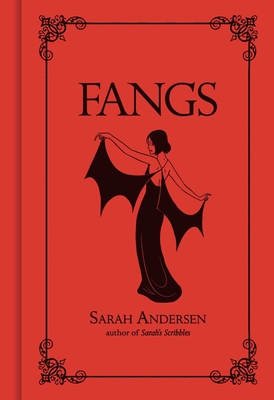
    A romance between a vampire and a werewolf has some decent romantic possibilities. Because I was trying to explore new kinds of romances when I picked a graphic novel, I deliberately went for something with monsters, and Fangs by Sarah Andersen was highly recommended.

    And it is absolutely darling. There's not much more story than "Vampire falls in love with a werewolf, and they resolve a series of funny conflicts."   It's not so much a story but a series of non-sequential vignettes about how they make it work (he insists that when they go for a walk, he will NOT wear a leash, even during the full moon). He has to be careful not to throw open the shades when he wakes up in the morning, stuff like that. Best of all, the relationship between Elsie the vampire and Jimmy the werewolf doesn't feel even slightly unbalanced. 

    The production quality of the book is wonderful - it's a hardback with a red cloth cover, and the page edges are actually black, something I've never seen before. The drawings are exclusively black and white.

    So highly recommended, but keep in mind that its value isn't the story itself.

Friday, January 10, 2025

Juliet, Romance, and the Award-Winning Genocidal Hero

Romeo and Juliet by Ford Madox Brown (1870)
 Is it just me, or is Juliet gritting her teeth?
And Romeo's pose is kinda awkward.

    Is Romeo and Juliet a romance?  

    No, it's not.

    Many people consider R&J the epitome of romantic stories, and ... well, I think they are wrong.  If someone wants to try to convince me that R&J is a romance, I promise I'll listen and hear them out (but I'm unlikely to change my mind).  
It is certainly a poignant story, but it is a heart-breaking tragedy and not a romance.  Hell, its full title is The Most Excellent and Lamentable Tragedy of Romeo and Juliet. 

    Seriously, on date night, do you think accidentally killing your partner's kinsman is romantic? Might you consider going no-contact with both families?  No? How about getting stranded because of a plague epidemic or committing suicide?   Do those sound like a fun and oh-so-romantic followup to a dinner by candlelight? 

    The death of children has never struck me as especially romantic, perhaps because I've seen the emotional wreckage it leaves behind.  Even in the 17th century, Shakespeare's audiences would have been horrified as soon as Juliet's age was revealed and that her mother had been had only been 14 when Juliet was born.  The groundlings at the Globe would have been considered Juliet much too young for marriage because a thirteen-year-old was still a pre-pubescent child (in 1600, the average age at menarche was 16). 

    Pregnancy in young girls was also dangerous as hell because they frequently died in childbirth (perhaps because their pelvises hadn't yet broadened), and infants born to very young mothers were nearly always underweight. In a time when the child mortality rate approached 50%, risking an underweight newborn was asking for trouble, and the Elizabethans knew it.  While it's true that on rare occasions, dynastic marriages occurred when the girl was only thirteen, the young couple was typically kept apart until the bride could safely bear a child, usually around the age of 18.  

    Romeo and Juliet may not be a romance, but it is about love ... and hate.   It's a conflict between the individual and the group; two individual kids fall in love, yet their families' hate tragically keeps them apart.  

    I'm comfortable with calling R&J a love story, though, because there is an important distinction between that and romance, but the terms are not interchangeable.  There is dissent, of course, on what counts, but the most commonly agreed-upon modern definition of romance is that it's a story that focuses on the romantic love between the main characters, has at least hope for a happy ending, and the main characters must be in a relationship at the end of the book (you can see how this definition excludes R&J).

    A love story is a much broader category, requiring only that love be at least a subplot. It is far more defined by what it doesn't require than what it does; no happy ending is necessary, the main characters don't have to end up together (they might even marry other people), and romantic elements don't have to be the primary focus.

    In other words, all romances are love stories, but not all love stories are romances. 

    The disagreement as to what counts as a romance even extends to the Romance Writers of America (RWA), and whoo-boy, do they have an oddball history, particularly with regard to changing social norms, and their inability to respond to the wishes and needs of their diverse readership. For the last decade or so, they've had egg (or entire omelets) on their face more often than not.  I'm not going to address most of the organization's problems here - that's the subject for a term paper or even an MA thesis, but I included a few links at the end if you are interested.

    But the RWA, with a stunning lack of awareness, confused love story with romance twice in a six-year period, honoring books featuring genuinely genocidal heroes. Because committing genocide is so, so romantic?

    The hell? 

    In one case, RWA gave one of its prestigious awards to a book that features a hero with a "tortured soul" (it's a common romance trope). He's an American soldier who took part in more than one massacre of Native Americans, including at Wounded Knee. I get that sometimes soldiers get caught up in horrific situations after the shooting starts, but those are tragedies.  And no matter how remorseful he is, how can one enjoy his romance and happily ever after against a backdrop of the innocent victims he murdered and the author's condescension toward the victims' religious beliefs? 

    In the hands of a skilled author, a genocidal soldier might make an interesting protagonist or anti-hero (Larry McMurtry and Cormac McCarthy, I'm looking at you), but a hero of a romantic story? Yeah, no. 

    In another case, the RWA advanced a book to finalist (in two different categories!) that features an SS officer at a WW2 concentration camp as a hero. The heroine is a Jewish prisoner, and they fall in love; he saves her, she rejects her Judaism, and converts to Christianity. While I don't think the hero needs to be a good man, it's pretty hard to accept one who is committing actual war crimes. The SS officers who ran the camps were evil shits, monstrous in ways the Beast never was in Beauty and the Beast.  

    There could also never be genuine consent by the heroine, and it's hard to imagine finding the love story between a Stockholm syndrome-suffering victim and an evil genocidal monster in the least bit romantic. And what happy ending is even possible when she knows her lover holds her ethnicity in so much contempt that he is willing to torture and murder people because of it? 

    It's reasonable to call the novels described above love stories, and I don't doubt they are well-written -- they wouldn't have been finalists or won awards if so -- nor do they lack realism; they strike me as possible, perhaps even probable in real life. I suspect the WW2 love story was inspired by the real-life relationship between Franz Wunsch, an SS guard at Auschwitz, and the Jewish prisoner Helena Citrónová. While she did have feelings for him, they had no happy ending (she married someone else, and he stalked her for years before finally giving up), and at his trial in 1972, she testified that, yes, he had indeed saved her, but that she had also witnessed him committing atrocities.

    So, I know I'm gatekeeping a bit, but I'd really prefer that genocidal main characters stay off the romance shelves and stay in the historical fiction lane where they belong. I'm pretty sure I'm not alone in this. 

    Oh, and did I mention that the RWA regularly passed over highly acclaimed entries by black authors in order to recognize books that featured the deeds of the aforementioned genocidal heroes?  Unsurprisingly, the RWA entered Chapter 11 bankruptcy in May of 2024.

Selected Links:

Saturday, January 4, 2025

Romance Challenge: Recommend a book to your friends

 "Recommend a romance book you’ve read to a friend or family member."

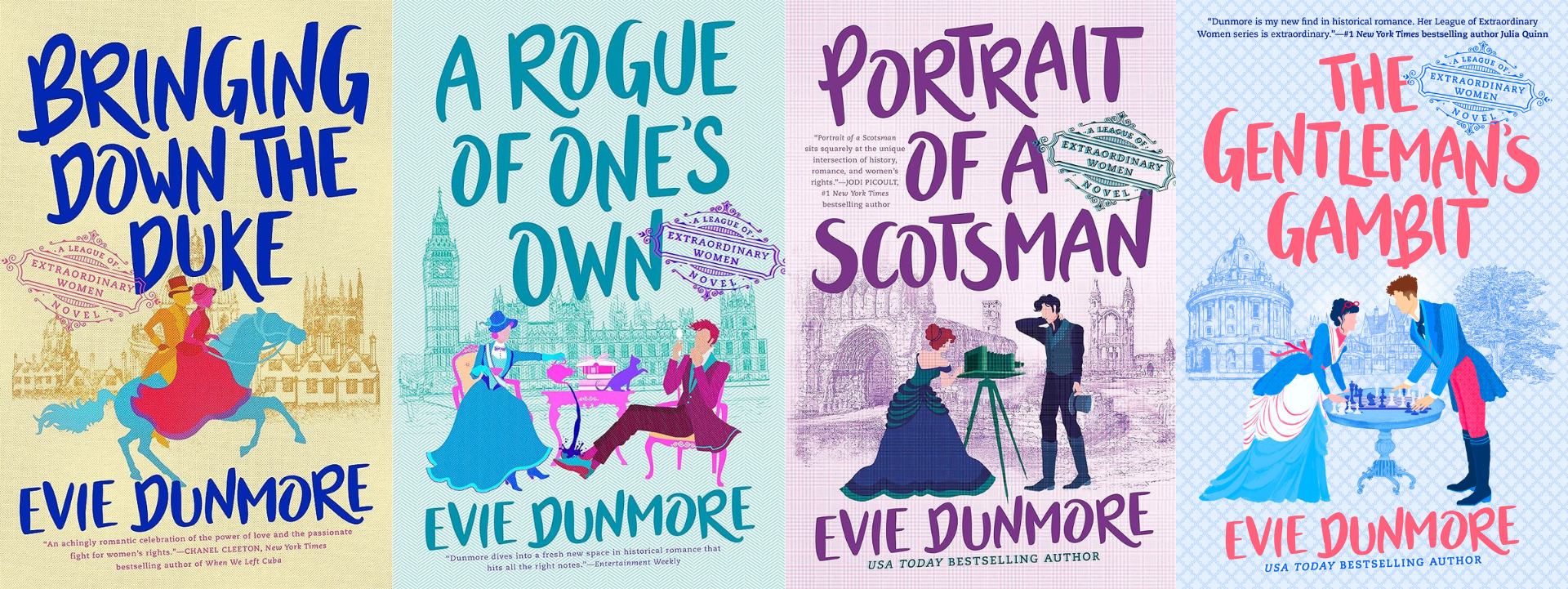
    I'm not just going to recommend a book, rather, I'm going to recommend Evie Dunmore's four-book series A League of Extraordinary Women.

    I've always said that I've learned a lot of history from reading historical romances, and this series is an excellent example of why this is so. They are thoroughly researched, yes, but they were also beautifully written and engaging, and I felt as if I were a silent friend and member of their suffragette chapter, along for their very bumpy ride.

The books are set in Victorian England in the 1880s and chronicle just how convoluted the fight for rights has always been.  Some of the more interesting things they cover:

  • Queen Victoria's own passionate disapproval of women's rights.
  • Women's suffrage in England (which didn't occur until 36 years after the series begins).
  • The right of women to own their own property after marriage.
  • Laws that allowed a husband to have his wife jailed if she decided to live apart from him.
  • Colonial art theft.

This series covers the lives of four friends who are among the very first women to attend Oxford University and the men they fall in love with. Most of the eight main characters are based on real-life suffragists and their allies who recognized injustice and fought alongside their wives and lovers (you can read about the real people who inspired many of the main characters at the bottom of this page) to help create a world where men and women can be true partners.

I especially loved how the books, which focus on the significant misogyny of the time, never cross the line into misandry.  The men (and women) range from good to bad, but nearly everyone falls somewhere in between the extremes.   Something that's interesting (and kind of cool) is that all four book titles honor the allies:


  • Bringing Down the Duke - Suffragette/Country girl Annabelle meets the Duke of Montgomery, Queen Victoria's Tory political strategist. My second favorite of the series.
  • A Rogue of One's Own - The heroine is more prickly than I like, the hero is a bit too handsome, though that in itself causes some humor. Focuses on a sympathetic eye on sex workers, who the heroine helps on occasion.
  • Portrait of a Scotsman - My favorite of the series, as the characters come from lower or middle-class beginnings (though they or their families have attained some wealth).  This book contains one of the very best grovels I've ever encountered.   
  • The Gentleman's Gambit - Heroine is a linguist and brilliant in her own right.  Hero is from the Levant and is interested in returning local artifacts stolen by British colonial powers.  The book turns the traditional grovel on its head by having the heroine do the groveling (as was contextually reasonable - she genuinely screwed up).

Anyway, I loved the books. Enjoy. :-)

The Ultimate Romance Reading Challenge

Tropes and Trifles link

After she inspired my romance genre paradigm shift, my daughter gave me this fun book for Christmas, and I am enthusiastically planning out the challenges.  

First some house rules:

  • No "already fulfilled the challenge" loopholes. In other words, I can't get a prize for the meet-cute (#1 below) challenge just because I've read many such books already. I must meet the challenge again, with a new book.
  • No re-reading books to meet the challenge. I must pick something new.
  • If I really cannot find a book to meet the challenge, I may write a 5000-word (preferably 7000) short story that does meet the criteria.
  • A book cannot be used to fulfill more than one challenge (unless the challenge encourages you to do so).
Now, the challenges. Numbers 1-15 should be prefaced with "read a romance novel that..." and any of the italicized items can be combined with other challenges, if desired.

Topic challenges:

  1. Is about a much older protagonist.
  2. Is a graphic novel/comic book.
  3. Is about a gay or lesbian couple.
  4. Was published in the year you were conceived.
  5. Was published before 1900.
  6. Was written by/about a different ethnicity than your own.
  7. Is a genre-bending romance.
  8. Includes a meet-cute trope.
  9. Includes an enemies-to-lovers trope.
  10. Includes a friends-to-lovers trope.
  11. Is a memoir about love and relationships.
  12. Takes place in a country other than your own.
  13. Is by a self-published author.
  14. Is a current bestseller.
  15. Is part of a series.
Action challenges:
  1. Recommend a romance you’ve read.
  2. Visit your local bookstore and ask for a recommended romance read.
  3. Pretend to be the main character of the book you are reading.
  4. Make a list of ways to enjoy your own company. Complete three.
  5. Write a love letter.
  6. Write a list of ten things you know/feel/believe about love.
  7. Learn 3 things about your ideal romantic destination.
  8. Read a summer romance outside near a body of water.
  9. Watch a movie/show based on a romance book.
  10. Check out three romance novels from your local library.
As I finish each one, I'll add links to their own short posts. 

Note: one thing I will not do, is share what the prizes are - I don't want to ruin the mystery, should you buy your own copy (linked above).  I also didn't use my Amazon Associates link, so I won't make any money from the link (not that I've ever made any money through that channel).

Friday, January 3, 2025

Romance Challenge: Much Older Protagonist

"Read a romance novel with a protagonist much older than you are."

    Well... I'm in my mid-50s, so "much older" means the heroine has to be at least 70 years old, and I wasn't sure how many romance novels exist where that is the case.

    Fortunately, some friends recommended a novella by an author I've read before, and liked: Mrs. Martin's Incomparable Adventure by Courtney Milan.


    I liked the book very much. It’s a historical romance that takes place in Victorian England, and the main characters are 73 and 69. The older of the two is quite wealthy, and her nephew and legal heir is a really awful person. He is a leach, living off the promise of inheriting his aunt’s fortune (and given that she is 73, it shouldn’t be far off), refusing to pay his debts (he hasn’t paid his rent in two years, having forged his aunt’s signature on the lease). He even hires prostitutes on the promise of paying them when his aunt dies. Bertrice and Violetta make it their mission to torment him. Madcap adventures ensue.

    The story touches on the loss of friends (when one reaches her 70s, she will absolutely have outlived a few loved ones), the lack of power women had at the time, and the fact that being falsely declared incompetent was a real risk. It even touches on NotAllMen (see footnote below), Victorian-style, which was fun. The dialog was wonderful, and there were many beautifully described, funny moments.

    The book displays more misandry than I typically prefer -- I like the main male character to be a good man, not a villain.  Aside from the Terrible Nephew (that's what they called him), all the other men in the book were extremely minor supporting characters, so that made it feel a little unbalanced. On the other hand, the story was really just about Bertrice, Violetta, and the Terrible Nephew.

    I really liked this septuagenarian romance, though it makes me wonder how common lesbian relationships were in Victorian times. I assume they happened, but they must have been pretty dangerous at least until 1967 when Britain partially decriminalized homosexuality. Anyway, a love story is a love story and this one was quite wonderful.  I really wanted the main characters to continue on their adventures together.

I also really adored how the author reframed the reader's image of elderly women's bodies from the typical wrinkled and withered to:

"Skin that was dusted with age spots and veined like the finest marble."

"Breasts that time had given a graceful sway."

"Every act of gravity and time made beauty in nature—except when it happened to human women. Not any longer. Ravines carved in her forehead by time made a striking landscape."

    Given that my own body has existed for 55 years, these descriptions made me feel appreciated, even admired in a way that most romance novels don't (or haven't in a long time).

    The book got me thinking, though, about romance between elderly folks. It's usually handled on TV as something of a joke - the shows Parks and Recreation (episode 5.4 "Sex Education") and New Amsterdam (episode 4.21 "Castles Made of Sand") have both dealt with outbreaks of STDs among elderly populations in nursing homes, and the humor is in no small part based on ridicule and disgust.   For some reason, people think old people doing the dirty is HI-LAR-IOUS and that their bodies are - to put it far more kindly than they did - unsexy.

    I prefer to think of elderly bodies as scarred by time.  Sexual desire doesn't go away just because someone accrues a few extra decades.  Neither does our need for friendship, intimacy, cuddling, companionship, and love.  

    Now that I think about it, movies and TV typically have two modes for love among the elderly - either long-time partners who are about to be parted by death (tragedy) or elderly folks bed-hopping (comedy).  

    With the former, it's usually (I think?) about the husband losing the wife, which is evidently more compelling, more heartbreaking, than the other way around, possibly because women outlive their husbands far more regularly than the opposite and is somehow less interesting because of that? For the record, I disagree with this sentiment.  I was lucky enough to marry my best friend, and chances are that I will outlive him, and well, that feels pretty damn tragic to me.

    And with the latter, well, the stories range from condescending ("Aren't these old folks so cute for acting like young people?") to outright jerky (characters pretend to vomit at the idea of sex between the elderly).  A particularly egregious example is from the 1971 movie Harold and Maude:


    To be fair, the scene, which bothers me in isolation, is much funnier in context, and I appreciate the subtext quite a bit.

    I'd really love it if there were more stories that fall in between the two, episodes more like 4.15 "The Benefactor Factor" in The Big Bang Theory, where Leonard sleeps with an elderly wealthy university donor.  Yes, there's some humor at her expense, but it manages to subvert the ridicule in a way that I like, and touches on her loneliness (she is also delightfully snarky toward most of the main characters), and the fact that both participants had a pretty good time in the process.

* While it is absolutely true that not all men are assholes like Bertrice's nephew, either in the book or in real life, the NotAllMen argument is nearly always an obtuse diversion that hands men an out, a reason not to try to change the system.  Even good men (of which there are fortunately plenty in this world) still benefit from a system that favors them, and unless they are actively attempting to put an equitable system in place, they are part of the problem.  I don't exactly fault them - it's awfully easy for anyone, including me, to look away, to go along to get along.  Also - while things are MUCH better than they were in 1867 when the novella takes place, women today still only make 84% of what men do.