Showing posts with label Memoir. Show all posts

Tuesday, June 17, 2025

1991: The disappointment was thick in Grandpa's silence

Real life vs Alternate Reality
(Click to enlarge)


Back in 1988, when I was recording my grandfather's war stories, he said this:

     "Well so, coming back — I am talking in disorderly way because I didn’t prepare all this, so it will be a hell-of-a-time for you to put this in order."

    Yeah, no kidding, Grandpa Arthur.

    Because it's hard to capture tone of voice in writing, I'll just tell folks how I sound right now: rueful and a little worn-out. I'm not being rude (well, maybe I am, but only a little). I loved and respected my grandfather, but there is no denying that he sometimes had unreasonable expectations.

    Anyway, "hell-of-a-time" is right. I am nearly 4 years into this project, and it's still not done. Occasionally, I wonder if it will ever be done, and sometimes I get just so sick of it, but then I discover some new clue, and my interest flares back to life, burning as brightly as ever.

    I recorded Grandpa the summer after my freshman year in college, and on tape I asked maybe two or three questions while I was recording him, and God, I was so young and just so ... ignorant. Now I have a million questions and I could kick myself because those questions never even occurred to me at the time, and now they will remain forever unanswered because he died nearly three decades ago.

    Well, at least I was curious and motivated enough to ask for his stories in the first place, and I'm grateful for that experience, but the tapes would have been orders of magnitude better if I'd brought along an experienced oral historian.  But, back then, I didn't know such people existed, and who knows if Grandpa would have agreed to talk to one.

    I was always interested in the war, because I knew my grandparents had escaped the Nazis and survived, but beyond thumbing through the pictures in my dad's Time-Life WW2 books, and reading a couple of novels, (including one for kids*), I had no real understanding of WW2. Dad gave me a copy of Shirer's The Rise and Fall of the Third Reich when I was 13 or 14, but I never got past the first 20 pages.

    The tapes sat around until I was a senior, and my first inkling that I had a treasure in my possession occurred when I mentioned them to the professor teaching my Holocaust class (Dr. Penny Gold, now Professor Emeritus at Knox College) and I wondered if maybe I could use them in some manner for my final research project.

    Dr. Gold's eyes widened, and then she got really excited, revealing her inner Indiana Jones. She was a far better teacher and historian than that fictional archeologist, though - she wasn't just excited that this artifact had been unearthed, she was excited on my behalf.

    This was around the time the movement to gather oral histories from those who experienced WW2 personally, from the soldiers, the holocaust survivors, from those who were there first started to gain momentum. Three years later, Steven Spielberg founded the Shoah Visual History Foundation. Its charter was to videotape 50,000 Holocaust survivors and witnesses.

    Dr. Gold suggested that I transcribe the tapes, and because she was far more aware of just how much work transcribing audio sources can be than I was, she offered to let me reduce the required length of my term paper from ... 15 or 20? pages down to 10.

    The paper itself ended up barely 10 pages, but with the transcription, the project ended up somewhere north of 40 pages. And yes, I got an A.

    Like my professor, my family was excited by my project. I sent it to my mom, and it ended up being a little earth-shaking for her, because Grandpa had told me many things he had never told his own kids. The war had been an extremely painful and dangerous time for my grandparents, and they mostly didn't talk about it. I asked her to send a copy to Grandpa, and she did that, but also sent one to my aunt, and just about anyone else who showed even the slightest interest. It was really clear that Mom was impressed, excited, and even proud of my work, and that felt pretty great.
    
    Unlike everyone else in the family, my grandfather was not excited.   

    I'd expected him to be pleased that I had transcribed the tapes of his stories, that I had even used them in scholarly research, and he was glad of it, I think. But mostly, he was ... disappointed.  

    He didn't like that his grammar wasn't perfect, that it—as is typical of oral sources— was full of sentence fragments, and was a little choppy. He didn't like that I hadn't rearranged his stories into chronological order or placed them in a historical context.   Grandpa even called me and asked that I please do two things: to clean up his grammar, and to put the stories in order. He even used a little guilt: I don't remember his exact words, but it was something like, "It would mean so much to me, if you did this one thing for me before I die."

    I said no, and the disappointment was thick in Grandpa's silence. I didn't feel guilty (not yet, anyway), and in a rare instance of self-confidence, I didn't let it bother me (much). He had no clue how much work I'd already put into it. The transcript alone took me 20 or 30 hours to complete (I'm sure I annoyed the other students in the computer lab, with my constant play-stop-rewind-play on my Walkman).   I also simply didn't have time.  I still had the final trimester of my final year of college to go, then I needed to find a job (a daunting task for someone with an English degree).  And, frankly, I was out of steam.

    I also disagreed with him. When transcribing oral history, you present what the subject really said, not what they wished they had said.  

    I figured I'd pick it back up again someday, but then Grandpa died in 1996, and I blinked and 25 years had gone by and I wanted to take part in NaNoWriMo (my daughter had completed two novels before she graduated from HS, and I wanted to keep up with her), and Grandpa's stories seemed like a natural fit.

    And now, all these years after Grandpa's phone call, I feel guilty that I didn't even try to fulfill what was kinda-sorta a dying wish.  Because I totally could have edited it the way he wanted, but in a separate document from the transcript (I haven't budged in my belief that a transcript should be the exact text of an audio source).  But the other part?  Putting it in order and placing it in a historical context?  

    Oof.

    If I've learned anything in the almost 4 years since I picked up this project again, it's that there was no possible way I could have fulfilled his second request before he died, because I lacked both the necessary experience and, more importantly, the tools to do it quickly.  

    But by 2021, the state of the technology had caught up with my needs, I had decades more experience and knowledge, and I was able to complete that part of the project in less than three years.  I'm guessing that if I had started it in 1991 after that phone call with Grandpa, it would have taken at least 10 years to accomplish what I later did in three.

    I used the internet to research, to accurately identify the correct books to read, movies and TV shows to watch, even newspaper archives. A friend with university access even found information on medical knowledge from the 1940s.   Instead of stumbling upon the occasional useful historical photo, I found thousands of photos with just seconds of work.  The internet also allowed me to find and build friendships with historians all over the world. 

    Computers have progressed, too.  I can do keyword searches through entire books in seconds.   I can listen to books while I'm out walking, and bookmark important passages in audiobooks without even having to stop exercising. Hell, I can even dictate notes in my audiobooks now.  You couldn't do that back when we were using Books on Tape instead of Audible.

    Now, imagine doing all that with the shots-in-the-dark that are card catalogs and inter-library loan, and having to manually skim entire paper books (probably missing key information) for hints and clues, without the ability to do keyword searches using a computer? Or translating the French and Polish letters in Grandpa's immigration folder, with nothing more than a dictionary?  

    I'm beginning to think that my 10-year estimate was wildly optimistic, and I'd have been lucky to finish it in less than 15.  

    * Snow Treasure by
Marie McSwigan, about a gold heist in Norway, pulled off by children on sleds, trying to protect the Norwegian treasury from the Nazis. It's a wonderful book.

Wednesday, June 11, 2025

My blood is not for the likes of Ixodes scapularis

I hates ticks. I hates them, I do.

I keep picking places to live that are the Grand Central Stations of Ticks. Hell, I even grew up in Missouri, which is no slouch when it comes to ticks (though it doesn't compete with New Jersey, and especially not with northern Minnesota).

One tick-borne illness 20 years ago is more than enough (Lyme Disease, but we caught it early, so no long-term effects), and I have a friend with another, though I don't know what it's called.  

Frankly, if I could push a button and incinerate all the ticks, I'd be sorely tempted.

Two days ago, I spent about 30 minutes pulling weeds. At bedtime, I remembered that I needed a tick check, and we found three of them attached to me - the tiny ones you can barely see.   We removed them (Lyme risk is low - they have to be on you for more than 24 hours before you are at risk for the disease, and these three had been on me for as much as 12 hours, but probably less) and went to bed.

But not to sleep. 

I got maybe 4 hours of sleep that night, because every little itch and tickle sent a jolt of adrenaline down my spine, and I'd feel around for the little blood sucker that I knew wasn't really there, but my imagination kept gleefully whispering in my ear, "What if?" 

By last night, I was so tired that I went to bed early and slept long and heavily, and now it's hard to shake the grogginess.

But I'm having my coffee, and I'm sitting here shielded from nearly head to toe in coveralls. Soon, I will put on my boots, hat, and mosquito netting, leaving only my hands exposed, because my blood will not be consumed by the likes of ticks.

In the spring of 2024,
protected from mosquitos and ticks.


Tuesday, April 1, 2025

Thoughts during the nascent pandemic

Prompt - Prism Light, White Hot (three minutes): Write a stream of consciousness without stopping, for three minutes, using the quote below as an initial spark of inspiration. “Let the world burn through you. Throw the prism light, white hot, on paper.” – Ray Bradbury, Zen in the Art of Writing (1990). Allow your thoughts to flow with complete freedom. Don’t be concerned with spelling or grammar (that can be taken care of later). Often the first line is the hardest to write, before flow fully kicks in. Don’t be afraid to just start writing - you can always erase the first line anyway.

*** 

“Let the world burn through you. Throw the prism light, white hot, on paper.” – Ray Bradbury

I sit at the kitchen table, listening to my daughter mutter and tap at her computer.  The chair is beneath me, but I’m sitting up straight. 

Coronavirus keeps us penned in like animals in our homes, though we seem to have a little more freedom than they do because we can still get outside if we want to or to the store, even if we have to endure glares from people who think we should be home. 

I want to help so much, so I’m going to sew and clean my sewing room to find elastic for masks for doctors, masks, and nursing homes.  

The kids are taking it harder, I think, because this is supposed to be spring break, a time of freedom and fun, while the older people are a little more content to just stay in.  The college kids are especially bad, converging on beaches with no thought to who they might spread the virus to, should they catch it.  

Grow up, little men and women, and have a care for your mothers, grandmothers, aunts, uncles, grandpas, and the workers who keep you comfortable.   

I may be older and more content to stay inside, but even I’m getting stir-crazy.


--March 29, 2020

***


Notes:

  • I wrote this one in early 2020 - my daughter was finishing her senior year in high school and we were sitting at the kitchen table together when I wrote this.
  • I never quite know what to do with these.  Is it a poem? Is it a paragraph? Vignette? Do I edit it into something more?


Thursday, March 6, 2025

Romance Challenge: (Not) Being Alone

"Make a list of ways to enjoy your OWN company. Complete three and collect your prize."

    This one left me befuddled because I'm a total hermit and introvert, and being alone is kind of my natural state.  I'm married to my best friend, so I'm not actually alone, but let's just say it's a good thing my husband is around to pull me out of my bubble because otherwise, I'd get really weird.

    In other words, this is just too easy, and it seems to me that the point of these challenges is to stretch our boundaries.  So I decided to flip the task a little to this:

"Make a list of ways to enjoy your PARTNER'S company. Complete three and collect your prize."

    Making a list of ways that I enjoy my husband's company is easy because I like the guy an awful lot, but arranging for them will take a little stretching because despite being a lifelong fan of the romance genre, actually being romantic has always made me feel awkward. 

    So, here's my list (in no particular order)

  1. Cooking together
  2. Hiking 
  3. Road trips
  4. Playing board games
  5. Sharing crafts
  6. Cuddling before and after sleeping
  7. Eating good food
  8. Exploring new places
  9. Watching excellent movies and talking about them
  10. Reading books and wiki articles together

    I didn't - ahem - include sex in my list, because intimacy is private, and while I'm no prude, I'm just not going to blog about my sex life.  

    We'd planned to head up to Grand Marais on Valentine's Day for Fiber Friday at the Northern Folk School, but snow was forecasted, and the roads would have been iffy on the way home, so instead, we ate the picnic we'd planned for at the kitchen table: chocolate-covered almonds, lemon Italian soda, potato-leek soup, and mozzarella, arugula, and pesto sandwiches.  We played the new-to-us two-player board game Undaunted: Normandy, and Chris taught me how to use his pin loom while trying out the new circular loom I'd gotten him.   

    It was a pleasant, low-key weekend spent with my best friend. Highly recommended. 


Saturday, March 1, 2025

The Bridge over the River Minnesota

Prompt - The Bridge (2–30 minutes): Two people are walking together across a bridge. Have one of them recount a story to the other, starting at the foot of the bridge and ending as they step off the bridge. Imagine the length of the bridge and how long it might take to walk across. Write your story in the time it would take to cross the bridge. A small footbridge – over in a couple of minutes. The Golden Gate bridge – 30 minutes. It may be wise to avoid the 100-mile Danyang-Kunshan Grand Bridge in China, but the choice is yours!

***

   Kivi and I parked next to the Minnesota River in the little state park outside Jordan.  The river was swollen from the spring thaw but hadn’t yet washed out the bridge.  Instead of taking the trail, though, I led her back up to the Jonathan Carver Parkway and started walking across the bridge. 

    “Mom, where are we going?”

    “I thought you’d like to see the giant whirlpools.”

    “I’ve seen them.”

    “Yeah, but it’s been a long time since you saw them up close,” I responded.

    “Ok…” Her voice made it clear she thought I was being a little silly but that she was planning to humor me.

    “So, the first time I saw them was back when I was teaching at Chaska, and I was driving this way every day. I told you and your dad about them, and then when we had a chance, I made us stop and take a look.  They were enormous - maybe 4’ across, and I’d never seen anything like them.”

    “I remember.”

    “You were eight or so and not terribly foolhardy, but I tried to make it clear to you that if you fell in, it probably meant you’d die. You’d get sucked in, and if you were lucky, you’d go shooting through the culvert, but more likely, you’d be pinned across it, and we wouldn’t be able to get you out.”

    “Mom, I’ve told you for years that I didn’t have any intention of going in.”  

    I shrugged, “I know. But you were edging really close. And you may not have planned to go in, but you might have fallen in accidentally. Remember how I used to take an extra change of clothes for you whenever we went up to Lake Superior?”

    Kivi laughed. “Yeah, and I usually did get wet.”

    “So, I insisted on holding your hand despite your objections.”

    “That made me kind of mad, I won’t lie. I thought you didn’t trust me.”

    I shrugged a second time, “I know - and you were right. I didn’t.  But I was less interested in soothing your feelings than in making absolutely sure you didn’t fall in.”

    We stepped off the far side of the bridge and continued alongside JC Parkway on our way to see the giant whirlpools again.

--April 26, 2020

***

Note: This is a blend of fiction and non-fiction.  The scene is set in the present, and the conversation between my daughter and me is made up, but in the imagined conversation, I described a real event (taking her 8-year-old self to see the whirlpools created by drainage culverts connecting one side of the road to the other).

Thursday, January 16, 2025

My brother, the plant influencer

    "You're just a goddamn plant influencer!" some rando on the internet accused my brother. 

    For the record, my little brother has a kelly green thumb, and he's pretty active in the online plant forums, sharing his indoor-grown potted olive trees, his giant poinsettia, and his 7-foot tall (2.1 m) fiddlehead fern that he grew from a mere 18" (46 cm) tall. 

    Paul wasn't bothered and just thought it was funny. A plant influencer?  Hell of an insult, right? I laughed when he told me about it and wondered what set the guy off.   

    I searched Amazon and found the following T-shirt, and had it sent to my brother.


    I didn't say who it was from, figuring he'd get the joke and know who sent it.

    But weeks went by, and no texts asking me if I'd sent him the shirt, no FB posts, nothing.

    So, finally, I texted him:

Hey, did you ever get a T-shirt in the mail that you weren't expecting?

Lol yes

    Then the phone rang, and Paul was laughing. "They sent me a shirt, and I thought it was a scam. Someone sends you something you didn't order, and they include a barcode, and you scan it, and it blows up your phone or something."

    "A scam?  Why would you think that?"

    Paul started laughing harder, "because it's the ugliest shirt I've ever seen."

    It was hard not to laugh along, but I was utterly flummoxed. The shirt I’d ordered was kind of attractive - I didn’t think anyone would describe it as ugly. "What shirt did they send you?!?" I asked.

    At this point, Paul was wheezing with laughter, and it was almost hard to understand him. "It's a picture of a ripped werewolf," and then he said something about a kitten.

    "Whut? Can you send me a picture?" I asked. A moment later, he texted me the following image:


    "Mom and Sean are looking at me like I've got two heads," he said, still laughing, then called to them, "It's my sister." Then to me, "It's dinnertime, and I need to go."  

By this point, I was crying with laughter, so I texted him a picture of the shirt he was supposed to get, and he texted back, "That is MUCH BETTER than the one I got."

    We hung up, and then, because my husband and daughter were looking at me as if I'd lost my mind, I explained. Chris discovered there was a whole line of ugly werewolf T-shirts, one of which said, "Lock up your wives, the ALPHA is here!"  We started joking about sending him werewolf shirts on purpose.

    After dinner, I talked to Paul again, and he confirmed that if he'd received the plantfluencer shirt, he'd have at least known it was someone he knew and would have asked who sent it to him.

    The story has a happy ending. Amazon refunded me for the shirt and didn't demand we return it, and I just ordered another plant influencer shirt for Paul. I wonder what shirt they'll send this time?  Probably the right one, but ... I can't help but hope he gets another ridiculous T-shirt.   

    Added Feb 10, 2025:


Monday, December 30, 2024

Paradigm Shifts and the Romance Novel

It’s a little bit hard to write about this openly because for so much of my life, I was embarrassed (even a little ashamed) that I enjoyed reading romances more than any other genre. If you asked me why I liked them, or even why they were worthwhile, the best I could come up with was that I learned a lot of history (which is true - and the historical romances are still my favorite flavor). In other words, I bought into the idea that they were trashy.

Note: Click on the image to enlarge it, then step through the whole meme within the image viewer.

I know some folks think romance novels are just thinly-veiled soft-core porn, and as someone who has been reading romance novels since I was 14, I can tell you unequivocally that they are wrong.  Yes, they usually do contain (sometimes explicit) sex.  And while there IS a sub-genre called steamy romance which comes - ahem, pun intended - close to that description, the erotic scenes are not the point of the genre.  Except for the clean romance subgenre, which specifically excludes sex, those scenes exist only as a support for the story itself, usually to demonstrate that the heroine's partner is an unselfish and passionate lover who cares about the heroine's needs, both in the sack and out of it.  But, even if you remove the sex scenes, the overarching romantic story is still there.


Anyway, a couple of years ago, my daughter sent me the meme I've included here, and it was wonderfully paradigm-shifting. I felt validated, and letting go of my embarrassment was more than a little freeing. I stopped being ashamed of the woman-centered escapism that I enjoyed so much, and last fall, I got to visit a small indie romance bookstore called Tropes and Trifles in Minneapolis, and it was wonderfully COOL. There are only about 20 such bookstores across the country (up from 2 just four years ago). Even though I don’t read paper books very much anymore, I’m grateful that the store exists.  I bought a book, a T-shirt, and a tote bag, and got a recommendation for a book about a suffragette in the late 1800s.


I don't read exclusively romance - I read a lot of science fiction, WW2 historical novels and nonfiction, and really a smattering from nearly all genres (whatever catches my fancy, really), and I have an ongoing project to read as many Great American Novel (GAN) candidates as I can.


Monday, September 2, 2024

An act of petty cruelty

 I witnessed an act of petty cruelty today that has left me rather shaken. 

I was at Jay Cooke State Park, walking down to the swinging bridge to get my weekly photo, when I saw two teenage girls watching the tiniest snake I’ve ever seen sunning itself on the sidewalk. From where I was, about 10-15 feet away, it looked like an earthworm.  Suddenly, a woman returning from the bridge walked right up to the girls, looked down, and deliberately stomped on the baby snake. I looked right into her face and noticed three things: she had dark hair, she was wearing a black sundress, and she was grinning as she walked away.

"Oh, I think she might’ve just killed it!" one of the teenagers exclaimed in dismay. 

"Is it a snake?" I asked when I reached them a couple of seconds later.  The proportions were all wrong for an earthworm. Far too slender and quick-moving to be a worm.  

"Yes," the girl answered as she walked slowly away.  

The snake, which was no more than 4" long and maybe 1/4" wide, didn't appear badly damaged. I didn't see any blood, but it flipped momentarily onto its back, exposing its red belly, which is not the behavior of a healthy snake.   I spent a few moments moving the snake off the sidewalk - it was so tiny I couldn't get ahold of it on the cement, so I scooted it off the sidewalk and into the grass where I was finally able to pick it up and place it in the shade, where it could either recover or die unmolested.  

That woman's actions harmed and probably painfully killed a tiny harmless snake (her behavior may well have been illegal, too - killing wildlife in a state park?), but horrified three other people who aren't going to forget her vicious act.  

I will be honest: I wanted to assault that woman. And call her obscene names.  But I did neither because I was just frozen.

Wednesday, August 14, 2024

The time Chris jumped over a cliff in pursuit of a bear

Chris and I got married in April of 1997, and two weeks later, we went on a pretty awesome honeymoon - a 17-day 6700 mile (10,800 km) road trip from our home in central Missouri, to Los Angeles, then up the Pacific Coast (Highway 1/101) to Vancouver, then home again. We stopped at national parks or forests in Colorado, Utah, California, Oregon and Wyoming.

Somewhere in the Pacific Northwest in the early evening, when I was sleepily gazing out the window at the lovely views, Chris suddenly screeched to a halt and pulled over.  

"What are you doing?" I asked, feeling a bit more awake.

Chris had already unbuckled and was on his knees facing backward, grabbing for his camera in the back seat. "Bear," he muttered, and was out the door, which he didn't even bother to close, leaving it hanging open.

I watched him sprint across the road, put one hand on the guard rail, and vault over it, dropping straight down, and out of sight.  

My heart skipped a beat. Did Chris just jump off a cliff? 

Hoping I wasn't a widow after only two weeks of marriage, I got out, walked around the car and closed his door. Then I walked across the road and peered over the guard rail.   

Fortunately, the drop wasn't nearly as precipitous as it'd appeared from the car - only dropping four or five feet, then forming a steep slope that, with care, a person could pretty easily traverse. Chris - clearly in one piece - was already at the bottom of the slope, and was scurrying toward the woods.  

I watched him disappear into the woods, and waited for him to come back.  It was probably only a couple of minutes, but it felt like forever, but he emerged from the woods, and picked his way back up to me.

"Did you see the bear again?  Did you get any photos?" I asked, relieved he was safe.

"Yeah, I saw him. I took a couple. Don't know if they'll turn out." 

I shook my head, and ruefully told him how it looked like he'd jumped off a cliff, and we laughed together.

Alas, the photos didn't turn out. The bear was nothing more than a dark blur - not even recognizable as a bear. Chris was disappointed.  

We moved to New Jersey in 1999, and sometime in the early 2000s we heard there was a bear in our rural area, but we never saw it.  We moved to Minnesota in 2004, but bears tended to avoid the Minneapolis suburbs, and the only wildlife we ever saw were the stray cats, possums, and raccoons that enjoyed our compost pile. 

When we moved to northern Minnesota in 2020, we knew that bears were more common up here than near the Twin Cities, so Chris's hopes were renewed, and finally, last summer, when he was driving through the lovely Cloquet Forestry Center on his way home from town, Chris saw a bear on the road. There was no traffic, so Chris stopped in the middle of the road, held up his phone, and snapped three photos before the bear ambled off into the woods. This time (probably because the photos turned out), he didn't bother following the bear into the woods and simply continued on his way. 

Chris's first successful photo of a bear in the wild.
Black bear in the Cloquet Forestry Center in July 2023

However, this summer our next-door neighbors have been seeing a young bear in their yard and even captured a few videos, much to our (good-natured) jealousy. We very much hoped it would make its way into our yard, too, and yesterday, it did!  I was enjoying my morning coffee when movement near the compost pile just outside my coffeehouse window caught my eye; at first, I thought it was a black dog, but I didn't know of any black dogs in our neighborhood. I leaned over to get a better vantage and ... 

"Oh! Bear!" I whispered and fumbled for my phone. The young bear, which was maybe the size of a German shepherd, heard me through the open window, and by the time I'd located my phone, the startled (and very shy) bear was running away, and I got only one good look at it before it disappeared into the woods on the other side of the gravel road. I didn't even have time to launch the camera app.

I went outside and across our driveway into the house to tell my husband what I'd seen, and he immediately followed me and looked around the area.  

"Next time, be quiet," he lectured me, "and get a picture!" 

"You could set up a game camera," I suggested.  

"That's a good idea," he answered, and set one up in the arbor vitae next to the compost pile.

No bear pics yet, but I'll update this article if we do get one.  For now, you can read up on Ursus americanus.

Thursday, July 11, 2024

Six Decades of Bickering

Calvary Cemetery, Tulsa, Oklahoma, United States.
Photo by S.M.

    As I've researched my grandparents' experiences in WW2, I can't help but think about their marriage, which spanned almost 62 years. Much of it includes things that you might expect even today—they were childhood sweethearts, they eloped to city hall, they raised three daughters together, and they are buried next to each other in a cemetery in Tulsa.  

    But there are other aspects that I have difficulty imagining; they escaped genocide and were forced to hide for years until it was safe for them to exist again, and then they had to (somehow) move on from the murder of most of their family. They also survived the loss of their oldest daughter, who died at age 34 from a particularly nasty form of multiple sclerosis. I can't (and don't want to) imagine the pain they must have felt.

    Despite my years of research, all the family stories, and even my own memories of them, I really don't get their marriage. They bickered and yelled constantly, didn't share a bed that I can remember, and usually didn’t even seem like friends. Yet, as far as I can tell, they hated being apart.  

    When I was a child, fighting at my Tulsa family’s dinner table was a given. Once, when I was about eight or nine, my mother got so sick of the shouting that she walked out of a family dinner, much to everyone’s surprise. I gleefully followed her (marching away from the dinner table felt wonderfully transgressive), though I didn't understand at the time that Mom had gotten used to the more peaceful atmosphere of the WASP family she'd married into and no longer wanted to participate in the spirited debate she'd grown up with.

    Fighting with a lover isn't something I really understand. I married my best friend 27 years ago, and like me, he has a temper. But we figured out early on that when someone lashes out, they inflict wounds that may never heal, and we learned to head off fights before they gathered steam. We do work through our problems — just not when our blood is up. 

    I know that my own parents also dealt with their share of marital troubles, even some serious ones, but they had worked through the worst of them when I was a very small child, and my memories of the rough patches are little more than fuzzy, incomplete vignettes.  Mom and Dad had 46 years together before Dad died, and I think their marriage was better than most.

    My grandparents though... they bickered all the time.  And it wasn't always just snips and snaps - sometimes their conflicts escalated to shouting matches. My uncle once told me about a particularly bad fight – Grandpa and Grandma were returning from a trip to Europe in the early 1970s, and they'd been fighting more than usual during their travels. When they landed back in NYC, they dropped in to see their oldest daughter and son-in-law who lived in Manhattan. I think my younger aunt was also there as she was attending college in the northeast. Anyway, something set Grandpa and Grandma off, and their yelling got so bad my grandfather fled to a separate hotel to sleep and cool down.  The next morning, when he arrived back at the apartment to retrieve his wife, their children staged an intervention of sorts to gently suggest that if their elders were fighting so much, perhaps they should consider separating or even ... divorcing.  

    After a moment of shock, Grandpa and Grandma instantly stopped fighting and became a united front against their children, enraged that they would suggest such a thing.  They told their daughters to butt out, and Uncle Jim said they acted like best buddies — as if the fight had never happened.

    Bickering isn’t the only thing I disliked about my grandparents’ marriage. Grandma gave as good as she got in fights, but their marriage wasn’t really an equal partnership. I know I’m wearing 21st-century-colored glasses here, but Grandpa was definitely the head of the family (though Grandma seemed to wear the pants sometimes) and sometimes acted in a paternalistic manner towards his wife.  

    For example, Grandpa once censored my grandmother's news intake. I doubt he made a habit of it or anything, but it still shocks me a little.  Anyway, when they immigrated in 1947, they flew from London to NYC. Grandma had never been on a plane before and was just terrified. So, for the two months between purchasing their tickets and actually boarding the plane at the newly-built Heathrow, Grandpa poured through the newspapers before Grandma could get to them, and removed any article that mentioned any sort of air travel accident.  I think he feared that if she found out about a crash, she'd refuse to get on the plane. I also suspect he also wanted to alleviate her terror as best he could. It was absolutely a kindness and also relatively benign, but I'd be nonplussed if I found out my husband was censoring my news intake.  

    Grandpa also made at least one serious health decision for Grandma back in the mid-1960s. She found a lump in her breast, went in for a biopsy, and woke up with no breast.  The doctors discovered the lump was malignant, and Grandpa authorized a radical mastectomy before she even came out of anesthesia.  She was mentally competent; doctors in those days just assumed it was his right to decide for her, and so he did.  Grandma didn’t seem to hold it against him and almost certainly would have made the same decision.  She mostly talked about how much pain she was in when she woke up and ended her story with, "he was scared to lose me."  

    I was a teen when she told me about her mastectomy, and even then, I knew I would never allow someone to make that decision for me. It's my damn breast; if I ever develop cancer, I will decide to have it removed or not. 

    Not everything about their marriage was bad—Grandpa also doted on Grandma, and Mom says he was devoted to her until the day he died. He was the first person in their neighborhood to install central air conditioning because Grandma hated the Tulsa summer heat. Because of that, their neighbors assumed they must be rich.  My grandparents had indeed clawed their way out of the serious poverty they'd endured when they first immigrated to the US, but they were far from wealthy at that point. Grandpa simply valued his wife's comfort over the many smaller luxuries others enjoyed. They got AC instead of TV, new clothes, movie tickets, or a fancier car. Even as their wealth increased, they continued to live frugally for a long time -- the deprivations of World War 2 made them very cautious.

    Toward the end of his life, when he was very frail from diabetes and heart disease, Grandpa told my mom that he hoped more than anything that my grandmother would die first.  It arose from an odd oxymoron of unselfish love for his wife – he didn't want Grandma to feel the pain of his loss – and the desire to rest without having to worry that she was properly cared for.  My aunt later told me that his doctors were shocked at how hard he held on before his body finally gave out.  Dying forced him to entrust the care of his wife to his daughters.  

    Grandma lived another three years without him. We once mentioned to her that they'd been married for 60 years. "Almost sixty-two years," she corrected us sadly.  Her memory had been damaged by lack of oxygen from a mitral valve failure years earlier, and she forgot calling us 10 minutes ago, but she remembered the pain of his loss.

    In the end, I suppose I don't need to understand their relationship. I didn’t like their bickering, nor the paternalism that crept into their partnership, but it somehow worked for them. Their marriage was woven from conflict and love and hand-in-hand survival of all the shit that life threw at them.

Sunday, August 28, 2022

My Tortilla Memoir: Mexican food and learning to make tortillas from scratch

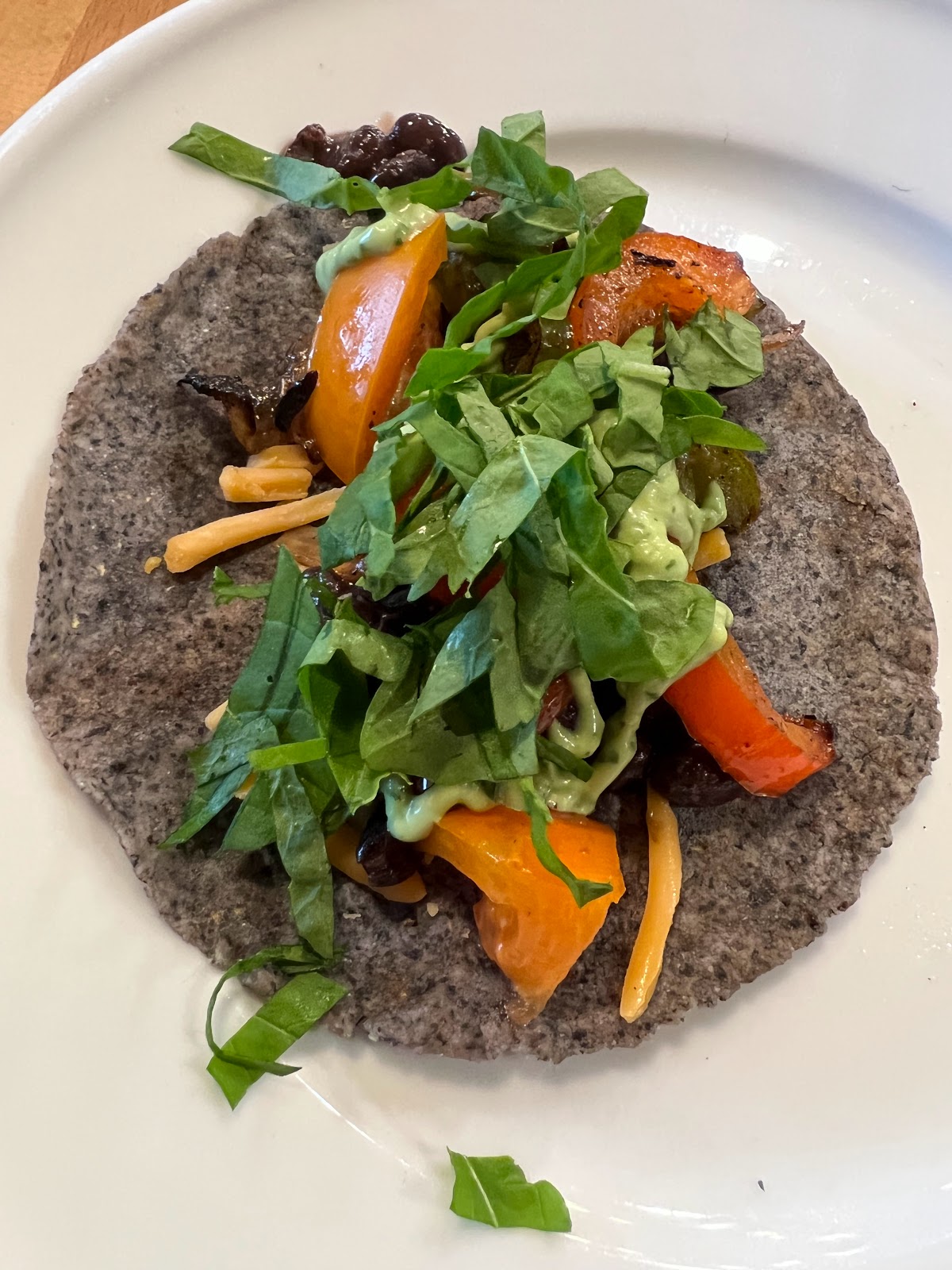
Taco filling:
Beans, cheese, arugula, tomatoes, avocado lime crema.
Not shown: cauliflower, jackfruit, salsa, guacamole. 


On and off (mostly off) over the last decade, I've been teaching myself how to make corn tortillas from scratch.

It's pretty funny, considering that I have no tradition of Mexican food in my family;  I'm Polish-Jewish on Mom's side, English/Irish/Swiss WASP on Dad's.  None of those groups are known for their corn/beans/chile traditions.  My Polish grandmother was an excellent French cook (funny story - when I was about 14, my grandfather once said, "How come you never make me French food anymore?" and my grandmother replied, "Arthur, I only make you French food!"), and my mother is pretty great at cooking savory foods, but with zero bite (she hates spicy food).  So, spicy food and corn and beans (other than a 3-bean salad which I didn't care for) were not a big part of my childhood. 

In college, my friends introduced me to Taco Bell, which was pretty good for fast food, but nothing special. If you'd asked me then what my favorite ethnic food was, I'd probably have said Italian because of pizza, I guess?

And then in grad school, I met my my future husband, and he loved Mexican food.  He'd grown up in SoCal, and even though his family isn't any more Latin-American than mine, he lived in proximity to many Mexican restaurants. And unlike my family, his parents both tolerated some spice, and liked Mexican cuisine.  

Anyway, when we went out, he always steered us toward Mexican restaurants. Los Bandidos in Columbia, Missouri had the best spinach queso.  Blue Cactus had GREAT spinach enchiladas, but to his horror, I ordered mine in (gasp) flour tortillas because, for years, I preferred flour tortillas to corn, which Chris found unfathomable. I also grew up thinking I didn't really like beans, and after tasting frijoles from his plate a few times, I realized beans were pretty good, too. I love them now.

Back then, it seemed like corn tortillas came in two varieties: fried taco shells, which break as you eat them, or soft ones that break when you try to fold them up. I did figure out that if you wrapped the stack of corn tortillas in damp paper towels, set the stack on a plate, and placed another plate upside down over the stack, forming a covered dish, you could microwave it and that this would steam-soften them enough to eat as tacos without splitting. (Usually, anyway).

Somewhere along the way, I guess I picked up a wooden tortilla press at the grocery store - and Chris said I made them a couple of times, but they were pretty thick, as I recall, and I preferred the store-bought kind for their pliability. 

Then, about 8-10 years ago, I acquired a copy of Crescent Dragonwagon's The Cornbread Gospels, and there was a recipe for tortillas. I thought, what the hell, and gave it a try again using Maseca masa harina, which is a type of corn flour. You add water until it's the consistency of play dough, press it flat, and fry them on a griddle.  I knew I didn't like the wooden press which couldn't get them thin enough, so I upgraded to an inexpensive cast iron model (which I am still using) that was capable of getting them quite thin.  They turned out great, so I started making them occasionally as a treat.

Through all this, my dad was in declining health - he had an illness called multiple systems atrophy, which looks a lot like Parkinson's but is terminal, usually within 8 or so years of diagnosis.  In November of 2012, a family friend called me and said it was time to start driving home to see him more often and that it wouldn't be long; they were guessing a few months at most. So my brother and I made the 9-hour drive in November, January, and again in late February to see him as often as we could. In February, it became obvious that Dad would die soon, so we stayed for almost three weeks.  It was a painful time, but I'm grateful we could be together the way we were, to be there for each other, and for Dad as his life coasted to a stop.

On the Sunday before Dad died, I offered to make taco fillings and fresh tortillas (I'd brought my press and some masa harina along) if Mom made the taco meat. She agreed, and we invited a few friends over for an impromptu dinner party. Dad sat at the table in his wheelchair and didn't talk much, though he seemed to enjoy being surrounded by his family and friends.  Dad was under 100 pounds by then and wasn't eating much, but as he sat at the table for this last quiet dinner party, he ate a few bites of my fresh tortillas and taco fillings, and I will always remember his eyes widening as he whispered, "oh, it's good!" That night he went to bed, and never really woke up again (He did say "hi" to the hospice nurses on Wednesday, though).  He passed on Thursday, March 6th, 2013.

It gives me a sublimely painful joy knowing that I cooked my father's last meal, that I introduced him to fresh tortillas, and that he liked them, too.

I didn't make tortillas again for more than three years. It just hurt too much. But, about a year after Dad died, I decided that corn tortillas - even store-bought ones - really were superior to flour tortillas. While I liked flour for burritos, the flavor of corn was just so much better, and I will always remember Chris's delight - it was as if I'd seen the light, at last.

Then, in the spring of 2019, my daughter went to Costa Rica with her HS Spanish Club, and during the homestay, she was served fresh tortillas that were made from fresh masa, not masa harina, and they were even better than the ones I made.

So I did a little research: it turns out that masa harina isn't just finely ground corn meal; rather it is ground dried hominy. Hominy is corn that has been cooked/soaked in an alkaline solution, in a process called nixtamalization (note the the root word 'tamal;' it shares the same root as tamale).

Turns out that more than 1000 years ago, people figured out that if you cooked corn with wood ash or limestone, that made the corn healthier to eat, and safe to use as a staple food.  Today, we know that the process also reduces mold toxins present in the corn by almost 100%, so people are also less likely to get food poisoning, and it radically increases the bioavailability of niacin and other nutrients, including calcium.

During the Columbian Exchange, corn was taken back to the old world, but without the knowledge of nixtamalization, and where corn became a staple, people wound up with a niacin deficiency called pellagra that can be fatal. One of the weirder symptoms of the disease is light sensitivity, and get this - historians theorize that pellagra may be the origin of the vampire myth.

But ... wood ash. I wonder how they figured that out?  Cool that they did, though.

Anyway, the nixtamalization changes the chemistry of the corn enough that you can form a dough with the ground masa by adding a little water to it.  Can't do that with cornmeal, no matter how finely ground it is - it falls apart.

We wanted to experience real tortillas as Kivi had (but without the expense of flying to Central America).  I had to start from scratch, acquire some pickling lime, and use some plain yellow field corn I had on hand. It's pretty easy. Add 1.5 tsp of lime to a gallon of boiling water, then drop 4 cups of corn into it.  You know the solution is properly alkaline if the base of the kernels turns from white to yellow. Simmer it for 40 mins (until the corn is soft enough to break open with your thumbnail) and the inside is about 50% chalky/uncooked and 50% translucent from cooking. Turn off the heat, and let it soak in the alkaline solution overnight.

The next day, you rinse away a little of the pericarp (the clear shell enclosing the kernel) and grind the now-swollen corn. I did it in my food processor.  You have to add a lot of water when using that tool to get the corn to continue blending, and that makes it too wet (think hominy baby food). So then you add masa harina to it until it's dry enough to form a dough. From there, the process is the same. Form it into golf-ball-sized chunks, press it, and fry it on a hot, dry griddle. Wrap the cooked tortilla in a dish towel to steam.

And holy mackerel it was GREAT. Much better than when starting with masa harina flour.  And no comparison with the ones from the grocery store.  The corn aroma is stunningly strong with these tortillas. Kivi said they were just like the ones she had in Costa Rica.

I was so inspired by my results that I ordered a variety of 5-lb bags of heirloom corn varietals from Mexico from a distributor in California (Masienda) that had been bred for hundreds of years to be great in tortillas and tamales, etc. I figured that if my nothing-special yellow dent corn turned out so well, that actual Mexican corn varieties would be even better. Right?

I also ordered a Victoria corn mill because they've been successfully used for generations, too. Seems like it should be more consistent than my food processor, and with a proper mill, masa won't come out too wet. 

And … the next two batches were failures. Tasted like cardboard and they broke when bent around taco fillings. After spending several hundred dollars on fancy corn, it was … disappointing. I went into a 3 year tortilla sulk and I haven’t made them since. Part of it was the move - I just hadn't had time, and I didn't know where my press or my corn mill was, and the corn sat waiting for me in an airtight pet-food vault.

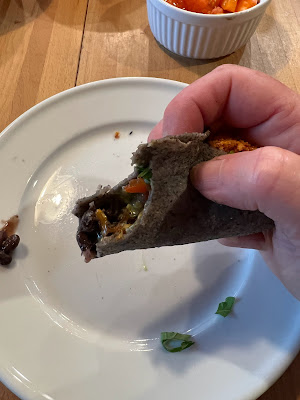
Then, a week ago, Kivi (who was evidently planning really far ahead), and requested them for her birthday dinner (in December) so I decided I needed to a) get over my sulk, b) start practicing, and c) figure out a trial-and error plan until I figured out how to make them right.  I nixtamalized the corn on Friday and yesterday afternoon, thinking that maybe I didn’t grind the masa finely enough before, I decided to put it through the grinder a second time. And maybe that WAS the issue because these turned out pretty well.  Soft enough to bend without breaking, strong enough to hold together until the taco is consumed:

Strong, yet tender and pliable.  

My goal is to make masa in bulk, and freeze it in meal-size portions. So when we want tortillas, just defrost the masa, adjust the moisture levels, roll into balls, press and cook.  Aside from the defrost time, it takes no more than 15 minutes to make enough for a meal, and that's totally worth it for such good tortillas.

Sunday, June 13, 2021

Perfect Disdain

Prompt - Stop the Clocks (300 words): An epigraph is a short quotation from literature or history at the beginning of a book or chapter intended to suggest its theme. For example, this line from a W. H. Auden poem: “Stop all the clocks, cut off the telephone, prevent the dog from barking with a juicy bone.” As an epigraph, it leaves the foundation for a sense of loss, mourning, and a lack of help, which can play out within the story. Search for your own epigraph, whether it be a quote from history or literature, or an existing epigraph from a favorite book. Write a short piece and include the epigraph beneath the title of your story. Epigraphs do not count toward the overall word count and so can be used to great effect. By giving the reader information up front, the meaning can reveal itself as the story progresses.

*** 

“If you sincerely believed in God, how could you form one thought, speak one sentence, without mentioning Him?” ― Neal Stephenson, Anathem

    The summer I was 16, I discovered that Jehovah’s Witnesses didn’t like Catholics and also that I didn’t like riding in convertibles with the top down.  I spent that summer babysitting for the Monroes because Cindy was going back to school to finish her degree, and her husband Fletcher had to work.  I really liked the kids - Jason was an engaging and sweet 7-year-old and toddler Katie was easy-going and usually wanted to do whatever Jason did.  

    Cindy had to leave early for the University, so her mother-in-law picked me up in her candy-apple-red convertible. It was a beautiful day, bright and sunny, and - unusually for Missouri in June - not too hot, and ... the top was down.  The wind was loud, and my long hair blew all around and got in my eyes. I mostly kept my eyes closed and tried to keep up my end of the shouted conversation. I think the elder Mrs. Monroe, was disappointed that I was unimpressed with her car.

    She dropped me off, and Fletcher left for work. The kids were watching He-Man and the Masters of the Universe, and I plopped down and joined them - the adventures of Prince Adam were a bit of a guilty pleasure.

    The doorbell rang and when I opened the door, I found a very tiny, very wrinkled old lady on the doorstep.  

    “I’m from the local Kingdom Hall. Does your family go to church?” she asked in a friendly rasp.

    Did she mean me personally or the Monroes? I wasn’t really in the mood for this - the mother of another family I regularly sat for was always trying to convert me. My own religious situation was complicated, so I decided to go with the Monroes - maybe that would head her off. “Well, I’m just the babysitter, but I think the family is Catholic.”

    Her friendly expression soured as her wrinkles slid into a frown.  “Oh,” she said with perfect disdain. She turned to go and left without looking back once.  

     Huh, I thought to myself.  That was almost too easy.

--October 29, 2022

***

Note: This one is a true story. I fleshed it out very slightly for context and because I don't remember the woman's exact words when I opened the door. It would have been something like what I wrote, though.


Saturday, February 2, 2019

Knitting is some dark magic

The swatch knitted from VHS tape (yes, he still has it)


Years ago, when I was a beginning knitter, I looked down at my little square of knitting, and felt … wonder and awe that I’d created this fabric out of interlocking loops. Chris and I were sitting together watching TV, and I said, “This is … magical.” He looked at my little square and said, “…. Ok.” (obviously not getting it).

Early on, Chris kept asking me to knit him little samples of really weird fibers. I’ve knitted jute, sisal, VHS tape (never, never again. It squeaks something awful), even some flexible wire (never, never again. It’s murder on your hands). I finally just said, “why don’t I just teach you how to knit?” and he shrugged and said, “Ok.”

So, I taught him. I had to learn to back off though - he refused to let me teach him when I thought he was ready, and made me wait and only teach him new techniques when he wanted them. I think he made a LOT of garter stitch items before he finally let me teach him to purl. And then he was off and running. He continued experimenting with unusual materials, even going so far as creating over-sized knitting needles so he could knit rugs from strips of old jeans.  At some point, he saw a TED talk about making hyperbolic sea creatures in crochet, and he decided it could be done with knitting, dammit. He even had me make him a special 6 foot interchangeable cord so he could make bigger ones (and binding off took him foreeeeeever). Then he was fascinated with entrelac - that was the first technique he picked up on his own as I didn’t know how to do it (and still don’t). He wanted me to learn it so I could teach it to him.  I bought him an entrelac book instead.

Anyway, years and years after I’d said it, he sat gazing at his knitting for awhile, then looked up, and said, “you’re right. This is magical.”

Sunday, December 30, 2018

My Knitting Yarn

Since the name of this blog includes a bit of wordplay surrounding storytelling, I thought maybe I should start off with my own yarn craft story.  Many of my Ravelry friends will know the story already, as it's in my profile.  But, I'm coming up on my 10th anniversary of learning to knit, so it seems appropriate to repeat it here.

Anyway - I learned to knit in January or February of 2009, a couple of months before my 40th birthday. I decided to learn because of a house fire and Christmas stockings.  Much of the story is happy, but some of it is a little painful, too.

Photo by Cathy Byland Weeks


Back in the mid-1970s, my mother had commissioned a local knitter to make matching Christmas stockings for my parents and myself.  The above photo is my stocking from that era.

I actually remember going to her house, and looking at the designs. I remember liking the reindeer design better, but when I look at the same design now, it doesn't speak to me the way it did to my 6-year-old self.  But, we hung our snowman stockings up every year.  Then, in the 1980s, when my brothers came along, my mother had matching stockings made for them too. And my Aunt Cathy requested stockings for her family as well.  And in 1997, I got married, so Mom had a stocking made for my husband and stepson.  And after my daughter was born in 2001, one for her as well.  

Then, in September of 2003, disaster struck.  My parents' house burned down.  

We lost so much.  My grandfather's WWII-era allied-issue radio that still worked. My father's christening gown.  All the cute vintage Christmas ornaments that I'd grown up with.  My father's violin. My brother's French horn. My other brother's trumpet.  My prom dress.  We were lucky in some ways- my grandparents' photo album and the antique cradle were in my possession.  A surprising amount of the antique furniture survived - but even after restoration, many of them have a few visible scorch marks.

The Christmas stockings were destroyed.  It seems that acrylic yarn isn't indestructible after all.  I still have mine, because it was in my possession. But Mom's, Dad's, Paul's and Sean's were gone.

The knitter who'd made them was still alive, but Mom sunk into a several-year-long depression, and told me she wasn't going to have them remade.  "I don't want to do them anymore. My children are grown."

I don't know what gave me the idea to make new ones for them. I remember calling a couple of yarn shops (I didn't know that such things even existed!) and asking if there were knitters who'd make them. But they told me they didn't really do that - rather they preferred to teach me how to make them myself.  

Chris was excited. For some reason, he'd thought I should take up knitting - and had even suggested it to me.  Not sure why he thought I should do it, but husbands are funny sometimes.  He urged me to learn to knit so I could make those stockings.  So, I did.

But, the fire had been 6 years prior.  And by Christmas of 2009, I was far from ready to knit stockings. I was still a beginner, mostly teaching myself. Progress was slow. By the fall of 2010, I was still not ready.  So, I decided to dip into my poly fleece stash, and sew them instead.

Photo by Paul Byland

They were modeled on the knitted stockings.  I ditched the corncob pipe, and used buttons for the eyes, nose, mouth, and holly on the hat.  I knit each tiny scarf with a different stitch pattern so they'd be slightly different and added a jingle bell.  A neighbor with an embroidery machine added the names for me. 

Inside each one, I put a clementine (gotta have an orange in the toe!) and a handful of dove dark chocolates. Inside my mother's I put a note: "You don’t have to fill them, but at least hang them up each year. Everyone should have a stocking."  I wrapped them separately, shipped them, and told my family to open them at the same time.

There were lots of tears, and laughter. I did good.  My brother Paul installed hooks that day, and they hung them up on Christmas Day.

Here's the photo they took:

Photo by Sean Byland

Everyone's in the photo, more or less.  My youngest brother Sean was the photographer, and you can see him in the mirror above the fireplace.

And Mom has hung them up every year, even Dad's, though he died almost 5 years ago now.

The knitter who made the original stockings did make one more stocking for us - for my Aunt Cathy's oldest granddaughter in the early 2010s. The knitter was very elderly by that point (she hadn't been young in the mid-1970s when all this started) and died before my aunt's second and third granddaughters came along.  Aunt Cathy found a knitter via eBay to make them for her.

In 2015, my stepson got married, to a lovely young woman named Leah.  By this point, I was plenty skilled enough to make the stockings.  So, I found the pattern (Mary Maxim Snowman Head Stocking) and purchased it.  But... I kept putting it off, and when my granddaughter Cathesa came along in February of 2017, I STILL hadn't gotten around to it.  

Part of the problem, is that I don't like the kind of colorwork that goes into it. I don't mind intarsia when it's a simple pattern, but this isn't simple. And all those ends to weave in???  It takes hours.  My daughter-in-law and granddaughter are totally knit-worthy people, but ... I just couldn't get myself to make them.  And as of December of 2018, Cathesa is almost two - old enough to start noticing that her stocking is different.  

So, I finally burst out, "I don't want to make the stockings!  Can I commission another knitter to make them?"  My husband looked at me, shrugged, and said, "Sure, if they aren't too expensive."  Knitters who do this professionally make the stockings ahead all year long, just without the name at the top.  Then when they get the order, they duplicate-stitch the names on, and ship them out. My stockings needed to be a custom order, because the design usually has a green foot, and I wanted it to match the ones I have - all red, with a white heel and toe.  If the knitter had more of the red yarn on hand, it's possible to cut the green foot off, put the loops back onto the needles and knit the foot downward.  But if not, then they would have to be knit from scratch.

I was taken aback to find many knitters on Etsy who make them - I had no idea these were so popular.  I suppose I shouldn't have been so surprised, but it was a happy finding.   I started sending out queries to the knitters, in the hopes that someone would have time to finish at least one of them, and get it into my hands before Christmas.  Most said no - I would have had to place my order by mid-November for that. I felt no ill-will - I know very well that knitting is slow work, and this was already after the first week of December.  But one of them said she could do my daughter-in-law's, and maybe even my granddaughter's by Christmas. And if Cathesa's got to me after Christmas, no matter - I'd give it to her for her second birthday in February. Yeah, a Christmas stocking in February would be weird - but she's turning two - she wouldn't care.

Much to my shock, the knitter - Tamara from DeBey Crochet (I love the rhyme!) finished both stockings before Christmas, and got them into my hands in EIGHT DAYS.  Even if she did cut the foot off two existing stockings, she worked FAST. I also really love it that Tamara also learned to knit because of these stockings, so it felt really right to have her do it for me.  

Photo by Cathy Byland Weeks

Here's the complete collection. It's a little hard to tell, but the colors vary a bit from stocking to stocking due to different dye lots and being knit at different times.  I love the variations - it adds to the history.  And, best of all, this freed me up to keep working on the scarf Leah and I designed together (which is shaping up to be one of the prettiest things I've ever made).