Tuesday, April 5, 2022

August 1937: My grandparent's new apartment and super cool modern technology


So we went back to Brussels, and found our beautiful apartment in town.

--Arthur Lubinski, 1988 

I found my wife, of course a little upset, but still quieter than me. She knew already that the war burst but she did not see incendiary bombs dropped from the sky and did not feel the mighty blast of explosive bombs. “You will never return to our home at avenue de Mai, my dear," I said to her.

--Arthur Lubinski, 1940s 

Really, this is just a continuation of my making connections down through time article, about how there are generous people are willing to help complete strangers with research.  And the cool tech that helped me this time: Google Streetview, and a historical arial photography website for the city of Brussels. They both gave me information about locations and neighborhoods.

Anyway, I wrote to a historical society in Brussels that is devoted to the history of Woluwe-Saint-Lambert, the township in Brussels where my grandparents lived.  More specifically I wanted to know if this apartment building in Brussels had been built before the war (hence, it is the actual building they lived in?), or after the war (so not the building they lived in)?

In other words, if I describe THIS building in my grandparents' stories, would it be accurate?
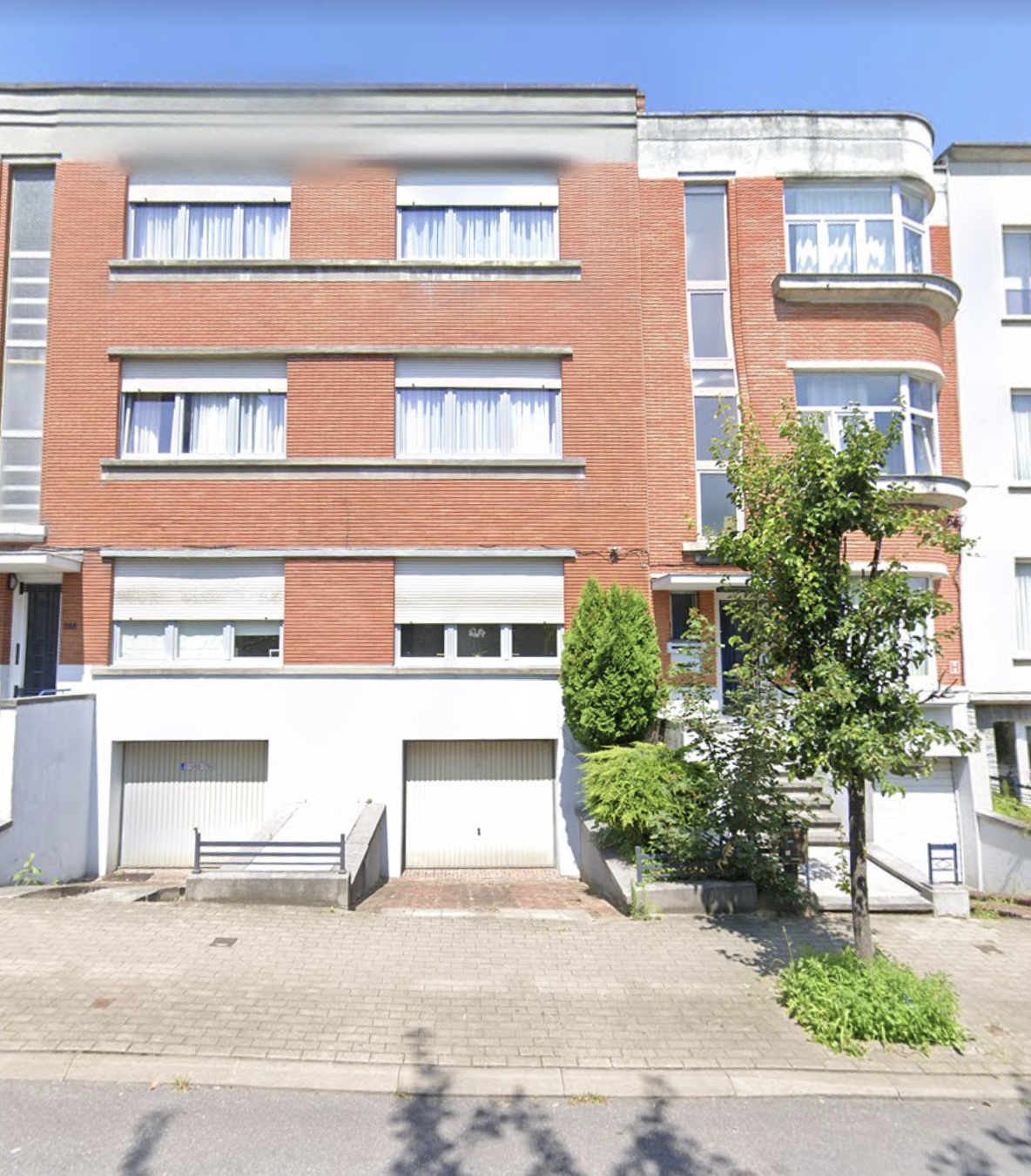
286 Avenue de Mai
Note the curved sunroom on the right. 
That's how I placed which building it was in the photos.

Here's the answer I got:

Dear Ms. Weeks,

 This building was built during the interbellum, probably in 1935-1936 (permit from June 1934). The houses nr. 286, 288 and 290 constitute an ensemble built by three different owners. Number 286 was built by the architect who designed the ensemble, Paul Aernaut. There are indeed three apartments in this house.

I invite you to check on Bruciel (it would be “Brusky” in English), you will see an aerial photography from 1930-1935 of this very building being built!

 My department is responsible for the ‘duty to remember’ in Woluwe-Saint-Lambert. We make a lot of research about occupation and resistance during the war, so I would love to hear more about your family’s history. Also don’t hesitate to get in touch with me if you have any further question about WWII in Brussels.

Regards,

S---- F----- 


Ok, this is excellent news! And so YES, that is indeed the apartment my grandparents lived in, when my aunt was born. That makes me very happy.  

Here it is in on the map. Note the pink heart pin - that's 286 Ave de Mai.

Ave Herbert Hoover and Ave de Mai
make a wedge-shaped neighborhood.

Bit of a surprise that there is an Avenue in Brussels named after an American president, but whatever.

Note the wedge-shaped neighborhood.   They are close to the narrow end of the wedge, and in my stories, I'd written that they grew vegetables in the courtyard behind the building, but ... that doesn't look like there's much space for a garden there, particularly if you consider the building on Herbert Hoover that is directly north of my grandparents' apartment.   So, using Google Streetview, I looked at that building. Is it modern or old? Is my understanding of the size of the space correct?  

In the picture below, the building north of 286 Avenue de Mai is the one on the right with the gray wall, with the back of my grandparent's building peaking through the gap between it and the next building:


Balcony?

Wait? Grandpa and Grandma had a balcony? Did people grew food in containers on those balconies?  But ... yeah. Not much space and maybe not much sun exposure - that space behind the building is on the north side of the building.  Given the food shortages during the war, I'm sure that if there WAS any usable green space, that it probably would have been used to grow food. 

So then I decided to look up the historical arial photography site the historian sent me, and ... whoa. Pay dirt!!  Take a look:


1935 or 1936 - during construction. Lots of open space. But that building behind it wasn't there.


1944: The building behind it appears to be there. I suspect that new construction
probably didn't happen DURING the war, so my guess is that it was built prior to 1939.
But, note that there appears to be open space to both the left and right.

1953.  Much clearer picture, but little change from 1944.  That is definitely open space to left and right. 

And, I wondered if maybe people really did grow veggies in those open spaces. Here's are two closeups of the 1944 photos, and ... maybe? They are patchy looking. Maybe they are vegetable gardens? Click on the images to enlarge even more.

1944 closeup of the open space to left of building.

1944 closeup of the open space to right of building.

Note: Here's the Belgian arial photography site if you want to play with it.

The Belgian historian had a colleague search the population registry, and found two dates: They moved into this apartment on August 27, 1937, and more interestingly, moved out on February 20, 1942, to Rue Stroobant, 42 in Ixelles.  I don't have any reason to doubt the move-in date, but I know the later date was false; I suspect it was some sort of deliberate falsehood designed to cover their escape to France in the fall of 1941 (and I have letters that establish their location in France in late 1941).

I can't be sure what it looked like on the inside, but there are a few pictures in my grandparents' photo album that were probably taken in that apartment (click to enlarge):

Grandma was about 8 months pregnant with my Aunt Lilly.
The war had not yet started in Western Europe.
Note the record player - Grandma loved music.


Aunt Lilly and the record player.
This was taken only a few months before they escaped to France.


Grandma Roma and a 5-month-old Aunt Lilly


Lilly had a bassinet (as well as a crib as shown below)


Grandpa and Aunt Lilly.
They were probably already planning for their escape.


Lilly's crib.  Note the briefcase in the background.
I wrote about Grandpa's briefcase in the book.


Thursday, March 31, 2022

1940-1947: Vintage map of France and playing with stickers

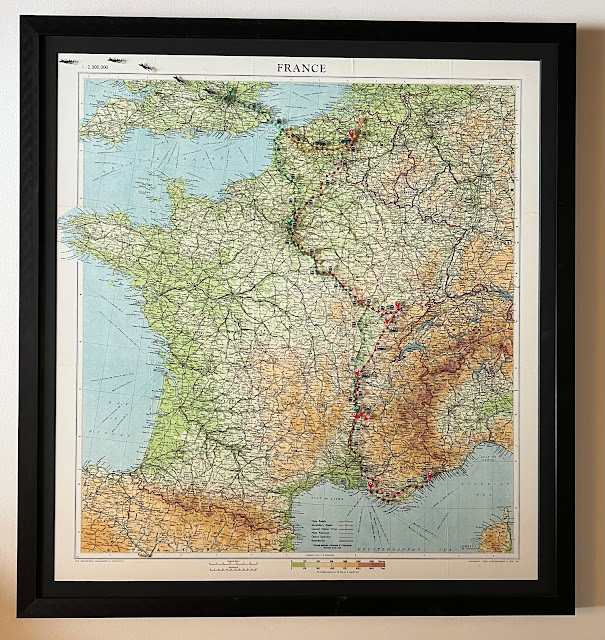
It might be reasonable to describe this project as perhaps the biggest, most expensive scrapbook page ever created. The map (printed in the late 1930s) wasn't especially expensive, but it's big (including the frame, it's 26" wide by 28" tall, 66cm x 71cm) and professional framing ain't cheap (and I even sprung for non-glare glass).


Framed map. (Click to enlarge)

Maps of France aren't expensive.  You can get excellent modern road maps off Amazon for a few dollars. But when I started researching my grandparent's lives during WWII, I realized that I needed a map that showed French and preferably Belgian roads and rails as they were during WWII.

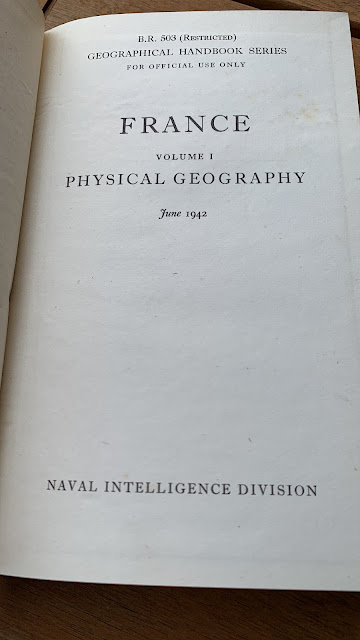
My husband Chris is my resident map guy, and I don't know how he found it, but he stumbled across a book printed by the British Naval Intelligence back in 1942, called FRANCE: Volume 1 - Physical Geography.  The book was actually restricted, not because it contained anything top secret, but because it contained everything about France's geography that one might need to, say, help the French Resistance units fight off Nazis, and it was all contained in one small, convenient book.  It's no longer restricted, of course. Today you can find far more detailed information using Google Maps and Wikipedia.

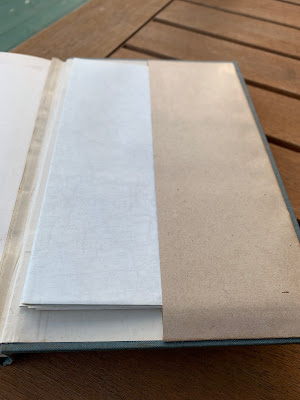
But most importantly, it contained a pocket in the inside back cover with a vintage map that had been printed in the late 1930s.  And he found a copy of the book at a used book store in England, and the proprietor verified the map was intact and in good shape. $25 including shipping from England, and 10 days later, I had it in my hands.

Front cover


Title page

Pocket with intact map.


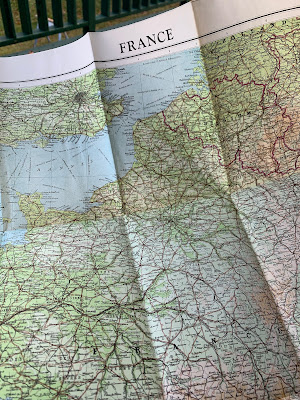
Map! (Note the creases)

I bought a cheap poster frame big enough to hold the map, thinking I'd place sticker versions of arrows and pins to show where my grandparents were, and to show their movements.

But it looked awful.   First, the poster frame wasn't stiff enough to hold the map flat between the clear plastic, and the particle board backing (which I covered with acid-free card stock to protect the vintage map), and I didn't have time to press the map flat for a few months between heavy objects - I needed it now. The book was in progress. So those creases were very evident, and it was hard to to follow the map in a continuous manner, because you had to tilt your head different ways when you went over the crease. 

And the poster frame fit one dimension well (it was the right width) but was wildly too tall so there was this huge blank section above the map (remember how I said it wasn't sturdy enough to hold it flat? It also wan't really sturdy enough to hold it centered vertically in the frame).  And I didn't want to use tape to hold it in place, because it was a vintage map. We must protect vintage maps, right?

I tried smoothing it, even (VERY CAREFULLY) ironing it, but that map had been folded for the better part of a century, and the creases were proving very stubborn, and resisted (pun intended!) all my efforts.

Another problem was that it didn't quite have the resolution I wanted - Ourches, France for example isn't even marked (town only has 250 people today, and had fewer than 100 people in the 1940s, but I could still stick a pin about where it is.

So I decided to have it professionally framed. I like maps, and I had a feeling that if I actually finished the book about my grandparents (end of January 2022, I finished the first draft, and I'm starting revisions soon), that I'd want to have the map as a permanent memento.  

I had been thinking that someday, I'd return the map to the book.  But ... those creases were a problem in a cheap frame, and they were going to be a problem in a professional frame, too.  So (and this still makes me cringe a little) I had it dry mounted on foam core.  

Yeah, no. That map is never going back into the book.  I feel a little like I permanently damaged the map.  But, it worked and it looks awesome. You can still see where the creases were if you look closely (and it gives it some character that I rather like), but it's laying flat now.  

As soon as I got it home I pulled out the map dots I'd ordered weeks ago, but never stuck to the cheap frame. The map dots are super cool - they come in all different colors, and they are transparent, so you can still see the map through them. I also bought "pin" stickers shaped like the pins in Google Maps. I only dropped pins in locations my grandfather specifically mentioned.  To replicate that below, I've turned the places that he specifically mentioned to the appropriate color.

Then, I went to town, sticking them to the glass:

  • Orange dots: First escape to France in May 1940, from Brussels to Pas-de-Calais on the North Sea, in a taxicab of all things, and then several weeks later, back to Brussels after France surrendered.  The route is entirely guesswork, though.  I know they started in Brussels and ended in Pas-de-Calais, and stayed on a farm as a refugee for several weeks.  I think they saw the North Sea, but the text isn't clear. When he said, "we arrived at Pas-de-Calais on the North Sea" did he mean that P-d-C is on the North Sea, (which it is - Dunkirk, Gravelines, and Calais are right there on the water, but there's plenty of that departmént which is not) or did he mean they arrived in P-d-C and were at the the North Sea? I took it to mean the latter, but the timing means they arrived when Dunkirk and Calais were a war zone.  I just can't know where they were for sure. It's a little like mapping a route from ... Terre Haute to Missouri at the Mississippi River. So there is an orange Brussels pin, but no orange pin in northern France.
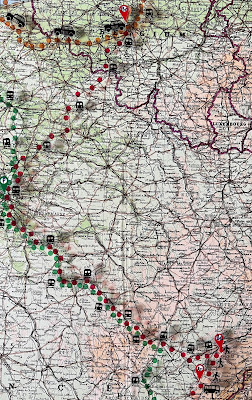
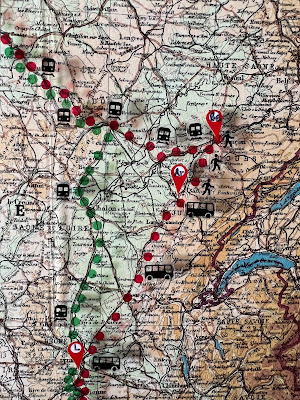
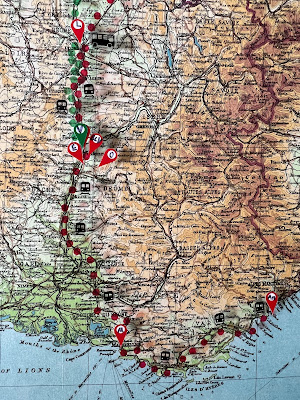
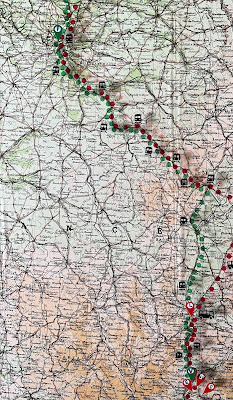
  • Red dots: Second escape to France in the fall of 1941, from Brussels to Antibes, then back up to Valence.  The entire northern half of the route is guesswork.  Grandpa mentioned taking the train from Brussels as the starting point, to Besançon, but other than that, I've got nothing -- he didn't mention which train route at all, and there were many. Straight south through Luxembourg and Switzerland? Or through France, but extreme eastern France, with many stops? Or through the hub of Paris? So I chose to have them follow a couple of "escape lines" that resistance organizations used to get downed Allied airmen to safety. And ALL of the different escape lines passed through Paris on the train. It was also the fastest and most direct, with the fewest stops (and therefore checkpoints). So, Brussels - Paris - Dijon - Besançon by train.  From Besançon they walked 35 miles (56 km) through Arbois, probably to Poligny, then took the bus to Lyon, then train down to Antibes. Then the train back up to the Valence area, where they stayed for the next 5 1/2 years.
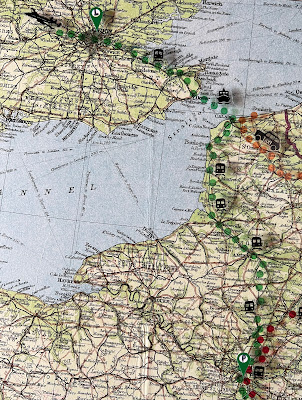
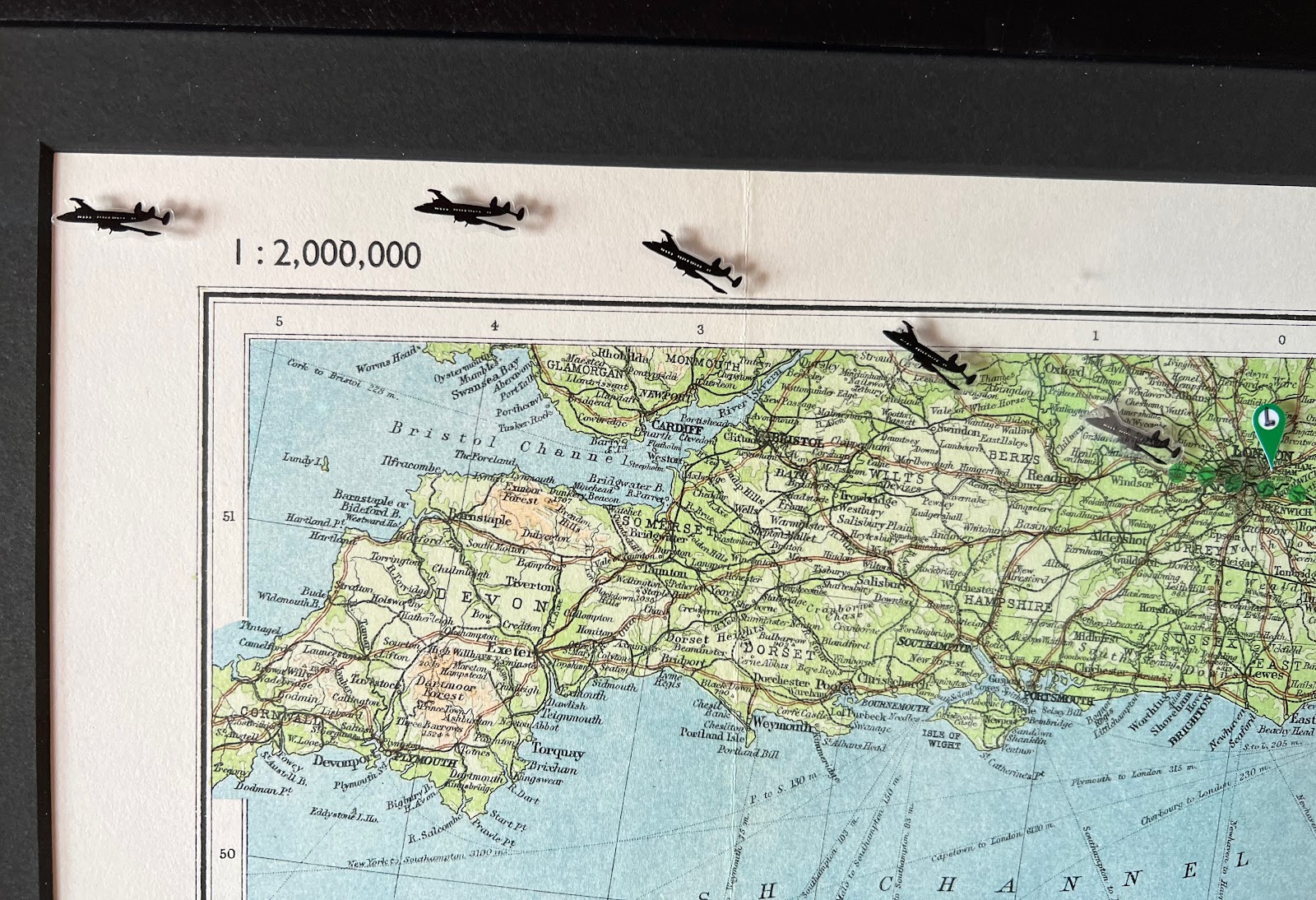
  • Green dots: Immigration to the US in Jan-Feb 1947, from Valence to Paris, then Paris to Calais by train, then a ferry across the channel, then train to London.  Then they took a plane from London to New York City.
It looked pretty great, but I really wanted to indicate modes of transportation, so I could find in an instant where certain things were. I imagined that I'd point to the map and say, "this is where they walked across the demarcation line, on foot."

So, I started looking for stickers.  But I couldn't find what I wanted. So I asked some friends on Ravelry, and someone suggested looking on Etsy for "planner stickers." Evidently people treat their planners a bit like scrapbooks and use fun stickers to categorize things. Huh. Who knew?

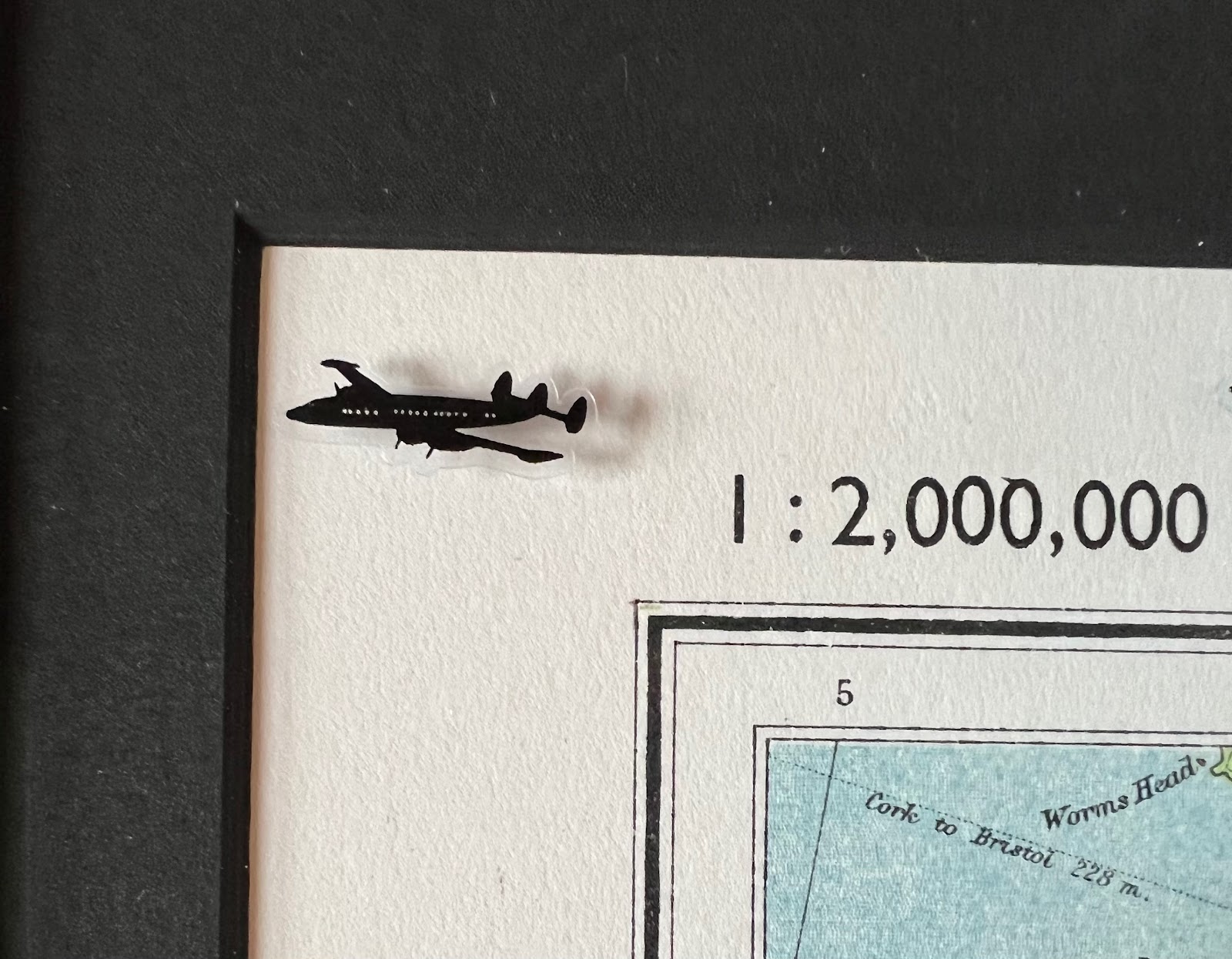
I ordered from several different vendors (at less than $3 per sheet, they were far more reasonably priced than what I could get at craft stores), but the ones I liked best were from OKPLANS.  Her stickers were a very deep black printed on a clear sheet, and they have the right amount of simplicity, and the right size.  And when some of the stickers from other vendors arrived and didn't look right at all (my first taxi sticker was barely a charcoal gray and didn't show up against the map well at all, and some stickers were printed on white paper which looked funny), I asked her to do some custom work and she did a great job, creating a vintage taxi and a vintage airplane with propellers and a triple-tail based on an actual Lockheed Constellation, which is the kind of plane my grandparents flew to America in.  So, a HUGE shout out to Kimberly for her excellent sticker-design skills.   And she didn't even charge me the custom work - I just paid for a normal sheet of stickers, and now she offers the designs I requested for sale in her store to anyone who wants them.  

Also, because the stickers are on the glass, you can see UNDER them and still read the map, by moving to the side a little.  Very nice unintended and 3-D effect.

So, here are a few closeups (click on the images to enlarge):

Orange Dots (first escape to France):

Taxi from Brussels to Pas-de-Calais, May-June 1940.

Red Dots (Second escape to France):

Pano that shows the entire trip from Brussels to Antibes,
fall, 1941. Smaller sections shown below.

Train from Brussels to Besançon, fall 1941.
Route is a guess, and follows escape lines.


On foot from Besançon through Arbois,
bus from Poligny to Lyon, fall 1941.


Train from Lyon to Antibes,
then back up to Valence, fall 1941.


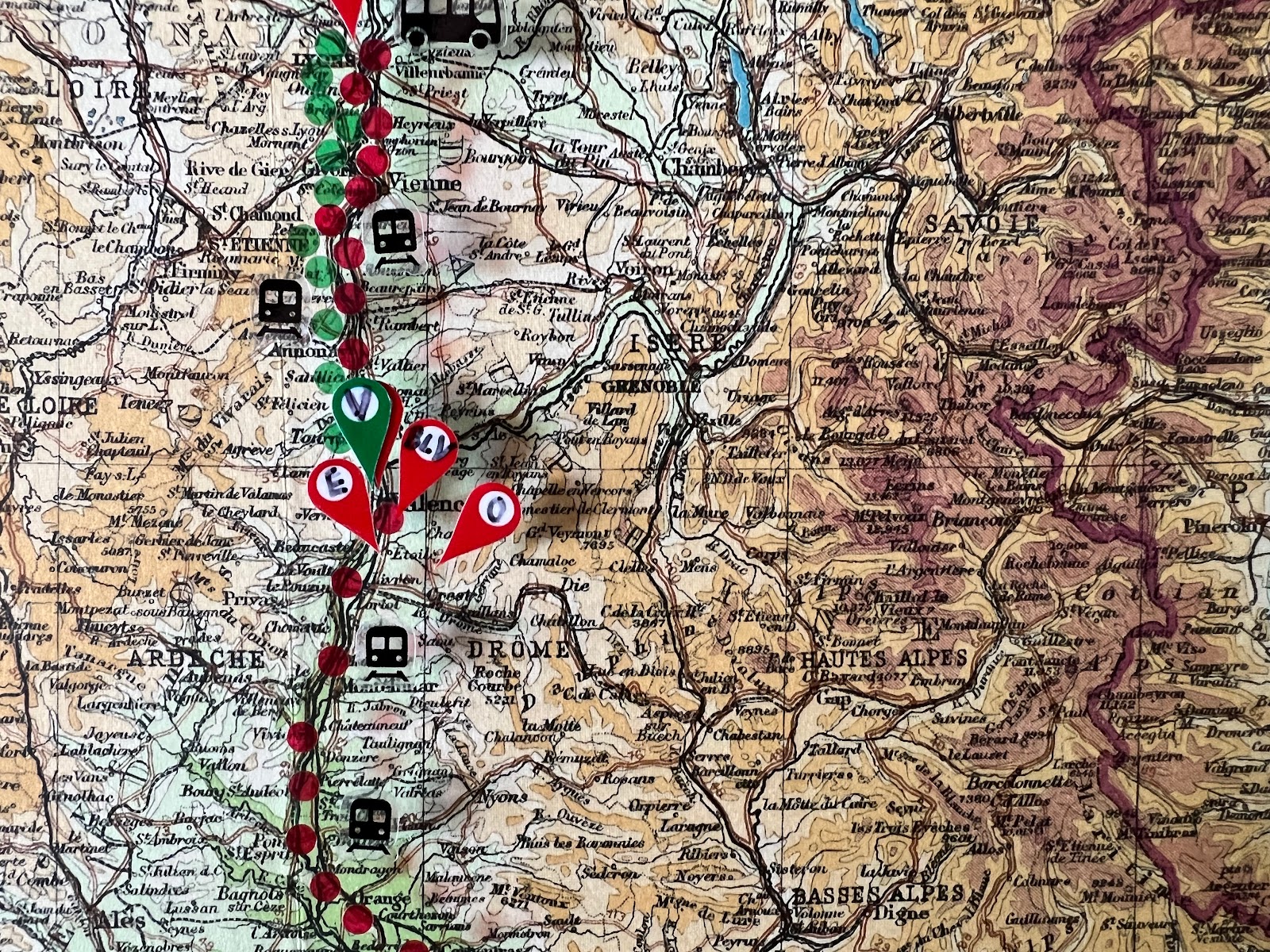
Valence, Beaumont-lès-Valence, Étoile, Ourches. 1941-1947
Note the mountainous region off to the right - that's the Vercors massif.

Green Dots (Immigration to America):

Train from Valence to Paris, January 1947.

Train from Paris to Calais,
ferry across the English Channel,
train to London, February 1947.


Plane from London to the NYC, February 1947.

Lockheed Constellation! 
Four propellor engines and a triple tail.


Tuesday, March 29, 2022

May 1940: The Hospital Where My Aunt was Born (AKA: Researching, Making Connections Across Time and Distance)

Time and again, I've been amazed at how much people around the world have been willing -- sometimes it seems like they are even delighted -- to help me with my research.

I've got friends in the knitting community who have helped me find things, translate stuff, you name it. I wrote to the grandson of my grandfather's commanding officer, and he bent over backwards to help. So did the residents of a tiny town in France where they were headquartered.  A few historians, a scientist, family ... the list goes on and on.

The newest one is that I looked up the address where my aunt was born (it was on her birth certificate 38 Rue Baron Lambert in Etterbeek/Brussels, Belgium), and found that today it's a small hospital - back then it was a maternity clinic, and I emailed them asking them when their building was built and whether it looks today what it looked like in 1940, and I got a response from the "Secrétariat de direction" which I think translates to "Executive Manager," and he confirmed a) the 1924 build date, b) that it used to be a maternité, and c) that it pretty much looks the same as it did in 1940. Here's a translation of what he wrote:

Hello Mrs Weeks,

The Baron Lambert Hospital was built in 1924. The building is still in its original state.

Following mergers with other Brussels hospitals, it is now part of the Iris Sud Hospitals made up of the Etterbeek-Ixelles sites located in Ixelles, Molière Longchamp located in Forest, Joseph Bracops located in Anderlecht and the Baron Lambert site in Etterbeek.

The Baron Lambert site no longer has any care units. There is a large polyclinic on the ground floor and administrative services on the upper floors.

Here is the initial plan of the building:


And the current building:

Hoping to have answered your request, I wish you much success in your search.

Best regards,
G---D----

Monday, March 28, 2022

May 10, 1940: Arthur visits his wife and newborn daughter during an invasion

 My aunt was born on May 8, 1940 in Brussels, Belgium, at a maternité (maternity clinic).

The Nazis invaded western Europe on May 10, 1940.

On that rather fateful morning, he had to make his way from their apartment (pin 1) at 286 Avenue de Mai (Meilaan in Flemish) through the intersection of Tervueren Avenue and Saint-Michel Boulevard (pin 2), to the maternité at 38 Baron Lambert Street (pin 3) so that he could be with his wife and newborn daughter during the invasion.


His story is both exciting, and rather dreadful.

Anyway, he awoke in his apartment on 286 Avenue de Mai (Meilaan in Flemish) the morning of May 10 at around 5:30 am to the sound of explosions and air raid sirens.  He was alone in his apartment, and his wife and baby were 2-3 kilometers away to the SW. 

Here's how he told the story of making his way during an invasion, to his wife's side. 

“What it is?—What is the matter?" I asked myself half awakened in my bed. A cannonade was heard outside. And suddenly a sorrowful widespread sound of sirens came to me. The sound was increasing during a few seconds and afterward it was fading to begin presently once more. Everyone can understand its dreadful meaning. Alarm! The birds of death are flying over the capital!

“Is the war there?" I asked myself anxiously. “Oh no!" Still I was fool enough to hope it was not true “Perhaps a squadron of R.A.F. is coming back from Germany and the Belgian army is shooting in a neutral manner, that is to say in trying to do no harm."

Here's what the outside of his apartment building looks like today (pin 1 on the map):


286 Avenue de Mai

I don't know when this building was built - was this what it looked like during my grandparents' time, or if this is new since WW2? I do know my grandparents mentioned a 2nd-floor neighbor, so they either lived on the third floor or the ground floor.  In my stories, I've chosen for them to live on the third floor and their landlady to live on the ground floor. So if the building was there in their time, I can just imagine them sipping coffee at a little kitchen table in that little corner bay on the right on the top floor. 

Here's an interactive Google Streetview map of where he was.  You can turn in a circle and see something like he would have seen, though without the mayhem and destruction.

Anyway, he rushed outside, and witnessed incendiary bombs dropping in the street, and the gruesome death (I'm guessing - it's not explicit) of a neighbor.

I got on as swiftly as I can. Five minutes later I was in the street.

I looked up, but could not discern at once the airplanes. However I was hearing the roar of their motors, somewhere far up. 

And suddenly a whiz tore the air. It lasted not long, a few seconds perhaps. I looked eagerly and perceived four or five meters farther, in the middle of the pavement, a thing beaming like a piece of hot steel which just left a forge to be hammered by a blacksmith. Of cylindric shape, its diameter might have been 6 centimeters and its length of 30. At one end was fasten a fixed steel helix. 

A hundred meters further another thing like this one fell and a neighbor was pouring a bucket of water on it. But instead of extinguishing it, big flames flashed from it.

I tried to imagine standing in the street outside that apartment, and seeing a neighbor engulfed in flames, and ... I just can't. He also describes how the most direct route (red dots on the map) to the maternité took him right by the military school ( École Royale Militaire - MS pin on the map) and he feared it might be a military target: 

The maternity was situated half an hour of a walk from our home. The straight way passed aside of the Military School. I thought that perhaps this spot would be an aim for the enemy airplanes and I decided to take a long way round, through the outside Brussels’s boulevards. The airplanes could be always heard, somewhere far in the sky, too far to be seen at once! 

There were few people in the streets. From time to time military motorcycles passed in a great hurry. The newspapers had not yet arrived to the stands in the boulevards. Some people impatiently waited for them. I remember somebody said: “I fear these gangsters may come till here." Nobody asked who were these gangsters ... the neighbor  violating the Belgium’s frontiers. Everybody knew it too well. Twice in our century they brought to Europe fire and blood, tears and death. 

Then the newspaper stand at Tervueren and Saint-Michel (pin 2 on the map) was destroyed by a bomb, moments after he left it.

Without waiting for a newspaper I went on my way. I had just crossed the “avenue de Tervueren" and was perhaps two hundreds meters past this lane when suddenly a dreadful sound came to me: a mighty whiz increasing from second to second. After that, a strong wind made me run. A thought crossed my mind: “Why are you running?—Two meters further the danger is not smaller than here!" 

So I tried to stop and I twined my head to see what happened behind me. A frightful sight struck my eyes. Above the trees of the boulevards hundreds bricks, clods, stones were flying in the air. A compact cloud of dust was rising to the sky. Something struck me. It was an old woman who fell into my arms. She was trembling. I tried to calm her. “That’s finished," I said, “the danger is over. The probability of two bombs falling near each other is not very big. There are no military aims here." 

But I must acknowledge that I was shuddering. I was afraid like a child. All my will could not help me to shudder. And I went on in a hurry to see my wife and my baby. If I had left home two minutes later, or, if I had chatted two minutes more at the news-papers stand, I should be among the victims. My baby would never know her father.

He finally made it to the maternity clinic. He didn't say how long it took him to make the trip.  

Here's the hospital. It was built in 1924, with another wing added in the early 1930s. Two other wings were added after the war.  What's cool is that it's still a hospital today, though it's a general-purpose hospital now and not specifically a maternity clinic.  Here's a Streetview link if you'd like to see the neighborhood.

38 Rue Baron Lambert - Iris South Hospital

I found my wife, of course a little upset, but still quieter than me. She knew already that the war burst but she did not see incendiary bombs dropped from the sky and did not feel the mighty blast of explosive bombs. “You will never return to our home at avenue de Mai, my dear," I said to her. “After a few days you will go down somewhere to the country to recover your strength and health and after that, we shall proceed to America." 

But I must acknowledge that I was not quiet at all. To wait too long at the room of my wife and listen to the sirens and airplanes, without something to do, got on my nerves. So, as I met Miss Foulon, the director of the maternity, I asked her whether I might not be in some way useful. 

And so half an hour later, arrayed from top to feet in a white surgeon cloth, I painted in blue the windows of the operation rooms. I was assisted by my brother who called on us in the maternity. Then we did many other works for the security of this house in which lay my wife and baby unable to move by themselves. Miss Foulon was very grateful to us and lunch and dinner was offered to us at my wife’s room and Mrs. Lubinski became the director’s and doctor’s pet.

One of the heartbreaking things about the Russian invasion of Ukraine, is that so many of the events of 80 years ago are happening again today, pretty much exactly as my grandfather described.  I very much wish people could learn from war, and y'know, not wage it.

Saturday, March 19, 2022

Winters 1941-1943: Using a Vichy Journal, Possibly In Order to Avoid Suspicion

So, it turns out that my grandfather's journal, that covers the events of May 8-11, 1940 (my Aunt Lilly's birth on May 8, and the Nazi invasion of western Europe on May 10 and the immediate aftermath), was written significantly after the fact, by about one to three years.  

While he was living in Brussels, Belgium during the events depicted in the journal, he states in other sources that he actually wrote the story down after he'd escaped to southern France in the fall of 1941, during the winters of 1941-1943; so it was not a daily journal; rather it's a set of recollections that he wrote in an epistolary format.  

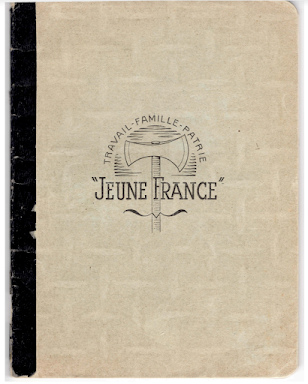
Additionally, the journal's cover provided a rather interesting clue.  He had to have purchased it after he arrived in France, because the cover of the journal is printed with pro-Vichy slogans, something likely only available in France, and not Belgium. Additionally, "Jeune France" was an organization created by the Vichy government in 1940, but was dissolved by 1942.  Hence, my grandfather had to have purchased it between the fall of 1941, when he arrived in France, and 1942, when the organization was disbanded.

But why would he have had a Vichy-branded journal?   He was a foreign refugee who idolized Charles de Gaulle and strongly opposed the Vichy regime.  I once heard him describe Pierre Laval, the Prime Minister of Vichy France from 1942 to 1944, as "the worst of all."

I can come up with three possibilities:

  1. He wanted to avoid suspicion and to blend in better. Early in the war, Vichy enjoyed a lot of popular support.
  2. He simply didn't realize at the time of purchase that the slogans were Vichy propaganda.   He was a stranger to France. I do have a hard time believing that if he did buy it in ignorance, that he wouldn't have figured it out by the end of the war.
  3. The were shortages of ALL SORTS of things. This may have been the only journal available to him, and his choice was either a Vichy journal or no journal.

Anyway, here's the cover:


The slogan "Travail - Famille - Patrie" means "Work, Family, Homeland" and is the slogan that the Vichy regime used in place of "Liberté, Égalité, Fraternité" (Liberty, Equality, Brotherhood) which had been used since the French Revolution (as soon as Vichy was overturned, France re-adopted the original slogan, and it remains in use today).  
    
As my friend said, "I guess the Vichy regime was not hypocrite enough to boast about freedom and equality."
    
La Jeune France was a political/cultural/propagandist movement that began in 1940 by the Vichy government, and then dissolved in 1942.

If you want to know more, here are two wiki pages about it:


Monday, March 14, 2022

June 1944: Killing a Kübelwagen (variations on a theme) v1-v4

So, I've run across some interesting challenges. Recorded history and testimonies often differ, both when they come from different people, but sometimes even from the same person but at different times.  Trying to figure out what the real story is can be really tricky.

But, I've found four different versions of the same story, of the destruction of a vehicle carrying the commander of the German forces near La Rochette, France by the maquis (Drôme FFI, 4th Company 2nd Battalion).

I've managed to determine the exact date on this one: June 28, 1944.


Version 1: In my grandfather's Yellow Pad Stories (written around 1974), he described it like this:

One lieutenant with three men on an advanced ridge did not start firing until the German column passed by and firing started between the Germans and us. Then he started his automatic rifle and hit the car which was following the first German column, killing the driver. The car rolled over many times from the road into the bed of the stream. Then Germans and we withdrew at about the same time, while the lieutenant and his secluded helpers kept firing at the Germans, who never knew that at that time they were many hundreds men against four. Later in the rocks of the mountain stream, inside the wrecked and soaked car, two bodies were found: the German driver and, beside him, the ... German commanding officer. In his handsome field leather bag, orders and information so precious to us were found.


Version 2: My grandfather told me about it in his 1988 oral testimony:

Why, we [untrained civilians in the maquis] were some sort of a mob who didn’t know exactly what to do, or what not to do. We were firing haphazardly; they [French army non-commissioned officers] knew exactly what to do, and one of them very close to me, shot down with a rifle, the driver of a – I want to say jeep, but that is American ... this was a German vehicle, but let's call it jeep. And I think he hit the driver who lost control of the vehicle which fell into a stream below ... and no one survived. Well, because of this, the Germans withdrew and it was over.

Based on his description, I assumed the vehicle was a Volkswagen Kübelwagen. One of these:


Version 3: Here's a translation of an account written around 1955, by Michel Planas, the son of my grandfather's commanding officer, who also served in that unit: 

The machine gun and the elements of the outpost go into action, repel the first attackers and overturn a light car (an 11 CV Citroën) which was advancing at high speed. The first engagement lasted a few minutes. The attackers fall back quickly taking their losses ... In the meantime, the disabled vehicle is inspected. It was the car of the Lt. Colonel who commanded the expedition. On the front seat, a briefcase containing plans and orders for the attack that we had stopped. On the translation of these, we discover a bewildering report, affirming that the Germans attacked OURCHES that day. After inspection of the new strategy, the Captain disperses the 3rd Section to the North of the positions of the first Section, on the hill which dominates the right bank.

Hmm... a Citroën 11 CV looks like this:


In this case, I would normally tend to trust the other guy's account, for two reasons:  
  1. It was written only a few years after the war. Less time had passed, and the details were unlikely to be forgotten. They also feel like the writer might have actually been there. Grandpa gave his accounts 30 to 44 years after the events in question.  His mind was still quite sharp, but those kinds of details tend to get lost no matter who you are.
  2. The specificity of the account. It wasn't just "a car." It was a Citroën 11 CV.  That's the sort of thing that gets written down in log books and records, and I think it's possibly (but not surely) right.
On the other hand, I think a Kübel seems more likely given the context. And why would my grandfather have called it a jeep, if it had been a Citroën?  And my grandfather was there, while I don't know if Michel Planas was.  

Version 4: I found what I think is yet another description of the same incident, in the 1978 book Tears of Glory: Heroes of Vercors, 1944 by Michael Pearson. The dates match up, and is part of the description of the same battle (La Rochette valley, the next valley over from where Grandpa was stationed).

The noise of the approaching column grew louder as the Maquisards waited beside the lane. Deliberately, they allowed the two motorcyclists at the head of the convoy to pass by them unchallenged.  Then they lobbed grenades at the first truck and the mountainside was devastated by noise. For a moment a sheet of flame concealed the vehicle. Then it was revealed, shattered into burning, smoking pieces. Everyone in it was killed -- including the commander of the column, as the Maquisards later learned.
In this account, it was a truck, they used grenades, and it exploded instead of rolling down the hillside. But the commander of the column was killed and they found out later, so I think it's probably the same event. 

Added 2025: I found a 5th version!

Tuesday, February 1, 2022

December 1945: Arthur's second daughter is born (chapter draft)

    This is the story of my mom's birth.  For those of you who know her, she goes by Jackie, a diminutive of her middle name.  For the first few years of her life, she went by her first name Sylvie. But when she was learning to speak, she evidently couldn't say Sylvie, and said "vee-vee" instead, so they took to calling her Vivi, and then people assumed her name was Vivian. Grandma got tired of that and told people to use Mom's middle name Jacqueline instead, which is how she came to be called Jackie.

***


Arthur's Second Daughter is Born


That summer I was informed that our home would soon be graced with a blessed event. I was at once possessed with a violent case of jealousy which, to this very day still lingers. I anticipated with sorrow the many privileges which I would have to surrender to this new baby. -- Lillian Lubinski, March 1955. 

The hospital was not heated, by lack of fuel. It was freezing in every room. The only heating was in surgeries and delivery rooms. Otherwise it was not. . . .brrrr. . . . shiver.  Well, the doctor asked me to step out. Today, there is a fashion that the father should be there, to see what happens for, I don’t know, psychological reasons. But anyhow, at that time they didn’t let me stay. I was out. And I was cold. I claimed I suffered more than Roma. Roma is laughing at that, but she was not cold, and I was. The baby came, it was a daughter, my second daughter and very lovely. What else you want to know?  --Arthur Lubinski describing the birth of her mother to his granddaughter, May 1988.


 The next day was Sunday, so Arthur didn’t go to work. He used the car he'd been given for the reconstruction work, and drove Paul around the area, to show him where he’d been, and Roma and Liliane went along for the ride. 


The farmhouse in Beaumont-lès-Valence was still empty -- the Auvergne family hadn't found tenants yet -- and the Ourches HQ was also empty. Paul and Liliane both were most impressed with the Château of Châteaudouble.  

“You stayed there?  What’s it like?” 


“Beautiful. Rich. On the far side is a ballroom that overlooks the fields as they descend toward the Rhône. I set up the radio there in a picture window, among marble columns and statues.”


“How’d your commanding officer get permission to use it?” 


“He didn’t ask permission. The collaborator who owns it knew Vichy was coming to an end, and didn’t argue when Dr. Planas told him we wanted to use it as our HQ. I think he hopes to use our presence there to demonstrate his patriotism.”


Paul laughed.   


“Can we go inside, Daddy?” Liliane asked.


“No, darling. It’s someone’s home now, and not our headquarters any longer.”


That evening, Roma went into labor.  Arthur was grateful that his brother was still visiting, because Paul could stay with Liliane, and that would simplify things a great deal. 


He kept the car about almost a kilometer away from the apartment, under a covered carport. His neighbor hadn’t had a car in years, and had given him permission to use the carport.  But the vehicle was very difficult to start in cold weather, and he didn’t want to risk it not starting when it was time to go to the hospital.  And it was very cold that night, -10 Celsius.


So every two hours, he walked the kilometer to the carport, started the car, giving it gas until the sluggish engine turned over, and then after it had warmed up sufficiently, he shut off the engine off again. Then he walked home, hands in  his pockets, his coat collar turned up against the wind, and went back inside the apartment to keep Roma company, sometimes dozing a little.  


When it became apparent that it was time to go to the hospital, he helped Roma into her coat, then had her wait at the curb while he got the car and drove it back to the apartment. Paul was waiting outside with Roma, and he helped his sister-in-law into the car.  Then Paul went back into the apartment, and presumably went to sleep. It had been a long night.


Arthur drove Roma to the hospital, and dropped her off by the doors, then went to park the car. She waited for him to join her again, and he took her arm and lead her into the hospital.  A doctor took her into an exam room, and Arthur started to take off his coat, then realized the room was very cold, that he could still see his breath.  


The doctor brought Roma back out.  “She’s not quite ready, perhaps another hour or two.  There’s no one else in the delivery room tonight, so you may wait with her there, until it’s time.”  Arthur nodded, so the doctor lead them to the delivery room. “We lack fuel to heat the entire hospital, so the only heated rooms are the ORs and the delivery rooms.”  That explained why the lobby was so cold.  


Arthur pulled a book out of his pocket. It was a new copy Madam Curie by Éve Curie. They’d left their first copy behind in Brussels. “Shall I read to you? It might help pass the time.”  


Roma smiled — she was between contractions — and said, “Yes, I’d like that very much.”


So he read to her, for hours, pausing when the contractions came, or when a doctor or nurse came in to check on her. 


After one such pause, he asked her, “So what are the names we picked out again?” 


“Jean after your commanding office, Jean Georges or Sylvie Jacqueline,” she reminded him instantly.


 When Liliane was born, they’d chosen a name with a common English cognate, and they’d done the same thing this time, still planning and hoping to go to America someday.  And while they weren't religious, and didn't especially care about the Jewish prohibition against naming a child against a living relative, it still informed their decisions. To name the child after Isaac, or Teofila or Lola meant that they had lost that tiny bit of hope that Roma’s family had survived. 


Finally, something seemed to change in Roma, and she said, “Arthur, I think it’s time.”  


He opened the door, and went to find the doctor, but the man was already on his way in to check on her.


Arthur remained in the hallway outside, his hands in his pockets, and he paced to keep warm.  


The doctor came out, and said, “the baby is coming soon; please wait in the seating area.”


“May I retrieve my coat?” Arthur asked, rubbing his cold hands together.


“Yes, of course.” 


Arthur collected his coat, hat, and gloves, then left the room, pulling them on as he left. Two nurses came in, and the doctor closed the door behind them.


The waiting area was very cold, and Arthur was freezing. If he sat down, he got too cold, and soon began shivering.  So then he’d get up, blow into his hands to warm them, and bounce and pace and run in place to warm up again. But then he got tired, and sat back down, only to start the freeze-thaw cycle again.  He was terribly uncomfortable, but he couldn’t bring himself to ask for a blanket. The patients needed the blankets far more than he did. His nose was cold and his toes were numb.


After two hours, the smiling doctor came to find him. “Mr. Lubinski, you have a lovely, healthy daughter, and your wife is just fine.”  


“May I see her?” Arthur was shivering, and his teeth chattered as he spoke.  He had been planning to get up and begin his warm up routine, but stepping into the heated delivery room sounded much better.  


“Yes. Come in where it’s warm.”  


He found a very tired Roma, cradling a wrapped bundle.  He leaned down and kissed her, then lifted the fold of blanket covering his new daughter’s face.  “Hello, darling Sylvie,” he said.  Unlike with Liliane’s birth, when he’d had to get used to loving his daughter, this time he felt it immediately.  It wasn’t as if a stranger had entered their family.  


“Why don’t you take off your coat?” Roma asked him.


“Because I’m still cold. This is one of the only heated rooms. My toes are blocks of ice.” He grabbed one of her hands, and let her feel how cold his hands were.  “I think I suffered more than you did.”


Roma laughed at him. “I don’t think so.”


“You weren’t cold all this time.”  But he smiled to show her he was joking. . . . Sort of.  


“Well, go home and get some sleep. They are going to let me stay here unless the room is needed.”


On his way home, he went to city hall, and filled out the paperwork for Sylvie’s birth certificate.  He was feeling so good, joy with his new daughter and wife who had both come through the birth safely,  happy the war was finally over and overjoyed the Allies had been victorious, that he gave his baby an extra name on a whim. Sylvie Jacqueline Victoire Lubinski. Victory.  He then promptly forgot about the extra name, drove home and went to sleep wrapped in a mountain of blankets, while Paul was out spoiling Liliane with sweets.