Thursday, July 14, 2022

1930: New Year's Eve at the Chantilly Jazz Club at the Hotel Terminus in Antwerp

 So, yesterday, I wrote about how my grandparents went out partying on New Year's Eve. My grandfather recorded the exact date (December 31, 1930) and exact time (10:30 pm) and that they were going to the Chantilly after the photo was taken.

Now, I haven't scanned all the photos in the album yet (I'm about 1/3 of the way through), but this is the only example so far of my grandfather's writing on the back of a photo. Most are blank.  One has what is probably my great-grandmother's handwriting on it. The others have what I suspect is my grandmother's handwriting.   

The romantic in me, sees the significance of my grandfather going to the trouble to recording the exact date and time and what they are going to do next. He didn't do that for any other photo, so it seems important somehow, like maybe ... he asked my grandmother to marry him when they were at the Chantilly, or something like that?  

Or maybe he just recorded it because they were young (18 and 20) and it was a fun night for them. 

Anyway, through the help of some friends, I've found out that the Chantilly was a jazz club in the Hotel Terminus on Pelikaanstraat in Antwerp. Friends found genealogy records of musicians who actually worked there in the 1930s.  And they found this old postcard that shows the hotel, and in the lower left, you can see the Chantilly (click to enlarge):


I "walked" up and down Pelikaanstraat (Pelican Street in English) in Google Maps using street view, and didn't find the building, though several of them looked sort of like it.  

I did a few more searches and found the following page (it's written in Dutch/Flemish), with this image:


The text on the page says in English:

Hotel Terminus, Pelikaanstraat, c.1910 | 2020
Another fine piece of work done by Antwerp, Wish You Were Here. It's great how the old photos are incorporated into the current street scene!

In the photo you see the former Grand Hotel Terminus in the Pelikaanstraat. This beautiful building was built in 1902 by Joseph Hertogs. The hotel was graced by luxurious interiors, dazzling banquet halls and majestic entrance halls. The clientele consisted of the then Antwerp bourgeoisie and wealthy tourists. Unfortunately, in the second half of the 20th century, this building too had to be demolished to make way for office buildings.

The Pelikaanstraat used to be a really prosperous street full of stately mansions. You also found a cigar factory and the presence of catering was evident here.

Alas, the building is gone.  But, there you have it: the jazz club my grandparents went out dancing on New Year's Eve in 1930.  

Wednesday, July 13, 2022

1930: My Grandparents Party on New Year's Eve

The battered photo below was on the first page of my grandparents' photo album.  In December of 1930, my Grandpa Arthur was just 20 years old, and my Grandma Roma was 18.  

My grandfather was born in Belgium, but grew up in Poland.  My grandmother was born and raised in Poland, and they were childhood sweethearts. Grandpa's family went back to Belgium in 1927 so he could finish high school and attend University.  Eventually, in 1931, my grandmother moved to Belgium where she too attended the university.  

The front of the photo tells me a few interesting things:  My grandmother visited my grandfather in Belgium before she started at the University as a college student in the fall of 1931 (keep in mind that traveling from Łódź to Antwerp took two days by train in those days).  They look like they are dressed for a party, and my grandfather had a full head of hair (he had significant hair loss by 30 and was bald by the time I knew him).  

Oh, and those look like martini glasses to me.  


The back of the photo gives a bit more information:


The photo was taken on December 31, 1930, in Antwerp (Anvers) Belgium. So it wasn't just any day in December; it was New Year's Eve.  And it was taken not just that evening, but at 10:30pm.  Google Translate told me the phrase "avant d’aller au Chantilly" meant "before going to the whipped cream," which doesn't make much sense (but is kind of funny). Then, I realized Chantilly was capitalized on the photograph, which indicates a proper noun.   As soon as I fixed that, Google Translate told me it meant "before going to Chantilly."    

So, does that mean Chantilly, France or something else?  Chantilly was about 4 hours away from Antwerp by train and it seemed odd to be going there when they look as if they are dressed for partying rather than traveling.  

A French friend came to the rescue and told me that if it were a city, it would be "á Chantilly". Because it's "au Chantilly" (which is literally translates as "the Chantilly") it strongly suggests a club or bar or restaurant. 

Anyway, this event was important enough for my grandparents to record the city, and the exact date and time, and that it was before they later went to the Chantilly, an event which was itself meaningful enough to memorialize on the back. And when my grandparents escaped to France, they left pretty much everything behind, but this photo (and a few others) went with them.

I can't know the importance of the Chantilly, but I love the mystery, the idea of it, and that my grandparents were once young party-goers.  

Monday, June 27, 2022

1920s - 1940s: The photographs mentioned in _Biscuit_

 Currently, there are three photographs mentioned in Biscuit:

It was a photograph, and it captured her perfectly. Her head was cocked slightly to one side and the top of her short hair was pulled sleekly back from her face, with short loose strands curling around her cheeks. She was wearing a dark dress and the heart pendant he’d given her for her birthday earlier that spring. She was looking up at the photographer with a small, secretive smile. 

My grandmother, Roma Neufeld, 1927 (about).
She was about 15 years old here.


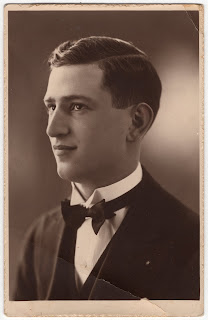
As it turned out, Arthur’s mother didn’t have a photograph he could send to Roma. But Masia arranged for a photographer to take one. Arthur got a haircut from his father’s barber, borrowed a suit, and wore a black bowtie. He thought he looked rather grown up.
My grandfather, Arthur Lubinski, 1927 (about).
He would have been about 17.


Arthur retrieved his camera, and asked to take a picture of Roma, Paul, and Liliane.  They agreed, happily posing, though Roma asked him to frame the picture so that  her belly didn’t show. Arthur snapped several pictures, then put his camera away.

Great-Uncle Paul (Lubinski), Aunt Lilly (with the bow), and Grandma Roma,
Probably taken in December 1945.


Saturday, June 25, 2022

1940s: I have a copies of my manuscript

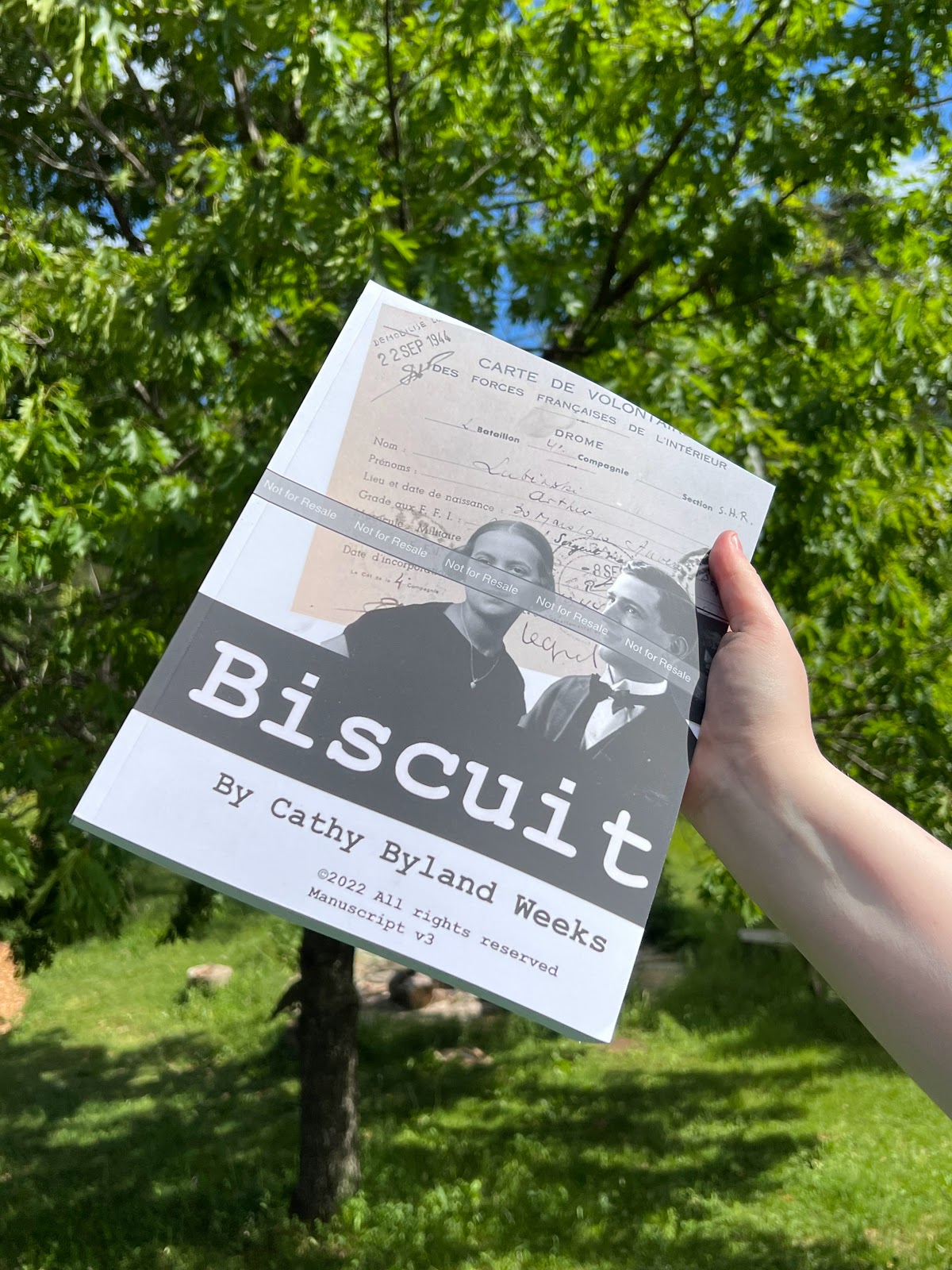
I ordered six proof copies of my manuscript and they arrived on Wednesday, and all I can say is WOW. It's impossible to describe how exciting it is to hold an actual physical copy of the book I wrote. 


I do wish the "Not for resale" banner was about an inch lower, and didn't go RIGHT THROUGH MY GRANDPARENTS' faces, but it's still really quite sweet.  I put a copy of it on the coffee table, and as I watched TV, I just kept glancing down at and grinning at it.


Four of the copies have been shipped to various beta readers, one was handed to my daughter (she's a beta-reader, too) and the final one is going to my last beta reader when he visits in a few weeks.


Saturday, June 18, 2022

1940s: The Book Title is: "Biscuit"

Ok .... Biscuit.  You might be wondering why I used that as the title. Well, it's simple: "Biscuit" was my grandfather's code name during WWII.  Seemed like the perfect title for a book that is primarily about his experiences during that time.

Two things:

  1. It's not pronounced "BISS-cut" like it would be in English. Rather you should use the French pronunciation, which is "Biss-KWEE."   
  2. In France (and England for that matter), a biscuit isn't a savory quick bread that you slather in gravy. Rather it's a dry dense crispy sweet dessert. So in essence, they called my grandpa "Cookie." (He was the radio operator, and was named after the metal tin his radio was packed in -- the radio itself was commonly nicknamed the "biscuit tin radio" by the Allies.)

It was my husband Chris who came up with the title.  

I had been thinking about calling it "The Maquisard," or "The Armband."  I like calling the French Resistance "the Maquis" and I kind of like calling Maquis members "maquisards" (which is what they were actually called). And I have his actual armband that he was given a few weeks after D-Day hanging on my living room wall.

Anyway, I told my husband the titles I was considering, and he looked thoughtful and said something like, "I dunno... I think maybe you should call the book Biscuit."  And I considered it for about two seconds and knew he was right, and that was that.  

Friday, June 17, 2022

1940s: Well, I have a book cover (sort of)


This is the cover of the manuscript draft


Well, I uploaded the book to Kindle Direct Publishing today. It's saved as "draft" so it won't go for sale, but it did allow me to order 5 proof copies (grrr... I need 6), for $5 each.  That's unbelievably inexpensive. Printing it through Barnes and Noble would have been $9 per copy. Lulu was going to cost $16.    Office Max would have cost (gulp) $40.  The latter two would have allowed me to have it spiral-bound which would have been nifty (and easier for beta-readers to mark up), but it wasn't worth $11 per copy, so it's being bound like a regular paperback book. It's also big, 8.5 x 11", and 342 pages (171 sheets).

Because I was trying to make it as inexpensive as I could to print, I didn't start each chapter on a new page ... there's just a triple-line-break between the end of the chapter, and the numeral that heads the next chapter. So that means I have a lot of "widows" and "orphans" and stranded chapter headings and stuff like that. Definitely not formatted nicely for printing, but that's OK for a galley proof for my beta-readers.

I also had some fun with the cover. It's been 20 years since I used Photoshop regularly, and I was REALLY out of practice, both with graphic design, and using the software. But I had some fun with it, and the lack of professional artwork is OK for an early draft of the book.

Here are the original pictures of my grandparents: The pictures of Roma Neufeld and Arthur Lubinski and were taken in the late 1920s, when they were still teenagers, well before they got married, in 1935. For the cover, I was trying to make them look like they were standing together, but the photos were very likely taken in different countries. The photo of my grandmother was probably taken in Poland, and the one of my grandfather was taken in Brussels, Belgium.


Saturday, June 11, 2022

1944: My grandfather's FFI papers

Here's something cool: My grandpa's FFI (French Forces of the Interior) ID cards that show he volunteered for and fought in the French resistance during WWII. This is the equivalent of a military ID.

Click to enlarge:

Front of FFI ID

Back of FFI ID