Saturday, June 25, 2022

1940s: I have a copies of my manuscript

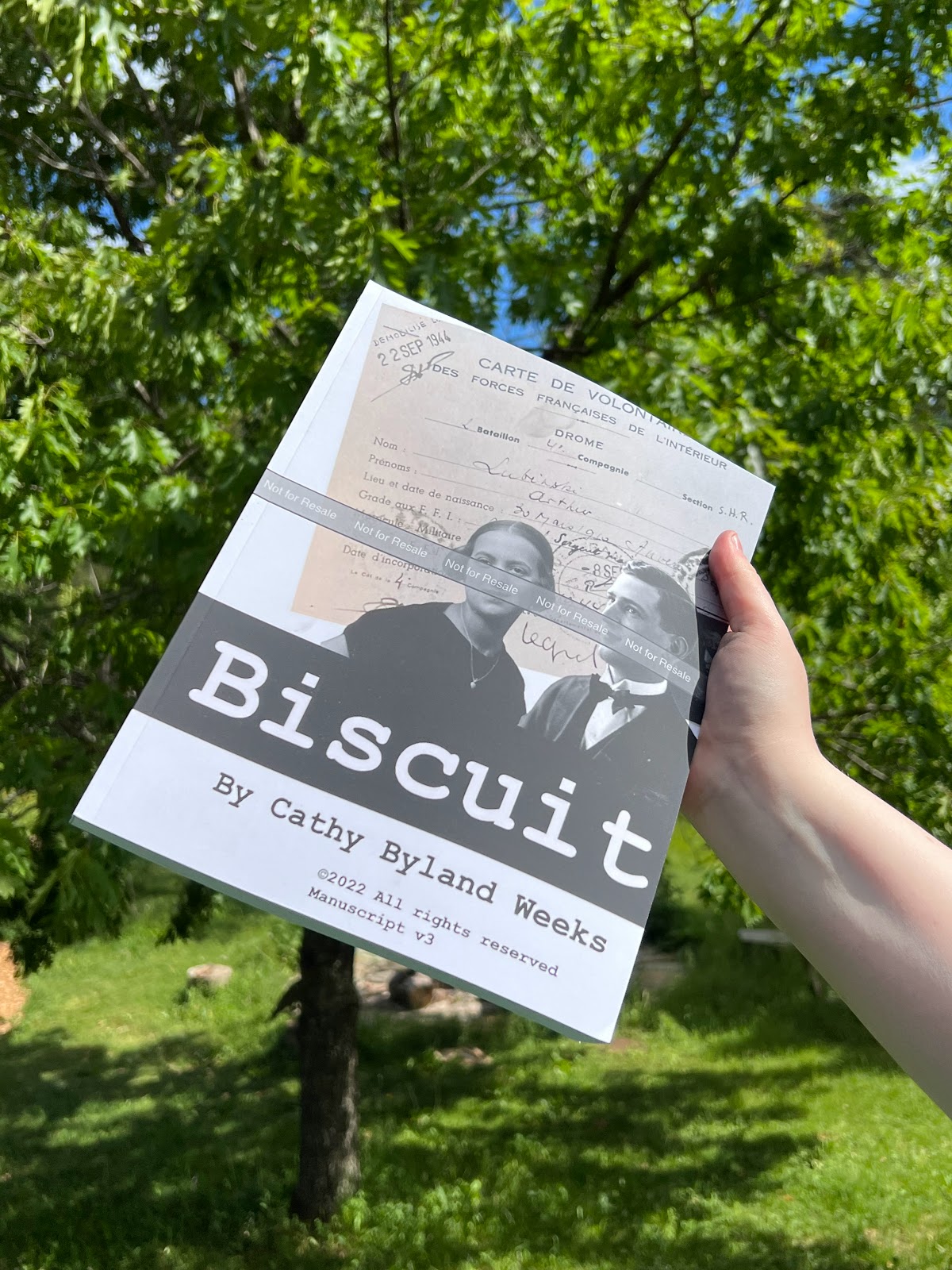
I ordered six proof copies of my manuscript and they arrived on Wednesday, and all I can say is WOW. It's impossible to describe how exciting it is to hold an actual physical copy of the book I wrote. 


I do wish the "Not for resale" banner was about an inch lower, and didn't go RIGHT THROUGH MY GRANDPARENTS' faces, but it's still really quite sweet.  I put a copy of it on the coffee table, and as I watched TV, I just kept glancing down at and grinning at it.


Four of the copies have been shipped to various beta readers, one was handed to my daughter (she's a beta-reader, too) and the final one is going to my last beta reader when he visits in a few weeks.


Saturday, June 18, 2022

1940s: The Book Title is: "Biscuit"

Ok .... Biscuit.  You might be wondering why I used that as the title. Well, it's simple: "Biscuit" was my grandfather's code name during WWII.  Seemed like the perfect title for a book that is primarily about his experiences during that time.

Two things:

  1. It's not pronounced "BISS-cut" like it would be in English. Rather you should use the French pronunciation, which is "Biss-KWEE."   
  2. In France (and England for that matter), a biscuit isn't a savory quick bread that you slather in gravy. Rather it's a dry dense crispy sweet dessert. So in essence, they called my grandpa "Cookie." (He was the radio operator, and was named after the metal tin his radio was packed in -- the radio itself was commonly nicknamed the "biscuit tin radio" by the Allies.)

It was my husband Chris who came up with the title.  

I had been thinking about calling it "The Maquisard," or "The Armband."  I like calling the French Resistance "the Maquis" and I kind of like calling Maquis members "maquisards" (which is what they were actually called). And I have his actual armband that he was given a few weeks after D-Day hanging on my living room wall.

Anyway, I told my husband the titles I was considering, and he looked thoughtful and said something like, "I dunno... I think maybe you should call the book Biscuit."  And I considered it for about two seconds and knew he was right, and that was that.  

Friday, June 17, 2022

1940s: Well, I have a book cover (sort of)


This is the cover of the manuscript draft


Well, I uploaded the book to Kindle Direct Publishing today. It's saved as "draft" so it won't go for sale, but it did allow me to order 5 proof copies (grrr... I need 6), for $5 each.  That's unbelievably inexpensive. Printing it through Barnes and Noble would have been $9 per copy. Lulu was going to cost $16.    Office Max would have cost (gulp) $40.  The latter two would have allowed me to have it spiral-bound which would have been nifty (and easier for beta-readers to mark up), but it wasn't worth $11 per copy, so it's being bound like a regular paperback book. It's also big, 8.5 x 11", and 342 pages (171 sheets).

Because I was trying to make it as inexpensive as I could to print, I didn't start each chapter on a new page ... there's just a triple-line-break between the end of the chapter, and the numeral that heads the next chapter. So that means I have a lot of "widows" and "orphans" and stranded chapter headings and stuff like that. Definitely not formatted nicely for printing, but that's OK for a galley proof for my beta-readers.

I also had some fun with the cover. It's been 20 years since I used Photoshop regularly, and I was REALLY out of practice, both with graphic design, and using the software. But I had some fun with it, and the lack of professional artwork is OK for an early draft of the book.

Here are the original pictures of my grandparents: The pictures of Roma Neufeld and Arthur Lubinski and were taken in the late 1920s, when they were still teenagers, well before they got married, in 1935. For the cover, I was trying to make them look like they were standing together, but the photos were very likely taken in different countries. The photo of my grandmother was probably taken in Poland, and the one of my grandfather was taken in Brussels, Belgium.


Saturday, June 11, 2022

1944: My grandfather's FFI papers

Here's something cool: My grandpa's FFI (French Forces of the Interior) ID cards that show he volunteered for and fought in the French resistance during WWII. This is the equivalent of a military ID.

Click to enlarge:

Front of FFI ID

Back of FFI ID


Friday, May 13, 2022

Spring 1940: So ... who was "Foch's Pupil"?

My grandfather wrote in his Journal 1940 about what he saw on May 11, 1940 (the day after the Nazis began their invasion of western Europe). 

A few things of note: 

  1. I preserved his British spelling and occasionally incorrect verb tenses. (He wrote this journal to practice his English, which he was still learning. I'm still in awe of how clear and well-written it was, for someone who was writing in a foreign language).
  2. I corrected his capitalization
  3. I used American-style quotation marks.
  4. I used hyperlinks to provide extra info for what are probably unfamiliar terms for most Americans.

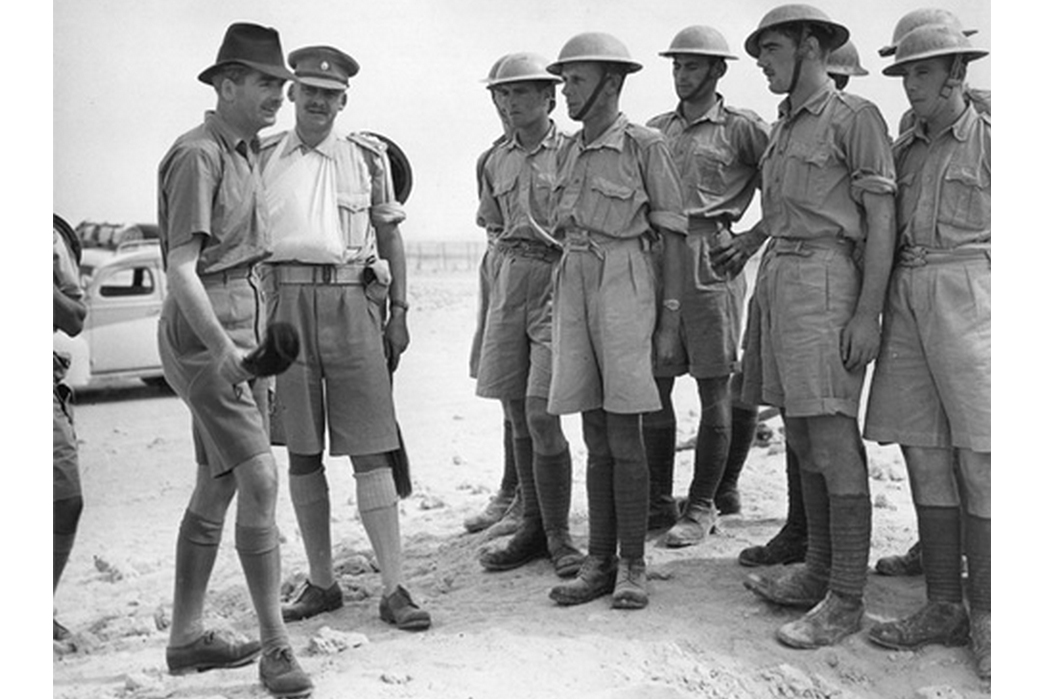
     In the first important street near the maternity I saw a big crowd. Something happened on the pavement. A noise of many cars, motor-cycles and trucks could be heard. Setting myself on tiptoe I understood at once the matter. The British motorised infantry hurried to the front. The soldiers weared an uniform unknown to me. A very plate helmet on the top, short trousers and a shirt with large pockets in the front. They were all very young and merry. 

Gurkha Shorts

     The crowd was happy to see them coming so speedy to the rescue of Belgium. Men shrieked (shouted!), waving their hats. Women and girls send kisses and throwed flowers. The Englishmen replied showing the thumbs of their right hands directed down, which meaned, I suppose: "We shall show the Germans what we are!" The Crowd was obviously optimistic. In the Rue de la Loi where were the ministries I noticed three high French officers. I remember quite well the oldest of them. He had gray hair, big, lively eyes, seemed thoughtful but quiet. A man of the street trusted him. He was perhaps Foch’s pupil, or another great chiefs, winners of Verdun or Chemin des Dames, makers of the victory of 1918.

So, does anyone know who [Ferdinand] "Foch's pupil" was?  Was there anyone in particular who that might have been? A friend pointed out that my grandfather probably didn't know who the man was, and was speculating, and he may be right. But that doesn't mean there wasn't someone who was known by that or perhaps "L'élève de Foch." 


Wednesday, May 4, 2022

Summer 1937: Discovering My Grandparents Delayed Their Honeymoon

 So, my grandparents got married in 1935. In 1988, Grandpa told me:

And then, I forgot when it was, a year later, we got married. Married in ‘35. In January of ‘35.

Somewhere along the way, my aunt told me it was January 12th, and that they eloped to the Brussels Town Hall, a building built in the 1400s:

Brussels Hôtel de Ville/Stradhuis 

Later, a historian in Belgium initiated a search for my grandparents in the Brussels city archives, and she was able to corroborate their wedding date: January 12, 1935.

Now, here's the detail we discovered that caught us by surprise: My grandparents evidently delayed their honeymoon for 2 1/2 years.   We think they went to the seashore (So when I was writing that chapter, I simply decided they went on holiday in Ostend).  They never told their daughters or me that they didn't take their honeymoon until the summer of 1937, but I'm virtually certain that that's what happened.

The one thing they DID tell us about it was that Grandpa read a biography of Marie Curie out loud to Grandma while they were on their honeymoon.   We think the biography in question was Madam Curie by Éve Curie because: 

  1. My family is pretty sure that that was the book based on memories of family stories.
  2. My grandfather nicknamed my grandmother "Ciupcia" (pronounced "choop-chah"), something he was inspired to do by the book he read to her on their honeymoon. The book described Marie's nickname, and was something that sounded a little like "anchupichu" (it's Polish). And that book has the following quote:

‘Manyusya’ a name of affection, and ‘Anciupecio’ a comic nickname dating from her earliest infancy. ‘My Anciupecio, how mussed your hair is! And how red you are!’”

That feels like very strong evidence that Éve's Madame Curie was indeed the book they read on their honeymoon.  And that book wasn't published until the summer of 1937 (simultaneously in France, Britain, Italy, Spain, the United States), two-and-a-half years after my grandparents got married. I looked for earlier books published about her but didn't find any (it doesn't mean there weren't any, just that I didn't find any -- it's hard to do searches in foreign languages).

I have no actual knowledge about why they delayed their honeymoon for that long, but I do have a guess: they wanted to wait until they had the money to take real honeymoon. Grandpa graduated from college in 1934, just six months before they got married, and would have been just starting out as an engineer. Grandma didn't graduate until early summer of 1935, six or so months after they got married. Waiting two years meant they had time to establish themselves a little, and save up some money for a nice holiday by the sea.

Tuesday, May 3, 2022

Fall 1941: Hints of Deception and Covering Up an Escape

 I may have found something cool: Possible evidence of deception on the part of my grandparents, an attempt to hide their whereabouts and also when they escaped Belgium to southern France.

My historian friend in Brussels got me several pieces of really interesting information today:

  1. My great-grandmother Masia's maiden name:  She was born Masia (or Mascha) Schiker.
  2. My grandparent's previous address: Rue de la Victoire 155, in Saint-Gilles (suburb of Brussels). Click the link for a street view image. (Note: It's the blue door to the left of the "POP0" graffiti)
  3. The date my grandparents moved into their apartment on Avenue de Mai 286: August 24, 1937
  4. The date my grandparents "moved out" of Ave de Mai: February 20, 1942.
  5. The address where they "moved" in 1942: Rue Stroobant 42 in Ixelles (suburb of Brussels)

Four and five are particularly interesting, because they directly contradict his oral testimony from 1988. One of the difficulties I've had, is knowing how to resolve contradictions between sources, and when to trust one over another.   The dates above are part of historical records, from the census and other archival and official sources.  But, are they correct?  I think not.

To understand why I think they are wrong, you've got to understand why my grandparents left Belgium.  They had two main reasons:

The first (and more important) was that Grandpa thought he was suspected of sabotaging aircraft fuel tanks at the factory where he was a foreman.  He wasn't the one who did it - in the family stories he always said it was one of his employees.  He never said (to me at least) if he even knew who was really responsible, and the story is vague enough in the details that it seems like he didn't know exactly how it was done.  For instance, he said "sand and other more abrasive than sand" powders went into the fuel tanks, and not for example, "silicon carbide or aluminum oxide that I took from the supply closet." He said it was done after it was inspected, but didn't say something like, "there was this window of time where you could access the tank when they sat on the truck overnight, unguarded."  In his words:

And someone in my division sabotaged the work by leaving in the tank after inspection, putting into it, inside ... some abrasive powder, sand and other – more abrasive than sand – powders. Obviously this would damage airplane engines to be tested. It was very bad. Before the Gestapo came to investigate what happened and who was responsible, I left a second time; we left Brussels. So the first time, it was in May, 1940, and now it was in late September, 1941.

The second reason: the owner of the factory was directly collaborating with the Nazis, violating Belgium's "Galopin doctrine" that aimed to keep the Belgian economy going despite the occupation. It stated that it was acceptible to produce and sell goods that a) were not war materiel, and b) helped Belgians even if it also benefited Germany.  So, food and consumer goods, fine. Munitions, no, and Grandpa didn't like that his employer was violating that doctrine. In 1974, he wrote:

Soon after the invasion the plant was bought by a “collaborator” i.e. by an individual for whom the desire of getting rich was stronger than any moral objection against working for the enemy. We started working for the German Navy and the Wehrmacht. These facts and some other considerations were the reasons why I made up my mind to leave Belgium for non-occupied France with my wife Roma and our one year old baby Lillian.

So, between the two reasons, he decided to GTFO. And it has also occurred to me that leaving when he did benefited the saboteurs -- by deflecting any suspicion squarely onto Grandpa. He would have appeared guilty because he disappeared.

But (and this is where it gets interesting) in 1988, Grandpa specifically stated that they left Belgium in the fall (late September or early October) of 1941, not February of 1942.  And he also said in a note to his daughter Lilly written in the early 1970s, that he worked on his English in 1941-1943 when he was in France.  So two different sources state he was in France in 1941.  He also talked about the weather in Brussels and how it compared to Antibes a few days later, and that description fits a fall timeframe better than deep winter timeframe as well.   Exact dates are easy to forget, but seasons less so. 

I can accept that there probably are mistakes in his testimony. Grandpa was a pretty brilliant man, very logical and rational, and was still sharp in 1988. BUT, he was elderly, 47 years removed from the events he was describing, AND at times he stated outright that he didn't remember everything exactly.
  
And ... I think it's unlikely he got the year/season wrong in this case. Escaping to France was a Big Deal. And we remember Big Deals. They left everything behind, taking only their daughter and a small suitcase. 

So, what's the situation with the address where they supposedly moved, and the date he moved there?  

I suspect that they either never lived at the Rue Stroobant address, or it was a much older, outdated address.  When someone moves under normal circumstances, they leave forwarding orders, so their mail is forwarded to their new address. But my grandparents were escaping. They would have wanted to throw off any investigations into their whereabouts (France), and what better way than to leave an official address that shows that they are still in Belgium? 
  
And, I also suspect the Feb 20, 1942 date was when their lease ended, not when they left.  And perhaps they even paid the rent through February, to deflect suspicion further.

Damn. I wish my grandfather were alive, so I could ask him.   

Anyway, here are photos from Google Street View that show the decoy apartment at 42 Rue François Stroobant, my grandparents' fake address.