Wednesday, June 4, 2025

October 1944: Arthur writes a tribute (and proves he is a damn fine writer)

     It's funny what you find when digging through a loved one's papers after they die. There are the usual expected items, like paperwork and old bills, and often a surprise or two, but sometimes, one is lucky enough to unearth a beautiful story, a gift to those who are left behind.   This is about one such gift.

    But this story is quite different from Grandpa's other writing from that time.  He wrote it in his native French for one thing, and for another, I think he was trying to be eloquent. He always was a good writer, but this is something extraordinary.  It must have been important to him, because three years later, he carried this handwritten original across an ocean, and five decades later we found it in his files.

    And unlike his other personal writing, he didn't write it on his beloved yellow legal pads.  Instead, he wrote it on a blank police report of all things.   

Police report used in Valence, France during the
occupation. This is page 3 of a 5-page tribute.


    After France was liberated, government entities stopped using forms that said "d'Etat" on them (as it was associated with the collaborationist Vichy government, which by the end of the war was tremendously unpopular), and so the Valence PD relegated this particular report to be used as scrap paper.  Paper was still in short supply due to wartime shortages, and so scrap paper got used instead of being discarded.  Grandpa's FFI unit also took over the Valence police barracks immediately after the city was liberated at the end of August, 1944, so he would have had easy access to such scrap paper. 

    I've written about the first part of this article before - when I compared Grandpa's three versions of his escape up a mountain, with Dr. Michel Planas's version of the same event, but I now have access to much better transcription and translation tools, and I re-did the translation (as always favoring the literal and use of cognates as much as possible, yet making sure it works in English). Grandpa also used some very complex French sentence constructions that resulted in confusing phrases in the translation that sometimes contradicted what he actually said.  This time, however, I'm including the second part, a tribute to a Swiss war correspondent named René Payot.

    When I finished the new translation, I was left in awe at the beauty of his writing, which reads like it was written by statesman speechwriter with a side gig as a naturalist poet undergoing basic training. He writes of forced marches and storms in the mountains, of the treasured miniature radio he used to listen to Payot, and finally of freedom of speech and conscience.

    See for yourself (the original French is at the end of this article):

Tribute to René Payot

The marching orders have just been given. The Company is leaving its forward position on the plain to join its comrades holding the plateau some thousand meters above. The endless column snakes along the mountain paths and trails, sometimes visible from afar, and at others plunges into the woods, where it could be said that friendly foliage physically hides it from the gaze of foreign birds of prey.  
Little by little, the pace of our ascent slows. A mounting fatigue takes hold of each man, his shoulders bend under the burdens of his mountain pack, his weapons, and as much ammunition as it was humanly possible to carry. The march has gone on for several hours, yet the company is still not halfway there. Time slips by.  Each step aches, and every moment, the pain in our muscles intensifies. Just two hundred more meters, and it seems we’ll no longer be able to go on. But at the end of that distance, willpower overcomes exhaustion, and we keep moving forward... We are still 10 kilometers from our objective, and drops of sweat flood our faces, stream into our eyes, and blind us, yet we keep moving forward.... 
A storm crashes into the mountain. Lightning streaks through the sky. Thunder crashes, almost wanting to shatter the stony path. Torrential rain drenches the forest.  It could be said that the earth and heavens merge into a single chaos. Not a thread on us remains dry. Our shoes, heavy with the water they have drunk, wade through the sunken trail, now a sudden rushing stream.  But we keep going, we always keep going... 
Night has fallen by the time the company finally arrives at its destination. They are to take over two farms and a shepherd’s hut. In near-total darkness—there is no electricity on the plateau — the various groups settle into sheds and haylofts. Guards are posted and kitchens are set up. 
Despite his extreme fatigue and the cold, the "radio man" leaves the farm in search of the mule convoy, which must have gotten lost in the mountains. Into the opaque night, the darkest night, he hurries off to find the column to which he entrusted his field radio - the little parachuted gem knows as "Biscuit."  
    An hour later, he's finally tuned in. Headphones on, pencil in hand, he jots down a few notes by the flickering glow of a candle. A few minutes later, he announces the latest news: “No message for us - Russian troops advanced 40 kilometers in 24 hours in the Bialystok sector. - A thousand American bombers attacked German fuel depots. - Enemy counterattacks repelled by the British southwest of Caen, etc..." 
In each person’s mind, the same thought arises: “All this and nothing to report — just blood on the distant Polish plain…”  To the west, the long-awaited day has yet to come. 
However, the radio man continues: "Yes, but it's Saturday night - in 30 minutes, at 11:15 we can catch René Payot on shortwave." 
“That’s true,” someone replies. “We missed it yesterday - we must catch it tonight.” 
And despite their exhaustion, a small circle of officers remains beside the radio man to hear what René Payot has to say. 
Who then are you, Monsieur René Payot, that in homes all over France, people gather every week to hear your voice, just as they likely do across all the oppressed countries of Europe where those with the most influence know French?  What explains this extraordinary influence you hold over millions of listeners? 
Above all, we all felt that at heart, you were an ally. Your country’s neutrality did not allow you to express this openly. But we understood, courtesy of your finely ironic and nuanced phrases, the jabs only a Gaullist would catch on the fly but the heavy German mind would miss, and most of all, your transitions, for which no description could ever suffice. 
But this is not the principal reason for your influence. Your sympathy for the Allied cause alone cannot explain your prodigious success, because that sympathy was already shared with us by every voice of the free world. We saw in you, Monsieur René Payot, a man who, in dissecting and analyzing the lives of nations, sought to set aside his own passions and partisan sympathies, a man who strives to judge with logic and intelligence alone. 
Sometimes you arrive at conclusions that dishearten us, and no doubt yourself as well. Yet we still welcomed them, because it made us feel closer to reality.  On the other hand, when you gave us information or deductions that matched our deepest hopes, they brought us even greater satisfaction, because we knew they came from a search for truth, and not from propaganda-- whether for a just cause or a harmful one.

It must not happen in the world of tomorrow, a world that will no doubt be striving toward improving the human condition and achieving a more just distribution of wealth -- it must not happen, I say -- that in such a world, great open minds don't have a place. It is essential that in society there always be men who speak and write freely, obeying only an inner need to seek what seems to be genuine truth, even if their ideas may contradict official propaganda, party rule, or corporate trust. 
I hope that in countries that remained free, and those becoming so again, we will always find both the critical and independent minds like yours, but also the conditions that allow them to flourish and speak. 
In the long dark night of the Nazi occupation, those conditions no longer existed, and yet through the ether, from beyond the Gestapo’s control, came the flickering light of the purest torch of Truth and Liberty.

Arthur Lubinski
Valence, October 1944


 Damn. That's good.


    There are a few "it could be saids" and similar phrases still in place, which are a little awkward in English (but are probably smoother in the original French), but I left them in to ensure that I remained true to his actual words. I think he must have written the story for publication, because he calculated the number of words in the article.

Page 6 of Grandpa's article, listing the word counts

     I don't know, maybe it was published somewhere?

    When I read this, I'm amazed at his talent (he was an engineer by trade, and not a writer), but I also feel a little uneasy, because I think just maybe ... that he was a better writer than I am.  

    I've always known my grandfather was a good writer.  He wrote a couple of books and many industry papers. A petroleum engineer once told me the story of taking a casing design class, and the professor handed out a copy of my grandfather's 1962 paper Helical Buckling of Tubing Sealed in Packers, and told the class "when given the choice of what to take with you to a deserted island, Arthur Lubinki's paper, or a beautiful movie star ... always chose the paper. The movie star will age, but the paper will always be beautiful."  

    It's also fitting that there's an industry award named for him, the Arthur Lubinski OTC Best Paper Award, that honors the highest quality paper presented at the OTC conference.  The award is often called "a Lubinski," as in, "he won a Lubinski."


Hommage à René Payot

L’ordre de marche vient d’être donné. La Compagnie quitte la position avancée face à la plaine pour rejoindre les camarades qui tiennent le plateau à quelque mille mètres au-dessus d'elle. L’interminable colonne serpente sur les chemins et sentiers de montagne, tantôt visible de loin, tantôt s'engouffrant dans les bois, dant le feuillage complice la cache, dirait-on matériellement, à la une des oiseaux de proie étrangers.  
Petit à petit le rythme de la progression se ralentit. Un fatigue grandissante s'empare de chaque homme, dont les épaules ploient sous le fardeau du sac de montagne, des armes et l’autant de munitions que il était humainement possible d’emporter. La marche dure déjà depuis plusieurs heures et la compagnie m’est pas encore à mi-chemin. Le temps passe. Chaque pas commence de provoquer une peine musculaire qui s'amplifie rapidement. Encore deux cents mètres, et nous ne pourrons plus, semble-t-il avancer. Mais au bout de cette distance la volonté vaine la fatigue, et l’on avance toujours … Nous sommes encore à 10 km du but, des gouttes de sueur inondent le visage, coulent dans les yeux, aveuglent, mais on avance toujours … 
Un orage s'abat sur la montagne. Le ciel est sillonné d'éclairs. Le tonnerre semble vouloir faire éclater les rochers. Une pluie torrentielle inonde les bois. On dirait que le terre et les cieux se confondent en un seul chaos. H m’y a plus sur nous un fil de sec. Les souliers, alourdis par l’eau qu'ils ont bue, pataugent dans le chemin creux, devenu soudain un torrent. Mais on avance, on avance toujours … 
La nuit est tombée lors qu’enfin la compagnie arrive à destination. Elle occupera deux fermes et une bergerie. Dans la quasi-obscurité, car sur le plateau il m’y a point d'électricité, les divers groupes se cassent dans les remises et les fenières. On organise le service de gardes, les cuisines.
En depit de tomte sa fatigue et du froid, le “radio” quitte la ferme a la recherche de la colonne muletiere qui a du se pendre dans la montagne. Dans la nuit opaque, la nuit incre, il s'élance à la recherche de la colonne a la quelle il a confié son poste de radio de campagne, le petit bijou parachute, dénommé “biscuit”. Un heure après, il est enfin à l'écoute. Le casque aux oreilles, le crayon en main, il prend rapidement quelques notes à la lueur vacillante d’une bougie. Quelques minutes plus tard il annonce les dernières nouvelles: “Pas de message qui nous concerne - Avance rus de 40 km en 24 heures dans le secteur de Bialystok. - Mille bombardiers américains ont attaqué les ressources allemandes en carburants. – Contre-attaques ennemies repoussées par les Britanniques au sud-ouest de Caen, etc…” 
Dans l’esprit de chacun naît ce commentaires “Somme toute R.A.S., sang dans la plaine de Pologne si lointaine … À l'ouest de jour tant attendu n’est pas encore venue”. 
Cependant le "radio" ajoute: “Oui, mais c’est samedi aujourd'hui; dans une demi-heure, á 23 heures 15, nous pourrons capter René Payot sur ondes courtes”. 
“C’est vrai” - lui répond-on- “Nous n'avons pu l’avoir hier, il faut le prendre aujourd’hui”. 
Et malgré la grande fatigue, un petit cercle d'officiers restera auprès du “radio” pour savoir ce que dira RENÉ PAYOT. 
Qui donc êtes-vous, Monsieur René Payot, pour que dans tous les foyers de France on se rassemble une fois par semaine pour vous écouter et qu’il en est probablement de même dans tous les pays opprimés d'Europe en ce qui concerne les élites qui connaissent la langue française? A quoi est dû ce prodigieux ascendant que vous exercez sur des millions d’auditeurs? 
Tout d’abord nous sentions tous que de cœur vous étiez votre allié. La neutralité de votre pays ne vous permettait point de l’exprimer ouvertement. Mais nous nous comprenions, grâce a vos phrases nuances d’une fine ironie, grâce à vos pointes qu'un gaullois saisissait au vol et qui étaient probablement sans justification pour le lourd esprit germain, grâce surtout à vos transitions pour lesquelles toute épithète semblerait vaine. 
Mais la ne gît point la principale raison de votre ascendant. Votre sympathie pour la cause alliée ne saurait expliquer votre prodigieux succès, car une telle sympathie nous était déjà acquise parmi tous les porte-parole des pays libres. Nous sentions en vous, Monsieur Rene Payot, un  homme qui pour disséquer, analyser les faits de la vie des nations, essaye de faire abstraction de ses sympathies, de ses passions, un homme qui pour juger, tâche de n’utiliser que la logique et l’intelligence.  
Parfois vous arrivez à des conclusions qui ne nous rejouissaient pas, - ni vous non plus, j’en suis sûr. Néanmoins nous aimions en prendre connaissance, car nous nous sentions alors plus près de la réalité. Par contre, lorsque les renseignement ou les déductions que vous nous communiquiez correspondaient à nos voeux profonds, ils nous procuraient un contentement d'autant plus vif, que nous les savions issues d'une recherche de la vérité et non d'un désir de propagande que cela soit au service d'une bonne ou d'une mauvaise cause. 
Je ne faudrait pas que dans le monde de demain qui sera sans mil donte oriente vers la recherche d’une amélioration de la condition humaine d’une plus juste répartition des richesses, il ne faudrait pas, dis-je, que dans ce monde, de grands esprits ouverts ne puissent plus trouver place. Je est indispensable que dans la société il y ait toujours des hommes qui puissent s’exprimer et écrire librement en n'obéissant qui à leur besoin inné de chercher ce qui leur semble être honnêtement la vérité, même si leurs ideas, peuvent déplaire à une propagande officielle, au parti qui détient le pouvoir ou à un trust quelaouque. 
J'espère que dans les pays restés libres, comme dans ceux qui redeviennent tels, ou trouvera toujours, à la fois, des esprits critiques et indépendants comme le votre, ainsi que les conditions qui leur permettent de s'épanouir et de s'exprimer. 
Mais dans la nuit obscure de la longue occupation nazie de telles conditions n’existaient plus apportait alors, a travers l'éther, incontrôlable, par la Gestapo, les reflets due plus pur flambeau de Vérité et de Liberté.

Arthur Lubinski
Valence, octobre 1944

Sunday, June 1, 2025

A Rabbi, a Journalist, and the Bates Motel

 Prompt - Crossword Clues (400 words): Get yourself a newspaper and go to the crossword puzzle. Take two or three of the crossword clues and formulate a story around them.  For example: From the New York Times - In Tahitian it means “good.” From the Guardian - Blue swallow feathers fell from above.

***

    “Jesus, just look at him!” My college roommate’s ex-girlfriend exclaimed when she saw the rabbi walking down the sidewalk toward the hotel where we were to meet. In the 10 years since we graduated, she still seemed surprised when people didn’t look the way she expected.

    I glanced at the elderly rabbi. Side curls, a bushy beard, the typical outfit of a white shirt, and a dark coat and pants.  It was winter, so he’d donned a big parka over his long coat, and a fur hat covered his yarmulka. I noticed that he was a little stooped, but everything else seemed pretty normal.  “Yeah? He’s a rabbi. What did you expect?”

    “I dunno.  But I wasn’t expecting a hirsute himalayan.”  She was grinning slightly, expecting me to rise to the bait. I debated letting it go but decided to give her what she wanted.

    “Kate, Seriously, did you just call him an abominable snowman?”

    She grinned, then cracked up. “I might have.  He’s awfully hairy, and that fur hat and all.”

    I sighed.  “Remember, don’t offer to shake hands. Orthodox Jews don’t touch the opposite sex, unless they are family.”

    “Yeah, yeah, I got it.” Kate said. She was a journalist, and in public, she knew how to use tact … when she wanted to. When she was among friends, though, tact went out the window.  

    “Rebbe Cohen agreed to talk to you, but he’s Hasid, so it will be very easy for a shiksa like you to make him uncomfortable.  Be polite.”

    “Of course.” She rolled her eyes at my worries.  “Does he know that I’m also going to interview … Holy Mary Mother of Jesus … what’s a mosque holy man called again?” She looked frustrated this time.

    “Imam, and yes, he does.”

    “Ever since the explosion, I lose words.”  She was definitely not smiling.

    “Oh.” I’d forgotten that the embassy where she was staying on her last assignment had been bombed. She’d been in a part of the building that had remained standing, but the shockwave had knocked her into a wall.  The doctors thought she’d recover, at least physically.  I wasn’t so sure about the PTSD.  “Sorry.”

    “No worries.  So, why does he want to meet at the Bates Motel?”  We’d pulled into the parking lot of a rundown inn.  She was right. It did look like a creepy film motel.

    “Because it’s neutral ground. An Orthodox rabbi would prefer not to have a Gentile in his house.  But, this is important to the community, so he found a way to make it work.”

    We locked the car and went inside.  Instead of the brash, tactless friend, she had assumed the role of a professional and strode up to the rabbi. “Rebbe Cohen, my name is Kate Smithson with the Washington Post. Thank you for meeting with me.” She nodded and did not extend her hand.

    The rabbi smiled warmly at her, and spoke loudly to be heard over the Metro squealing to a stop nearby. “Of course, my child.  It’s not every day that the imam of a local mosque organizes safety patrols to protect Jews from antisemites.  He is a brother to us. The least I can do in return is to normalize the idea that not only are we all Americans, we are all sons and daughters of Abraham.”

--April 18, 2021

***

Notes: 

  • Clues came from Washington Post crossword from April 18, 2021. I set the piece in D.C. because of that.
  • I used 3 clues: 70. Hirsute Himalayan, 73. Mosque Holy Man, and 109. Creepy film motel.
  • I wildly missed my 400 word goal; it's 550 words. It also doesn't feel like a stand-alone story, and feels like the introduction to something longer.

1945: Grandpa Arthur's 2nd daughter is born at a hospital in Valence, France.

Source: Memories of Drôme. Photo from the late 1930s.
Polyclinique de Notre-Dame Auxiliatrice, the hospital
where my mother was born.

        Grandpa Arthur told me a little bit about Mom's birth back in 1988 when I recorded his stories:

     Was it a hospital or maternité? I forgot. I think it was a hospital. Lillian was born in a maternité. It was only for birth. But this was a hospital. So when it became apparent she was supposed to go to the hospital, I went and got the car and drove her to the hospital ... and the hospital was not heated, by lack of fuel. It was freezing in every room. The only heating was in surgeries and delivery rooms. Otherwise it was not ...  [brrrr] ... shiver. So when I picked up Roma in the car to get her to the delivery room. How cold the delivery room was? Well, the doctor asked me to step out ...  And I was cold. I claimed I suffered more than Roma. Roma is laughing at that, but she was not cold, and I was. But all right. What else you want to know? The baby came, it was a daughter, my second daughter and very lovely. 


    You can read a rough draft of that chapter here, but keep in mind that it's definitely rough, and has been revised since I posted it (and will be revised further still).

    Anyway, a couple of weeks ago, I had the following conversation with my mom:

Me: Can I get a photocopy of your birth certificate?

Mom: Why do you need that?

Me: Because sometimes there are clues on the document that will help with the story.

Mom: What sort of clues?

Me: Well, on Lilly's document, it listed the names and ages of the two out-of-work guys Grandpa paid to be his witnesses. It also provided the street address of the clinic where Lilly was born, and listed their home address, which allowed me to map out a plausible route for Grandpa to follow on the day of the invasion.  

Mom: Well, it's in the safe deposit box; give me a few days.    

    Mom's birth certificate proved to be just as useful as Lilly's. It:

  • Corroborated their then-current address in Valence.
  • Provided the street address of the building where my mother was born (44 Rue Amblard, Valence France), which confirms that it was indeed a hospital, and not a maternity clinic.  
  • Listed the time of day she was born (the wee hours!).
  • Cost my grandpa 2.50 francs in paperwork fees, and another 3 or so francs in other taxes.

    With the help of my historian friend in France, I learned that the building was constructed in 1935, and was originally called the "Polyclinique de Notre-Dame Auxiliatrice" (In English, "Notre-Dame Auxiliary Hospital"). 

    It was a public hospital at the time, but today it is privately-operated as a retirement home called La Maison de L'Automn ("the Autumn House"):

La Maison de L'Automn, today.
Source: MDRS.

Saturday, May 24, 2025

1948: Grandpa Arthur describes my mom

Sylvie Jacqueline "Jackie" Byland née Lubinski,
age two or three.

    In a letter from 1948, my grandfather described how his children were doing, to a friend back in France*:

    She [Liliane] is eight and a half years old. Her English is nothing like her parents'. She speaks it without the slightest accent. Some French. It's good, but she lacks some complex vocabulary. And Dad is an absolute dictator, who totally forbids bilingual “salads”. Each language must stay pure.

    Sylvie is two and a half years old. Made (according to Dad) in France. Delicate, without appetite, a loud voice, and in perfect health. She is allowed a bilingual salad. 
--Arthur Lubinski to Dr. Jean Planas, July 29, 1948 
    I cracked up when I saw this, because Arthur obviously knew his middle daughter well, and except for the bilingual salad part, it's all still true, more than 7 decades later.   Mom is slender, doesn't eat much, and has always been healthy as a horse. And she has never had any difficulty making herself heard when she wants to. ❤️

Grandpa Arthur with Mom,
seven months after immigrating to the US.

* Elle [Liliane] a huit ans et demi. Son anglais n’est pas comme celui de ses parents. Elle le parle sans le moindre accent. Som français. C’est bon, mais de mots compliqués lui manquent. Et papa est un dictateur, un absolu, qui interdit totalement la salade bilingue. Chaque langue doit rester propre.

Sylvie a deux ans et demi. Fabrication, d'après père en France. Frêle, sans appétit, voix haute et en parfaite santé. À elle la salade bilingue est permise. 
--Arthur Lubinski au Dr Jean Planas, 29 juillet 1948

Wednesday, May 21, 2025

1948: Arthur writes a letter to his commander

     I'm working on transcribing and translating a letter my grandfather wrote to his Maquis commander back in France, about 18 months after my family immigrated here. As I work on these documents, I'm amazed at how well my grandfather's voice comes through in his letter, even given my poor French and (probably) clunky machine translations.

    The man could write.  Take a look at the following excerpt:

    I'm very happy here. My lab rolls from one drilling site to another, all by itself. After some initial difficulties, I now have three surveyors who know their stuff and have perfect professional ethics. I therefore devote myself almost exclusively to the research work that fascinates me. Before emigrating, I feared that I would become a small cog in a huge gear train. I thought the entire face of America was like the butcher shops of Chicago (Duhamel's "Scenes from a Future Life") or the Ford assembly lines in Detroit. Instead, I found here a greater freedom than I have ever had.

--Arthur Lubinski to Dr. Jean Planas, July 29, 1948 

     *See below for the original French.

    It is striking how much hope is in his letter, and how positive he was, but what he didn't say is as important as what he did. Grandpa didn't mention his family's struggles to get by (starting over in a new country is expensive). He touched on the fact that his job took him from drilling platforms (even a few early offshore sites) to oil wells all over the American South and Southwest. He liked the job, which served as a crash course in petroleum engineering, but hated that it kept him away from his family for weeks at a time.  And I believe he was exaggerating when he said that he was devoted exclusively to fascinating research, though that became true later.
    
    He actually liked the job so much that he asked my grandmother if she would consider living in a camper, so she and their daughters could accompany him as he explored the Southwest.  My grandparents had been separated by war for most of 1944, and Grandma was used to being self-sufficient. She knew Grandpa would eventually find a job that would allow him to stay in Tulsa, and that the separation would be temporary.  So she said no, as she wanted a stable home for their girls, preferably one with good schools and near her brother (who was her only surviving relative - so far as she knew, the Holocaust erased everyone else). 

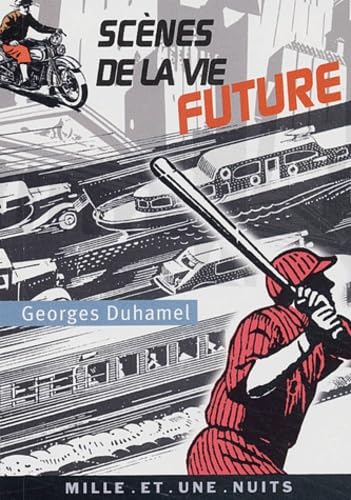
    Grandpa referenced someone named Duhamel in the excerpt, and I had to look that one up. In 1930, Georges Duhamel published a book called Scènes de la vie future, or in English, America's Menace: Scenes from a Future Life.  Like Dr. Planas, Duhamel was a French medical doctor who served in World War I.   In 1929, Dr. Duhamel visited the United States, arriving in New Orleans and traveling north along the Mississippi, then pausing for significant visits in Chicago and New York City.  


    His hosts introduced him to various aspects of America, trying to give him a genuine sense of the country.  He saw the slaughterhouses and the elevated train in Chicago, mass production in giant factories, and the subways of New York City. They also introduced him to our cultural influences, taking him to see museums,  architecture, movies, and sporting events.  He was impressed by our ingenuity and technical innovation, but horrified by our soulless consumerism and puritanical morality (he visited during Prohibition).  It doesn't surprise me that Arthur wasn't deterred by Dr. Duhamel's book.  As an engineer, he would have valued the booming industry and the efficiency it described.  

    Interestingly, I found a copy of Duhamel's book for $750. It's a first edition and is inscribed to H. G. Wells, of all people. I found myself wanting it for no good reason, because, damn, that's so cool (no, I didn't seriously consider buying it).  If you'd like to read more about the book, which many people consider to have planted the seeds of anti-American sentiment in Europe, this is the French Wikipedia page about it (I have my browser set to automatically translate).  The page is worth reading -- it makes many good points about American culture, but because this is my home, the scales weigh differently for me than they did for Duhamel. And if you are really interested, you can find the book in English on the Internet Archive, although you'll need to create an account to access more than the flyleaf and table of contents.

    And finally, it's fascinating to me that Grandpa worried about being insignificant here in the US, but happily didn't find that to be true.  I think most Americans know they are small cogs in a big wheel, but Grandpa was curious, hardworking, highly educated, and brilliant. And most importantly, he wanted to work somewhere that needed men like him, men who could point out a problem and then be given the freedom to solve it.  Even to a cynical American cog like myself, "I found here a greater freedom than I have ever had," gives me joy.

Je suis très heureux ici. Mon labo roulant d'un chantier de forage à une autre jonetiance tout seul, Après quelques difficultés de début, j’ai maintenant trois orienteurs connaissant leur métier et ayant une conscience professionnelle parfaite. Je me dévoue donc presque exclusivement aux travaux de recherche qui me passionnent. Avant d'émigrer je craignais que je ne devienne ici une petite roue d’un immense train d'engrenages.. Je pensais que l'entier visage de l’Amérique est comme les boucheries de Chicago (“Scènes de vie Future“ de Duhamel) ou, les chaînes de Ford à Detroit. Au lieu de-tout cela, j’ai trouvé ici une liberté plus grande que je n'ai jamais eue.
--Arthur Lubinski au Dr Jean Planas, 29 juillet 1948

Tuesday, May 20, 2025

1934-1947: Where my grandparents lived during the war (the good and the bad)

 I know of eight places where my grandparents lived in Europe in the 1930s and 1940s. I've found the addresses in my grandfather's writing, in letters from his brother-in-law, from archivists who looked them up in city records, and historian friends who traced previous owners of properties (when I knew the actual names of the people they lived with, but not the location of the property).  This doesn't count places my grandfather lived separately from my grandmother (when he was in the maquis, for example).

Of those 8 places (in chronological order)

  • One is the apartment where my grandparents were probably living when they got married in 1935. I don't know when they moved in, or how long they lived there, only when they moved out (and into their next apartment). 
  • One is the apartment in Brussels they were living in when my aunt was born and war broke out. They moved there on August 24, 1937, and moved out when they escaped from Belgium in the fall of 1941.
  • One is farm in France where they lived for several weeks in June 1940 as refugees prior to the fall of Belgium and France, before returning to their apartment in Brussels.  I know what town they were in, but that's all.
  • One Brussels address is almost certainly fake, or rather, it was a real address, but they never lived there.  They supposedly moved into the apartment 5 months after they'd escaped Belgium. I'm guessing it was some sort of false forwarding address (and I have evidence they were in France when they moved in according to Belgian city records).
  • One early address in France is unknown, and I doubt I'll ever identify it.  Grandpa told me they lived in three places in Beaumont-lès-Valence, but only ever described the one where they lived for several years. He refused to talk about the other two.
  • I identified one of the two Beaumont addresses Grandpa refused to discuss through letters he sent and received from an American consulate in Vichy, France. However, the address is incomplete by modern standards, identifying only the name of the homeowner and the town.  In those days "Chez Mouriquand, Beaumont-lès-Valence, France," was enough to get a letter to the right person.  My historian friend was able to identify that it was a farm and its physical location, but after the war, the farm was sold and developed into the Le Granges neighborhood, and we don't know which house is the one where they stayed.
  • The third Beaumont address is one where they lived for about three years. It had been a disused cottage on a farm, originally at 11 Rue des Faures. The cottage was torn down after the war, and the farm has also been developed into housing, but the stone well they used for water is still there (and is considered a historical landmark). 
  • The first address in Valence where they moved not long after the liberation of France (probably in late 1944 - I have a letter dated from December of that year, mentioning that they had moved). It was a tiny apartment. I got that address from letters he received from his brother-in-law in America, and it's also listed on my mother's birth certificate. From other letters, I know they were still living there in May 1946, but I'm not sure when they moved out.
  • The final address in Valence where they were living when they immigrated to the US in early 1947. They lived there less than a year.

1946-1947: The Lubinskis' last apartment in France

    Sometime after May of 1946, my grandparents moved out of the tiny apartment on Rue du Parc and into 19 Boulevard Maurice Clerc in Valence, where they lived until early February 1947. Grandpa didn't go into much detail, but this is how he described their two homes in Valence:

    In Valence, we lived at two other residences ... The first where your mother was born. And later, after, we moved into a more spacious, pleasant apartment. 

    Rather matter-of-fact. I only found the address because my grandfather listed it as his permanent address on a form he filled out in February of 1947 when going through customs at La Guardia in NYC:

Grandpa's Customs and Immigration form
Click to enlarge any photo.


    There were streetcar rails running very close to the buildings, and a park or green space was located on the other side, so the light coming into the apartment would be dappled. I found a couple of historical photos of the street on old postcards, but I'm unsure of the year they were taken.   

Maurice Clerc Blvd Postcard
Source: itoldya archives

Maurice Clerc Blvd Postcard
Source: itoldya archives

    The apartment faces slightly south of east, which means that early morning sun would blast in through the windows, particularly in the winter.

Red pin is #19.
The building is fairly deep front-to-back


Google Streetview photo from 2018. The brown door
is #19. I wonder what floor they lived on?
Note the black shelter in the left foreground.


A better view of the black shelter.

    I love the balconies. But I can just imagine my grandmother fretting about the safety of my mom and Aunt Lilly.

Google Streetview photo from 2024 showing cafe seating out front.
I wonder if Grandpa parked his car there, too?


    I couldn't find any photos of the inside of #19, but there's a hotel with rooms to rent just a couple of blocks away, at #5.  

The building with the reddish-orange balcony at left is #5.
#19 is pretty far to the right. It's a darker tan building with balconies,
just past the black shelter noted above.


    Except for this photo showing the view from #5, the interior photos aren't helpful as it's a different building, and it's been thoroughly modernized (though it's quite lovely):

View from 5 Blvd Maurice Clerc
Source: Hotels in Valence


    It's strange to know that my mother lived there, although she has no memory of it (she was only 14 months old when they left France).