Saturday, November 8, 2025

Mojo de Ajo (Garlic Oil Sauce)

I found this recipe in a vegan taco cookbook, and it adds fantastic flavor to a wide range of dishes. It's not a vegan recipe, per se, just a normal recipe that happens to be vegan.

Ingredients: 

  • 4 cups of a good, fruity olive oil
  • 2 cups of peeled garlic (this is a LOT).
  • 2 tsp of coarse salt 
  • 1 cup lime or orange juice
Instructions
  1. Pour the oil, garlic, and salt into a saucepan
  2. Boil the garlic until it turns golden and is soft enough to mash.
  3. Mash the garlic with a potato masher.
  4. Carefully stir in the citrus (it may bubble and sizzle).
  5. Boil for another 10 minutes, stirring regularly (the garlic will sink after it's mashed)
  6. Let cool, stir, and transfer to a jar. 
  7. Store at room temp (3 months) or in a cool dark place (6 months)
To make a spreadable version: substitute ghee/clarified butter for half of the olive oil. Here's how you clarify butter (it's very easy).  At room temperature, it will be very thick, but still liquid, and the garlic will still sink, so once it's cooled to room temperature, transfer to the fridge (still in the pan) and chill overnight. Remove from the fridge, stir the now solid mixture to distribute the garlic, and transfer to a jar. Keep refrigerated.  If you let it come to room temperature, it will re-stratify, and you'll need to chill and stir again, if so.  

If you need it to be spreadable at room temperature, increase the percentage of ghee. 

To keep it vegan, use refined coconut oil.

You can add other yummy flavoring agents like black pepper, cumin, or chili flakes to taste.

Saturday, November 1, 2025

Rosie's Roadhouse

Prompt - The Suitcase (500 words): You are staying overnight in a motel room. The previous guest has left a suitcase in the closet. It is slightly open and you can see a bundle of hundred dollar bills and the handle of a revolver inside. What else is in the suitcase, and who owns it? What happens when the owner comes back for it and knows you’ve seen the contents? Write a story describing the scene that unfolds.

*** 

   Rosie entered the room, pulling the cart behind her, breathing heavily, her heart pounding.  She wished she could take time off - chemo had really done a number on her - but these rooms wouldn’t clean themselves.  She flipped the security latch so the door wouldn’t lock and let it drift closed behind her.

    Rosie grabbed the scrubbing bubbles and a washcloth from the cart and went into the bathroom, noting her newly-thin body in the big mirror. “Only good part about about the Big C is I finally lost the weight.”  She didn’t like her skin, though. Under her clothing, stretch marks covered her breasts, belly, hips, and thighs. “Nobody ever sees those, so what do I care?”

    Rosie kicked the damp towels toward the cart and went to work wiping down the bathroom, ignoring the painful pins and needles in her hands.   When she finished, she remade the bed, tidied up, and gathered up the dirty laundry, depositing them in the cart.  Finally, she did a once-over.  

    “Bed’s done. Bathroom’s done… water glasses not used … Gideon’s in the bedside … hangers. gotta check those.” 

    Rosie went to the closet and pulled it open.  “Huh. A suitcase. Wonder what they left me?”  

    She grabbed the handle and tried to lift it, but it was heavy. Fortunately, it was one of those new-fangled kinds, and it glided easily on wheels. She dragged it across the room and, with a big heave, got it onto the bed, wrinkling the bedspread in the process. She unzipped it, and hauled it open.

    Loose diapers and a pacifier sat on top but didn’t hide the green stacks of bills nearly filling both sides.  And tucked down next to the money was a stubby-barreled revolver. “Ruger Alaskan,” she said, recognizing the model.

    Rosie’s heart started to pound. And it wasn’t the chemo this time.  She looked around. “Door’s not locked.”  She ran across the room, but just as she reached the door, someone pushed it open.

    Rosie didn’t know who was more surprised, her or the woman standing there.  They stood frozen, staring at each other.  The woman was tall and young and wearing a T-shirt and sweats. No makeup. The sweats sagged low on her skinny hips, revealing her own stretch marks.

    “I guess we’ve both lost a lot of weight,” Rosie mumbled, then wanted to kick herself.  

    The woman just looked at her. “I left my suitcase…” she said, her eyes drifting past Rosie.  She strode to the bed and paused for a moment - Rosie sure hoped she wasn’t grabbing the gun - then closed and dragged the suitcase to the floor.  She smoothed the wrinkles out of the spread, then came to the door, pulling the case behind her.  “Here,” she said, thrusting a brick of bills into Rosie’s hand. “You never saw me.”  

    Rosie nodded, watching her leave. There was a Baby on Board sign in the back window of the woman’s car.   

    Rosie smiled ruefully. “I guess I’ll be able to pay the docs, after all.”

--April 12, 2020

Sunday, October 12, 2025

1941: The Valence Beat Cop (Deleted Scene)

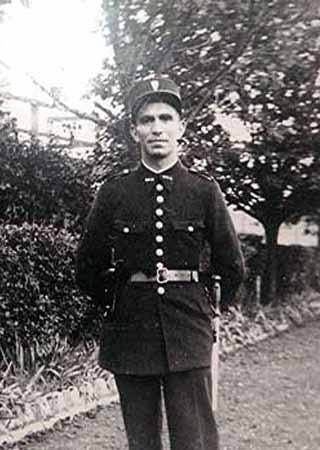
Henri Mosmeau, Paris Police, and a member of the Resistance.
He died in 1944, defending Paris against the occupiers.
Source: France24

    As I've studied WW2-era France, I've noticed a curious trend, a divergence of sorts between two classes of police officers:

  • Group 1: Collaborators.   Police officers tend to favor law-and-order, and are often comfortable enforcing tighter restrictions. They do their job, regardless of who they are working for.   The French police forces were responsible for rounding up a LOT of undesirables so they could be sent to detention camps, and this group absolutely helped carry out the Holocaust.
  • Group 2: Resistors. There were a few who did what they could to help the Resistance, including warning the different units of impending raids.  As far as I can tell, this group was far smaller than the above, but they did exist.

    Really, there was a third group, probably the single biggest:  they did what they were told, but didn't like it. They knew it was wrong, but not knowing what else to do, they did their job anyway. I tend to include these men with the first group, because even unenthusiastic collaboration caused serious harm when the collaborator was in a position of power. 

    I wrote a scene that was intended to be a tribute to the second group, the police officers who did what they could to protect the people from Vichy or Nazis abuses, often at the risk of their own lives. I imagined this man later helping people join my grandfather's maquis unit, and sending them intelligence when he could.  It's a good scene, one I intended to be funny, but it no longer fits in the book (they would have arrived in the afternoon, not in the wee hours as depicted below).   

    Anyway, here's the scene:

    Arthur shook Roma awake, and they sleepily stumbled off the train in Valence.

    Too tired and cash-strapped to look for an inn, they found an unoccupied bench at the train station and made themselves as comfortable as possible. Arthur removed his shoelaces and used one to tie his briefcase to his wrist.  He shoved the suitcase under the bench and tied the handle to his ankle.  Then they covered themselves with their coats, and he and Roma fell asleep cuddled together, Liliane on Arthur’s chest.

    Something tapped Arthur’s shoe.  Arthur ignored it.  Then whatever-it-was smacked his shoe again, hard enough to hurt.  Arthur woke up and found a police officer standing over him.  Arthur jumped to his feet, nearly catapulting Liliane off his chest before Roma snatched the baby from him, which she did as neatly as if they had practiced the maneuver.

    “Yes?” he said as politely as he could, trying to keep his balance with the suitcase tied to his ankle and briefcase dangling from his wrist. He felt both frightened and utterly foolish.

    “You can’t sleep here. This isn’t a hotel.” The policeman was obviously trying not to laugh.

    Arthur took advantage of the man’s mirth and gave him an embarrassed smile. “Yes, I am sorry. We got in at 1:30, and nothing was open. We will not be staying.”

    “Best untie yourself before moving on,” he said, grinning slightly. “Clever idea. Ridiculous, but clever.”

    “Uh, thank you. And yes, I will.”

    “The markets are starting to open,” the officer added, “if you want something to eat, you should go early.”

    Arthur glanced at his watch. It was now five-thirty, and there were a few early morning travelers milling around.  “Oh, good.” He sat back down and untied his luggage, and re-laced his shoes.   When they stood, the policeman wandered off, though he kept an eye on them as they left the train station.  

Saturday, October 11, 2025

1947: La Guardia, not Ellis Island


    I've always known I came from immigrant stock. I mean, it's kind of hard to miss when your grandparents had a name like Lubinski, spoke 3 languages, and had an accent.  I think I was 10 before I realized that when Grandma Roma said très bien, she wasn't actually speaking English. I knew what she meant.

    I'm not sure when I realized they were also refugees, Holocaust escapees, and that they went through something so terrifying, so traumatic, they rarely talked about it.  No, not the concentration camps, though they had relatives who survived the camps. And relatives that died in them, too. My grandparents survived by hiding.

    Anyway, I grew up assuming that they had gone through Ellis Island, which has a certain romanticism. However, when my grandparents and their older two daughters (one of whom is my mom) came here, they did so not by ship, but on an airplane.  They flew into LaGuardia Airport in New York City, decades before JFK was built.

    They had intended to take a ship across the Atlantic, specifically the SS Île de France. They had booked passage and everything, but then the French government requisitioned it as a troop transport for the war in Indochina. That one surprised me, because I hadn't realized that the roots of the Vietnam War reached so far back.  

    The ship wore many hats: a luxury ocean liner, a prison ship, a troop transport, and a movie set.  The women of the 6888th Central Postal Directory Battalion took the ship from the USA to England during WW2, and from what I can tell, it was more prison ship than luxury liner at that point.  In the late 50s, it was purposely sunk during the filming of a disaster movie, refloated, and quietly scrapped.  

    Anyway, my grandparents had to scramble to find alternate transportation and eventually got airplane tickets.  My grandmother was terrified to fly; for the 2.5 months before they left, Grandpa snatched the newspapers before Grandma could get to them, skimmed the papers for stories of crashes, and cut them out so she wouldn't see them.   I have no idea what he told her, or even if there were any airplane crashes at all during that time, but there you have it.

    So they went through customs and immigration not at Ellis Island, but at La Guardia Airport, and I imagine they were grateful to be on the ground again (my aunt was 6 1/2 years old, my mother was 14 months old, and I understand that both girls cried a lot, so I'm sure it was a flight from hell).  

    And when they emerged from customs, my grandmother's brother was waiting for them. I imagine it was a bittersweet scene.

Wednesday, October 1, 2025

Salvadore Dalí and the Alien Foster Father


Prompt - A Gun to the Head (60 seconds). Your main character is in a life-and-death situation, a gun to their head. Write out their internal thoughts or their final monologue in that moment, their final 60 seconds. Try to convey the frenetic energy and chaos they are experiencing. Bildungsroman is a literary device whereby the plot is played out through the growth and changes of the main character. This might be a social, physical, emotional, moral, or mental change. In the case of flash fiction, the change needs to be accelerated, like the final thoughts running through the mind of a character with a gun to their head. NOTE: It’s possible to read 200 words in 60 seconds.

Note: This is a rare bit of fan fiction. :-)

***

    The alien serving as my Foster Father spoke. “It will take a minute to charge. But when it fires it will silence your thoughts, and stop your heart. We will revive you after 37 seconds.”

    “Why 37?” I asked, glad a human medic was standing watchfully by. I trusted Foster Father, but he was concerned that he didn’t yet understand human physiology well enough to bring me safely back.

    “Tradition. That is how long our first foremother stopped her daughter’s heart in order to gain the trust of her rival clan. After that, they created a treaty that still stands today.”  He pointed at one of the paintings on the wall. "I painted this to represent that parent-child bond."

    I nodded, and he continued. “This ritual will cement your trust in our family and society and help you confront death, for no one can be an adult without understanding their own mortality. It is what marks full adulthood in our culture.”  He lifted the device to my head, and I felt him speak directly to my thoughts. Lizbet, are you ready? 

    “Yes.”

    With steady hands, he pulled the trigger, which started charging the device.

    Will it hurt? I can’t believe I agreed to do this. The passage to adulthood rite. Passage rite. Rite of passage. Rite. Right? What if they are unable to revive me? What do I do if it doesn’t work? Mom’s gonna kill me is this is it worth it?  Will it hurt? What happens when I wake up?  Will Star Fleet court marshal me they didn’t authorize this, but I did bring the medic.  It’s going to hurt I don’t want to die. I hope there are no bullets in that thing. His hand isn’t shaking at all oh my god oh my god. When is it going to happ— 

-     -     -     -     -

-     -     -     -     -

-     -     -     -     -

-     -     -     -     -

-     -     -     -     -

-     -     -     -     -

-     -     -     -     -

-     -

    Lizbet.

    “Yes, Foster Father?” I said, but it came out slurred. Yesh, Fosher Fozherrr.

    Lizbet, he repeated, not seeming worried. Use my language.

    I had to think about that.  “I did. I said, ‘Yes, Foster Father.” I tried to enunciate but wasn’t sure if I was any easier to understand.

    Much better.  Now, are you ready to help us sign the treaty? We are ready to join your Federation.

    “Yes,” I said, opening my eyes. The medic was relaxed now and looking avidly at Foster Father’s artwork adorning the Rite room’s walls. 

    Foster Father was patient as thoughts and senses returned, and then he helped me up, and we left to join the ambassadors in the formal meeting room across the courtyard. “Who is ‘Dalí’?” he asked aloud, reading my thoughts and probably those of the medic’s.

    “A human surrealist painter,” I said, feeling myself smile. “You’ll like his work. I’ll show you pictures later.”

    “That would be excellent,” Foster Father said.

***

Notes: I wrote most of this bit of Star Trek fanfic in May of 2021, but couldn't figure out how it should end. Inspiration hit in January 2025, and I added the waking up section then.

Thursday, September 11, 2025

May-June 1940: The Exodus in a Peugeot 402 Longue/Familiale

     As I mentioned earlier, the taxi my grandparents used to escape the invasion of Western Europe might have been a Volvo PV 802, which, according to an internet source I found somewhere, was the more likely candidate out of the two possible models, so planned for the taxicab to be a Volvo.

    Well, I've changed my mind.  I've decided that the other possible model, a Peugeot 402 Longue (long), also called a "familiale," is the one I'm going to go with.  Here is why:

Peugeot 402 Familiale retrofitted with a wood-gas generator.

According to Wiki:

    In 1939 Peugeot were already investigating the adaptation of petrol/gasoline engines to run on gas created by the controlled burning of charcoal. The technology would prove particularly suitable for the long bodied Peugeot 402 ... On the car it was possible to fit the necessary components without excessive modification of the bodywork. A charcoal burning boiler, able to accommodate 35 kg of charcoal, was mounted on a stout platform at the back of the car. This provided sufficient power for approximately 80 km (50 miles) before more charcoal needed to be taken on board. The controlled burning of the charcoal produced carbon monoxide, known as gazogène, which was captured and transferred in a stout pipe mounted on the outside of the right-hand C-pillar to a roof mounted gas tank. From there another stout pipe mounted on the outside of the right hand A-pillar drew the gazogène down to the engine. Between 1940 and 1944 more than 2,500 Peugeots were equipped with a gazogène fuel system.

    My grandfather helped develop that very fuel system!  On a memorial page to him, it says, "Before World War II he worked on the development of devices generating motor fuel from coal," and I took that to mean he worked on Coal Liquefaction technology.  But when I looked back at a copy of his CV, I found the following: "In his first job, he worked on the development and manufacturing of a gas generator used in wartime for the propulsion of civilian buses, trucks, and cars. Gas, produced in the generator from coal, charcoal, or wood, was used in conventional internal combustion engines."

    Gazogène fuel systems, also known as wood-gas generators, burned wood or charcoal, which creates a producer gas, a mixture of nitrogen, carbon monoxide, hydrogen, and methane. It's filtered and then piped into an internal combustion engine. But you could run a car for about 50 miles with 80 pounds of charcoal. Not very efficient, but better than nothing in a world without gasoline.

    When writing stories, you try to reuse characters and themes as much as possible to create an interconnected world. This model of car was particularly well-suited to a wood-gas fuel system, and when installing the system, Arthur would recognize the car where he spent two miserable weeks of his life.  It's a connection, not between people, but between artifacts

    Anyway, here's a video that thoroughly explores a 1936 model (it's in German, so if you don't speak the language, you can leave the sound off). Just skim through it to see the interesting bits, including how the jump seats fold down from the back of the front seats. You'll also notice there's a lot of leg room without them, but almost none when they are in use.   It shows the gas tank, the trunk space, and even how you access the engine compartment (the panels lift up on either side of the engine like gull wings).   


Monday, September 8, 2025

1939: Teofila's Brooch

Source: DropofDifference. Used with permission.

 My great-grandparents on my mother's side lived in a very similar manner. They also owned vast amounts of land, which was cultivated by tenants.

--Liliane Lubinski McCullar, 1955

    I grew up hearing stories of my great-grandparents, who had been very wealthy, but lost nearly everything (I think) during the depression that followed the stock market crash of 1929, and what remained was confiscated after Poland was invaded by the Nazis in 1939.  But there is family lore about my great-grandmother Teofila's brooch, a bit of inherited wealth that she held onto as long as she could. Supposedly, it had two big diamonds and many small diamonds.  

    Anyway, her son Jakub was a brilliant student, a mathematical prodigy, and he wanted to study physics and engineering, but wasn't allowed to study at the University of Poland due to the racist numerus clausus policies implemented across the nation.  But Teofila's husband, my great-grandfather Isak, was opposed to Jake leaving Poland. She didn't agree, and to fund their son's travel and living expenses for his studies at the University of Brussels, Teofila sold one of the big diamonds without her husband's knowledge.  

   When Isak found out that his own wife had given Uncle Jake the means to leave, Isak got so angry that he hurled a big ring of keys across the room, smashing a bunch of glassware in the process.  My grandma was present; Roma was their youngest child, and she would have been about 12 years old at the time. Grandma told us later that she had never seen her father act with such violence before. She (understandably) found it pretty scary.

    Then, around 1928, when Uncle Jake wanted to get an advanced degree from a school in the United States, she sold the second big diamond to send him to America. That's why he was able to ride out the war in the United States (he became a citizen in 1942) while the rest of the family was trapped in occupied Europe.

    We know what happened to only one of the smaller diamonds. It wound up in my Grandma Roma's possession, and she brought it with her to the United States in 1947, and wore it on a ring. I don't know for sure when her mother gave her the diamond, but I think perhaps it was during Roma's last visit to Teofila in Łódź in late August 1939, just days before the invasion of Poland.  We don't know what happened to the rest of the small stones. Did she give them to Roma, who was pregnant at the time? Or did she use them to buy safety for herself, her husband, and her oldest daughter, Lola?  Or were they just confiscated by the Nazis?

    Anyway, I do my best written descriptions when I can SEE the item I'm describing, and in this case, I imagined a glammed-up snowman (or figure 8) surrounded with diamonds like an aura, and that struck me as being quite ugly.  I also had no idea what jewelry styles from the 1800s even looked like, so I did some internet searches ("vintage brooch two big gemstones surrounded by small gemstones") for a piece of vintage jewelry to use as a model for Teofila's brooch, because the sparkly snowman design just wasn't doing it for me.  I eventually stumbled on the one in the picture in an Etsy listing.  It's massive, about 3.5" (8 cm) tall and 2.6" (6.5 cm) wide, and it is almost certainly much larger than Teofila's actual brooch, as the remaining small diamond was much smaller than the ones shown.   

Source: DropofDifference. Used with permission.

    The Etsy listing describes it as an antique setting from the 19th century (Georgian/Victorian), a sterling silver and quartz brooch. You can see more pictures here (many thanks to Marie from DropofDifference for granting me permission to use her photos).

    I imagine Teofila would have sold the bottom diamond first (because she could have the entire dangling part removed, and it would still be a nice brooch) to send Jake to Belgium, then the big central diamond to send him to the United States.  I like to think my great-grandfather changed his mind about the wisdom of his son leaving Poland. Isak and Teofila Najfeld died in 1942, but I imagine they were glad that at least one of their children was somewhere safe.