Thursday, September 4, 2025

Spring 1942: The Miller's Tale (deleted chapter)

     Then, at nighttime, the grain which I got, I put in a buggy, which I pushed myself, a couple of miles to the mill. The mill was a water mill, and the miller took half for himself, and half he gave back to me in form of flour.

--Arthur Lubinski, 1988

    As I write (and in this case, re-write) the book, I try to imagine what the mill and miller were like. I read up a little on water mills, and I found myself totally geeking out about how they worked.  And if I geeked out over this ancient technology, then I'm certain my grandfather would have, too.

    However as much a I love this scene, it doesn't move the story forward (like at all) so I killed off my darling (an intimidating miller) and his super cool mill.  Enjoy.


The Fountain Mill in Beaumont-lès-Valence

The Miller's Tale

    Very late Saturday night, he loaded the winnowed grain, which now filled the big bucket and was quite heavy, into Mr. Durand’s cart and took it to the miller.  The mills were monitored too, but less stringently.  Perhaps because flour was more perishable than grain?  

    Mr. Durand told him that the miller ground the illegal flour at night, and to avoid suspicion, he also regularly ground legal flour at night.  

    When he got close to the mill — he could hear the river — he left the cart in a small stand of trees and, trying to be surreptitious, approached the mill.  The lights were on, and the wheel was turning, though he realized that did not necessarily mean the mill was in use; a gear inside could probably be engaged or disengaged to turn the millstones. He walked in a wide circle, looking for signs of surveillance but saw none.  He picked up the bucket, lugged it to the mill door, and knocked.  

    The miller opened the door.  He was a big man, but unlike most Frenchmen, he was merely trim and not skinny. He was dressed plainly, wearing an apron over his work clothing. He looked at Arthur and waited for him to say something.  When Arthur did not speak, he finally asked, “You have some grain?”

    “Yes.”

    “Well, bring it in.”

    Arthur carried the heavy bucket inside and set it down.  He gazed at the huge stone wheels at the room’s far end.  There were two, one stacked on the other, with a metal shaft rising from the stones and into the floor above, and a second, massive wooden shaft stood next to the millstones, extending floor to ceiling.  

    Before the miller started on Arthur’s grain, he explained the rules. “I take 50% of whatever I grind illegally.”

    Arthur stopped looking at the millstones and gave the man his full attention.

    The miller went on. “Yes, I use it to keep my family well-fed and comfortable because they are more important to me than anyone else in France, and in these Godforsaken times, I should be well-paid for the risk.”

    Arthur was not accustomed to such plain speech about dangerous activities, particularly from a stranger.  Having no idea how to respond, Arthur simply nodded at what he hoped were the appropriate times.

    “The leftover, however, I give to the very hungriest of people. It is in your best interest to never tell anyone what I am doing for two reasons: One, word gets around, and no one else will grind grain for you, and two, because there will be reprisals.  I feed many people, and they will be … disappointed if their flour source disappears.  Do I make myself clear?”  The miller stepped slightly closer and stared into Arthur’s face.

    Arthur was intimidated, which he knew had been the miller’s intent. “Very clear, yes. I have no intention of talking about you to anyone.”  Arthur also realized that the man was risking his life, so perhaps his threats were appropriate.

    “Good. Nice to meet you.” The miller stuck out his hand. 

    Arthur realized that the handshake was not just a greeting but a promise, an agreement.  He shook the miller’s hand.

    After releasing Arthur’s hand, the miller hooked the bucket’s handle to a chain hanging through a trap door in the ceiling and hoisted it up through the opening. He then climbed a ladder to the floor above. 

    He could hear the miller dump the grain all at once into a hopper, which he guessed was metal from the sound.  The miller descended the ladder to the basement, where he apparently engaged a gearing mechanism, and the upper millstone began to turn.  “May I come down to see the machinery?” he called.

    “Of course!” the miller answered from the floor below.

    Arthur climbed down and found the miller affixing a flour sack to the bottom of a chute.  Arthur examined the system of gears and grinned. It was ingenious. He knew from his studies that the Romans had designed the apparatus two thousand years ago. Modern engineers had merely improved it.

    The miller caught Arthur’s smile. “I see that you admire it.”

    “Yes. I am an engineer. We studied the technology a little at University.”

    “Then you’ll be interested to know that 20 years ago, I converted it from a breast shot wheel to a backshot, which increased the efficiency from 50 to about 90%.”

    “You are an engineer, too?” Arthur asked in surprise. 

    “No. I studied engineering for a year, though. My father wanted me to finish, but when he got too sick to run the mill, I came home.  But, I’m smart enough to know a good idea when I see one.”

    Flour started pouring down the chute and into the flour sack.   When the grinding was complete and no more flour came out, he disengaged the gears. He carried the flour to a set of big scales and removed half, which he dumped into a barrel.  He handed Arthur the sack of flour. “Save the sack for next time. Supplies are limited.”


Tuesday, September 2, 2025

May-June 1940: Eight People and one baby packed like sardines into a Volvo PV 802 taxicab

    I rented a taxicab – and in the taxicab, big taxicab: Roma and myself and the baby Lillian, a few days old, and my father and my mother, and Felicie, who was like family, and in addition, the cab driver and his wife and a child, were all squeezed in one big taxicab.

--Arthur Lubinski, 1988

    During the 1940 Exodus, my grandparents escaped the invasion of Western Europe in a taxi, traveling from Brussels to Montreuil-sur-mer, a trip that normally took three hours, but took them 2 weeks.  Most refugees were on foot or bicycles; cars, while there were enough of them to clog the roads (particularly after being abandoned due to lack of fuel), they were comparatively rare.  However, my grandfather had several serious issues to deal with: his wife was one week postpartum, his father was elderly, and his mother was late middle-aged and had tuberculosis.  I imagine that he felt there were only two choices:  either stay in Brussels as it fell to the Nazis, or find transport that would allow them to ride.  They took the second option, but probably should have taken the first, given that they ended up returning to Brussels six weeks later.

    Anyway, they needed an eight-seat taxi: seven adult passengers and one child (plus a newborn, but she rode on my grandmother's lap).  There weren't that many taxis in 1940 that carried 8 passengers. There were a few American models that did, and a few of them were imported (primarily to southeastern Europe), but they were uncommon in Belgium and France.  I did find two eight-seat European models, though: the Volvo PV 802 and the Peugeot 402 Familiale.  Both are essentially six-seaters, but with additional seating that could fold out as needed.

    Of the two models, research suggests that the Volvo was perhaps the more likely vehicle. The pages I looked at didn't explain why it was more likely, but I'm going with it. (Added: I changed my mind and am going with Peugeot).

Click on any photo to enlarge.

The Taxi:

1938 Volvo PV802. Volvo Museum. Photography by Serhii.
See the end of the article for more pics of the car.

    It had two large bench seats (front and back). The foldable jump seats were situated between the two rows of seating, and could be tucked away when not in use (though the legroom surrounding the jump seats must have been minuscule).  It was also designed to be a small ambulance - the right side of both bench seats could fold down, and a stretcher could be loaded through the trunk.  (If you are interested, there are more photos of the taxi at the end of this article.)

    Note: Belgium didn't have standard taxi colors in the 1940s. It could have been any color.

The Travelers: 

    This little band of travelers spent about six weeks together, first on the road, then as refugees on a dairy farm in Montreuil-sur-Mer, France.

    First, we have the taxi driver, his wife, and their child. Their names have been lost. I know they existed, but I have no idea who they were or what happened to them after they returned to Brussels in June of 1940.  I named them Marc and Violette D’Abruzzo, and their 9-year-old son Robert.

    But the rest of the people in the car were my family (photos from their Belgian naturalization files):


Great-Grandfather Herman Lubinski,
circa 1926.

    The 63-year-old Herman was a businessman who owned his own agricultural commodities trading company. He was resourceful, but he did a poor job of planning for the future, spending money freely when he was flush with cash, only to face periods of complete financial hardship when he ran out of money.   Eventually, (in 1941 or 1942), his business was seized, and he was imprisoned in Breendonk concentration camp, but he miraculously escaped (!?!) and survived the war by hiding in a retirement home.  

Great-Grandmother Micheline (Mascha) Lubinski,
circa 1926.

    The 58-year-old Mascha Lubinski was a highly intelligent woman who led salons in her home, inviting philosophers, artists, and scientists to discuss the great topics of the day.  My grandfather was very close to his mom and credited her with making him the generous, ethical, and hardworking man that he became.  She contracted tuberculosis at some point and survived the occupation by feigning mental illness and hiding in an asylum.


Félicie Turska, circa 1931

    Félicie Turska, aged 46, served as a housekeeper for Herman, who fell in love with her.  He married Félicie after Mascha's death. I think she was a lovely woman, but she looks high as a kite in the photo.  And my great-grandfather Herman must have had real chutzpah to travel with both his wife and his lover in the same taxi. Can we say tense and awkward?

    Interestingly, Herman's sons (by his first wife), Arthur and Paul, had different attitudes toward Félicie. Arthur resented her for her relationship with Herman, while Paul seemed to have accepted her as his stepmother, and my cousins in Belgium tell me she was very kind and that she was the only grandmother they ever knew.  


My grandparents, Arthur and Roma Lubinski
at the time of their 1935 marriage
   
    Ohmygod. My grandfather's hair!!! It's so ... tall!  Even before he lost his hair, he kept it short and much neater than in this photo (according to the family album, anyway).  


1938 Volvo PV802. Volvo Museum. Photography by Serhii.


1938 Volvo PV802. Volvo Museum. Photography by Serhii.
Note the rear luggage rack (most didn't have that) and the dinky trunk.

Monday, September 1, 2025

Recipe: Roma's Neighborhood Soup (AKA: Chicken noodle soup with egg drops) - Meaty and Meat-free Versions

     My grandma, Roma Lubinski, was a fabulous cook, and when my mother and aunts were growing up, Grandma Roma often found herself with a bunch of neighborhood children running through her house. Having gone through the deprivations of WW2, she simply couldn't allow a child to go hungry.

    So, she invented an inexpensive, fast, and easy soup that someone dubbed "Neighborhood Soup" (because she was feeding the neighborhood!), and the name stuck.  My mom, her sisters, and all of their friends loved it, often requesting the soup if they happened to be visiting. It is also great when you're feeling under the weather.  

I emailed my mom and aunt and got the recipe, and now I'm sharing it with you. 

Note: I'm still refining the recipe, so it might change a little over the next few weeks.

Egg Drops (both versions below):

My grandmother's recipe was based on the Austrian dish Eierflockensuppe, or "egg flake soup," in that she mixed flour into the eggs before dropping them into the boiling broth.

Beat 2 eggs thoroughly. Add 1 tbsp of water, and 2 tbsp of all-purpose flour into the egg mixture, and beat well.

Bring the soup to a gentle boil, and drizzle the egg mixture into the broth, stirring slowly and occasionally. For chunkier egg drops, spoon them in without stirring.  If it gets crowded, just push the already hardened egg drops aside to make room. Simmer for 3 minutes and serve.

Instant version (meaty):

Prepare egg drops (see above) and set aside.

Make Lipton Chicken Noodle Soup according to the manufacturer's instructions.  After the soup has simmered for 1-2 minutes, add the egg drops. Simmer until the noodles are cooked, and then serve.

Homemade version (meat-free or meaty):

I've been a vegetarian for 25 years, so when I got a hankering for Neighborhood Soup, I developed a meatless version, which is a little more involved since pre-made vegetarian chicken noodle soup mixes don't exist.  So, from scratch it is. However, for those who eat meat, use real chicken and chicken broth, where the substitutes are listed

  • Chicken substitute of your choice, preferably one that doesn't have breading (I like Gardein chicken products, but small cubes of tofu will do in a pinch). 
  • Carrot, 1 large, sliced
  • Celery, 1-2 stalks, sliced thin
  • Onion, 1small, roughly diced
  • Frozen peas (optional) - 1 cup
  • Garlic, sliced - to taste (lots!)
  • Fat (butter or olive oil) - 2-3 tbsp
  • Umami flavor to taste (about 1/4-1/2 tsp of MSG, or 1+ TBSP of miso, or 1 tsp mushroom umami seasoning blend)
  • Seasoning to taste (1/4 tsp - 1 tsp of some or all of the following: turmeric, rosemary, thyme, red pepper flakes)
  • Better than Bouillon No Chicken Base
  • Fine egg noodles - 6 ounces
  • Parsley, finely chopped - 1/3 cup fresh, or 1 tbsp dried
  • Chives, chopped - 1/4 cup (optional)
  • Fresh ground black pepper - to taste
  • Lemon - squeeze a tsp or so over the top of each bowl before serving (optional)
  1. Prepare the chicken substitute as per the manufacturer's instructions. Cut it into small chunks and set aside.
  2. Prepare egg drops (see above) and set aside.
  3. Place carrot, celery, onion, and fat into the bottom of the soup pot, and saute until slightly browned. 
  4. Stir in umami flavoring and seasonings, and 4 tsp of Better than Bouillon (this is about 1/2 the amount called for on the jar, but it's very salty). Add the peas if using.
  5. Add 8 cups of water and bring to a simmer. Taste the broth - if it's not flavorful or salty enough, add additional Better than Bouillon base, 1 tsp at a time, until it tastes right. Bring to a simmer, and cook until carrots are almost soft.
  6. Add egg noodles and cook at a full boil for 1 minute.
  7. Add egg drops (see above) and cook for 3-4 minutes (the noodles should be slightly al dente). 
  8. Add the chicken substitute, black pepper to taste, parsley, and chives.
  9. Ladle into bowls and squeeze a little lemon over the top of each bowl.
Note: You can use whatever size or style of noodles you like, but you will need to adjust the timing somewhat - add the egg drops about 3 minutes before the end of the noodle cooking time.


Nobody Goes There

 Prompt - Nobody Goes There (300 words): “Nobody goes there anymore. It’s too crowded. “– Lawrence “Yogi” Berra, The Yogi Book: I Really Didn’t Say Everything I Said (1998). Use this paradoxical line as the catalyst for your story.

***

    Jenny went to her support group, as she did every Thursday.  A support group for introverts with severe social anxiety was something of a paradox, but they made it work by placing dividers - spoke-like - between the chairs.  Jenny could see the people across the circle from her, but they were comfortably distant. She couldn’t see the people on either side of her, and that was helpful, though their voices were annoying, loud, and … close.

    The problem with being an anxious introvert, as far as Jenny could tell, is that humans need contact with others.  Without it, they shriveled up inside.  Hell, babies that didn’t get held enough could actually die.  And Jenny was so lonely.  Soul-suckingly lonely.  

    The therapist spoke up. “This week, I’d like each of you to go to a state park and walk the trails.”  

    The person to Jenny’s left cleared their voice and then spoke up. “With the pandemic restrictions being lifted, state park usage is up 800% in Minnesota.”  It was John’s voice.  “Nobody goes to the parks anymore. It’s just too crowded.” John was plain-looking, but his eyes were very kind. 

    Despite repeated encouragement from her therapist over the last year, she’d avoided asking him out, but now the loneliness was overwhelming her. 

    Jenny’s favorite state park was far to the northwest, hours from any metro area, and she knew it wouldn’t be crowded.  Her heart pounding, she pulled out a sheet of paper and wrote John, I know a park that won’t be crowded. Maybe we can go together? - Jenny, and passed it around the divider. 

    A minute later, he passed it back. Her legs felt rubbery, and her stomach clenched as she unfolded the note, wondering if a yes or a no would be worse.

Jenny, I would love that. Saturday? - John

--June 21, 2021

Friday, August 29, 2025

May 1940: L'Exode (The Exodus) or "The traffic jam from hell"

French refugees on the road of the Exodus, 19 June 1940, near
Gien, France. CC-BY-SA 3.0.
This photo was taken by a German soldier.

    Between May 10, 1940 when the Germans invaded western Europe, and the end of June, when France surrendered, a massive migration, one so biblically enormous, it was given the name l'Exode (the Exodus) in France.  

    The 8-12 million affected people were a mixture of refugees from Belgium, Luxembourg, and the Netherlands, but also internally displaced persons (IDP) from within France itself, and they all had the same goal: to get farther from the front, to find safety.

    Regardless of nationality, people sort themselves into three groups in tense situations: 1) the exceptionally good people who rise above the situation and try to help those around them; 2) the genuinely bad people who heartlessly take advantage of the desperation of others; and 3) everyone else, the desperate masses who just do what they can to survive.  This last group is massive, usually comprising over 90% of the participants. 

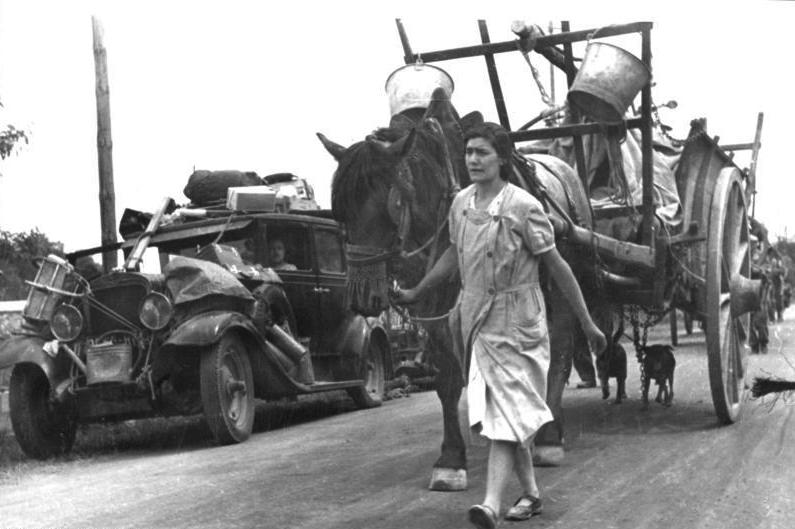
    It's hard to capture what the Exodus in 1940 was like, and hell, it's hard to even imagine it. Millions of people were on the road, stuck in a traffic jam from hell that lasted not hours, but weeks.  People were on foot, on bicycles, in horse-drawn carts, or in automobiles.  But mostly, they were on foot.  The average speed was 1-3 miles (2-5 km) per hour.

    There was a heatwave, and there wasn't enough food, water, or fuel. There were no sleeping arrangements, showers, or even toilets.  People were packed closely together with their dogs and horses, and surrounded by clouds of automobile exhaust.  The smells must have been intense.

    There were constant threats of crime, violence, and chaos. People were beaten for their food. Women were raped. Children were occasionally separated from their parents (sometimes permanently), and war profiteers charged people exorbitant fees for sips of water, and a simple sandwich might cost a week's wages. 

    And the Luftwaffe and their dreaded Stuka dive bombers made a habit of not just strafing Allied soldiers, but columns of refugees as well. There are a couple of scenes in the 2017 movie Dunkirk that show what it was like:


    Note: that weird high-pitched whining sound that sounds like an anvil dropping on Wile E. Coyote's head (link to short clip that includes the soundwasn't an air-raid siren, nor was it an artifact of the Stuka engine noise. Rather it was psychological warfare in the form of ram-air sirens mounted on the Stukas themselves.  They were called "Lärmgerät" (noise devices) but despite popular myth, they were not really called "Jericho Trumpets" (which is what I think the whistles on bombs were called).  Most common was probably "Stuka Siren".

    My grandparents and great-grandparents joined the Exodus of 1940. And they did it with my newborn Aunt Lilly, my grandmother, who wasn't producing enough milk (probably due to terror and the deprivations of the trip itself), and my great-grandmother, who suffered from tuberculosis.  My grandfather told me about the taxi he hired (but not how they avoided running out of fuel), about the traffic jam, but not how long they were on the road, about who he took with him, but not about their misery.  He summed up the experience in a single word: pathetic. I think he was describing not just the stasis of the troops, but how he and his family felt.


     So after Lillian was born, and as soon as we could move – I didn’t have any car at the time, so I rented a taxi cab – and in the taxi cab, big taxi cab: Roma and myself and the baby Lillian, a few days old, and my father and my mother, and Felicie who was like family, and in addition the cab driver and his wife and a child, were all squeezed in one big taxi cab. We started escaping from Brussels. 

     Well, you couldn’t do more than ten miles a day at most, because the highway was crowded and millions of people who remembered the war – the first World War, 1914 to 18 ... So they wanted to escape and be on part of France where the front would never arrive.  So millions of them were moving; including fire trucks with people on it. And including ambulances with people on it; etcetera, etcetera. Completely packed by millions of people. And English and French and Belgian troops couldn’t move because of the civilians packing the highways.

     It was pathetic.

--Arthur Lubinski, Oral Testimony, 1988


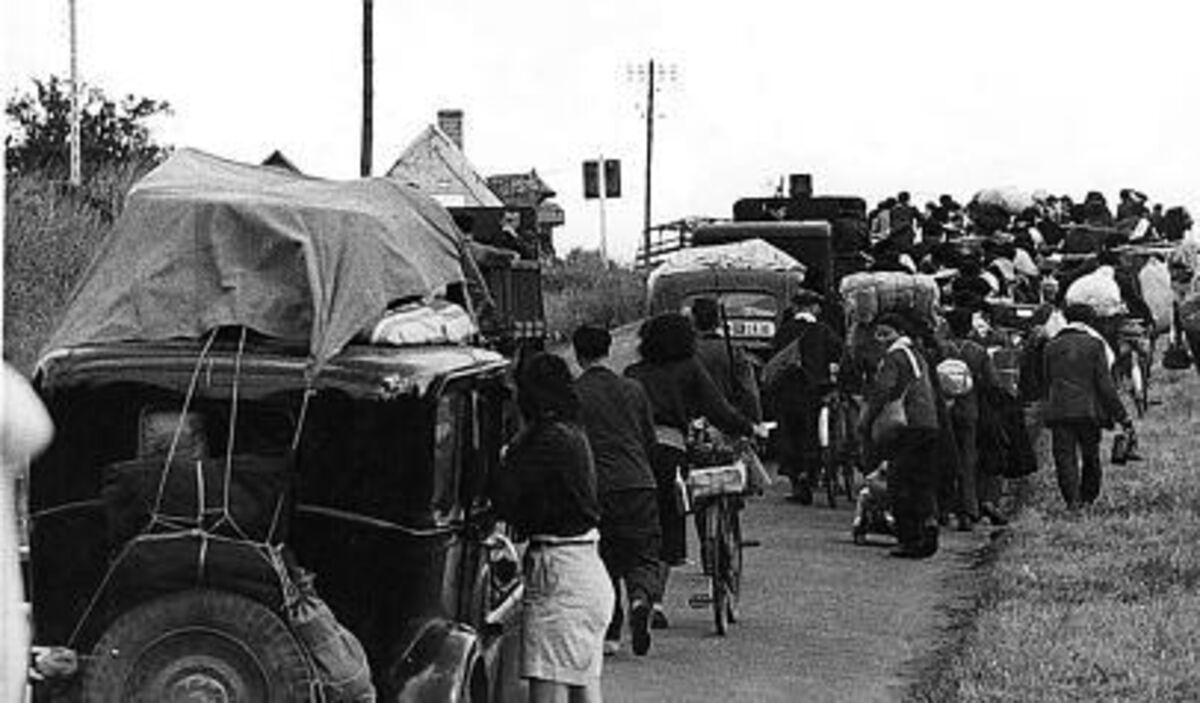
Source: https://www.odomez.fr/
Note the mixture of cars, bikes, and pedestrians

    When I recorded him, Grandpa said they traveled ten miles (16 km) a day, and the route I think they took (which is admittedly a guess), from Brussels to the coast, and then along the coast to Montreuil-sur-Mer, France, taking them right past Dunkirk and Calais, was 180 miles (290 km). I think they also hoped to reach England, so a coastal route made sense. He also said:

 And we arrived at the North Sea. In the … you would say “state.” In French, it is département, department – but that means state if you want – of Pas-de-Calais on the English Channel. 

    The North Sea comment also suggests a coastal route. I'm not certain if they stopped in the city of Calais or just the region of Pas-de-Calais, but in 1988, I got the impression he meant both, although I'm not entirely sure.

The route my grandparents might have followed during the Exodus of 1940
Interactive Google Maps Link

(Added: I now think they probably went to Lille first, then north to Calais)

    My research suggests that a key route during the Exodus was from Brussels to Lille in France, and from there to Paris and then to Bordeaux. But we know they went to Pas-de-Calais, and Paris and Bordeaux were in the wrong direction for that.  It's possible they went to Lille first, and then turned north, but that route and the stops they must have made (they stopped every night in a town with a maternity clinic for my grandmother's benefit), and that would have added a day or two to the trip.  So, I think they made a beeline for the coast.

    Another problem is that if they traveled only 10 miles a day, then the dates don't work - it would have taken them 18 days to arrive in Montreuil, where they stopped for several weeks (a dairy farmer took them in).  However, at 10 mpd, they would have encountered many of the areas after they had fallen to the Germans, whereas his story as a whole suggests that they encountered German soldiers only at the end of the trip.

    So, I started researching the Exodus to see how far people typically traveled in a day:

  • On foot:  6-12 miles per day (10-20 km). This was the majority of the refugees.
  • Bicycle or horse-drawn cart: 12-18 miles per day (20-30 km)
  • Car: Up to 20 miles per day (32 km).  Autos were less common, there were serious fuel shortages to contend with, and many cars were abandoned after they ran out of gasoline. 

    I also have the sense that the trip took less than 2 weeks, probably about 10 days, based on their departure date (May 15), the length of time they spent in Montreuil (3 weeks), and the approximate date they returned to Brussels (after the cease-fire went into effect in France on June 25, 1940).    In those days, cars traveled nearly as quickly as they do today, and under normal conditions, they would have made that drive in about 3 hours.

    The return journey to Brussels would have been tremendously easier. The roads had mostly cleared by then, and the French government offered fuel vouchers with short expiration dates to encourage people to fill their gas tanks as soon as possible and go back to where they came from.   

Well, after three weeks France capitulated. There was no reason for going farther south. So we went back to Brussels, and found our beautiful apartment in town.  

    Grandpa's taxicab would have made the trip back to Brussels in only a few hours.  He didn't tell me this outright, but given his complete lack of detail regarding the round trip (there was probably nothing to tell), I think it's a safe bet.

    But, I do have to figure out how to capture my grandparents' Exodus, because it was miserable and integral to their story, but ... it was two weeks of boredom, punctuated with terror and misery. I want to convey that it was a boring experience, but without making it boring to read.

Bibliography:

Tuesday, August 19, 2025

Movie Review: Superman (2025)


    I really liked this movie.  It was a lot of fun, and it pulled me out of my overthinking head for a couple of hours, and that's always appreciated.

    I like comic book movies, and always have, though comic books themselves aren't really my thing. I think it's because comic books have a simpler focus, and that translates really well to the screen. It's no coincidence that the storyboards that movie makers create as part of movie development, look like ... comic books.

    I loved the fact that the fight scenes were slowed down and easier to follow (there was a 20-or-so-year trend toward chaotic fight scenes in both DC and Marvel movies, that I hated - if I can't tell what's going on, then the violence turns into a boring slog). The acting was also really good, and Nicolas Hoult might well be my favorite Lex Luthor.  

    It wasn't without flaws: the plot was too complex, and there were too many heroes and villains, and all of that diluted the story.   It was an ensemble movie in search of a single, central protagonist.  I wanted to know more about so many of the characters, and they all felt a little short-changed.

    I hated the fact that the recording by Jor-el and Lara was in Kryptonian. The focus was always on the impact of the message on the characters of the movie, and never on the message itself.  First, you see how their telling Kal-el to do good helps to shape him into a hero, then when the message is repaired, the focus is on how much it devastates Clark, and how it turns the world against him.  But when I saw the message, all I saw was a couple speaking a made-up language, and that made Clark's bioparents seem kind of like background noise. They translated the message, but that just made it look like a lie, a manipulation on Lex's part.  It turns out to be true, but we were told it was real, not shown.

    What did I like about the movie?  It was damn fun.  I missed seeing his childhood a little, but as my husband pointed out, they can't tell the 1978 movie over and over again, and we know the story. I enjoyed Crypto, the fact that Lois (at least in private) could provoke Clark into getting mad (and she did ask some very pointed, very reasonable questions that absolutely pointed out that Superman had acted thoughtlessly).  

    Was the broohaha over his being an immigrant warranted?  Nah.  

    There certainly was some political commentary there - the movie seems to depict either the Israel-Palestine or Russia-Ukraine war, and that one fictional world leader might have been poking fun at a couple of real-life people.   But the movie connects Superman, not so much to immigrants, but rather to "meta-humans," other powerful beings. When so much power is concentrated in a single individual, it's pretty reasonable to worry about what they are going to do with it, because power corrupts and all that.  It's basically the same theme of "distrust the mutants" that featured in many of the X-Men movies.

   For now, it's my third-favorite DC superhero movie, after Wonder Woman (2017) and Superman (1978).  


Friday, August 1, 2025

The Bridge Inspector

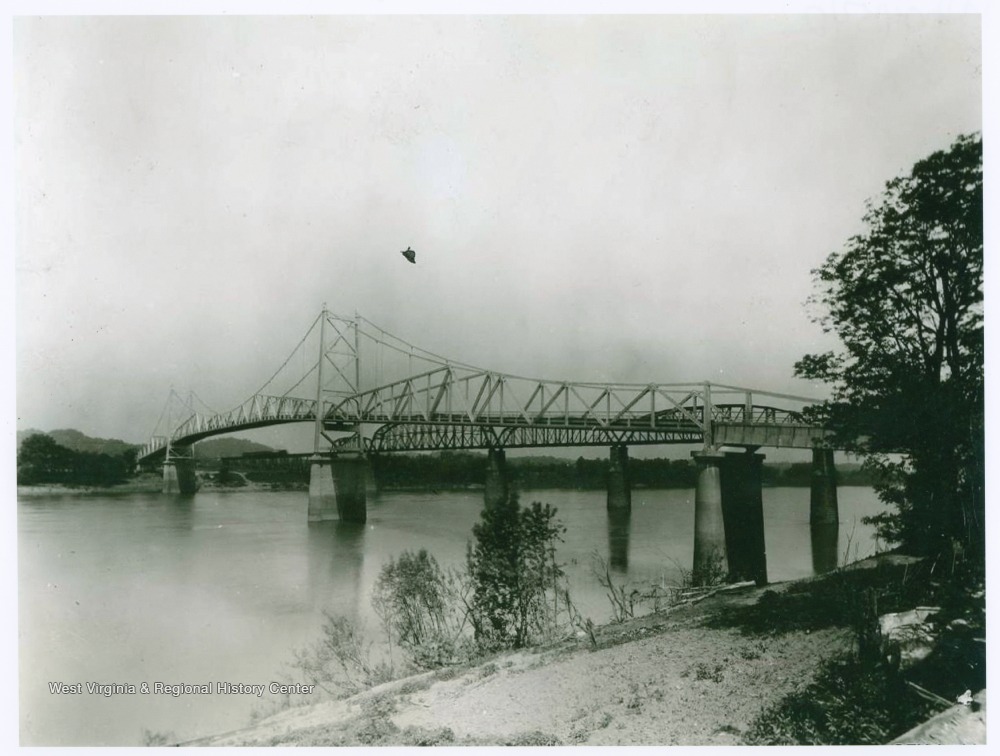
Silver Bridge Before Collapse; Point Pleasant, W. Va. A&M 3914, Duez Collection
Virginia and Regional History Collection, West Virginia University Libraries.


 Prompt - Unknown Town (500 words): Grab a map of the country you live in and look for the name of the town that you have never heard of before. Do some research on the town so that you build up a picture of the location and its history. Use this town within a story of 500 words or fewer.

*** 

     James was working late, and his cell phone rang.  He put his pencil down on the yellow pad where he was jotting some notes and poked the answer button. “James Mason, Point Pleasant Engineering.”

    “Mr. Mason, this is Governor Tim Pawlenty of Minnesota.”

    James felt his stomach clench. There was only one reason the governor of Minnesota would be calling an engineering firm in West Virginia, but he hoped he was wrong.

    “We just had one of our big bridges collapse in the cities - the I-35 bridge over the Mississippi in Minneapolis.  The NTSA recommended I get you up here.”

    Damn it.  James felt his arthritic knuckles complain and forced himself to relax his grip on the phone.  “Ok, I’ll get on a plane this evening.”  

    Governor Pawlenty continued, his voice tense, “I’ll have my office buy you tickets, and we’ll put you up in a hotel for as long as you need. What’s your nearest airport?”

    “Huntington Tri-state, but buy two tickets out of Port Columbus. I’ll drive the 80 miles. Don’t book anything earlier than 4 hours from now. I’m bringing my intern.”

    “Done.”  Pawlenty hung up.

    Joan had heard James’ half of the conversation. “Hey Boss, what’s up?” she called from her desk.

    James sighed, folded up his laptop, and started grabbing equipment from the shelf. “I-35 bridge in Minneapolis collapsed. You see anything on the news?”

    “What??” Joan asked but was already looking at her brand-new cell phone.  What was it called? iPhone? Smartphone?  She could do web searches on it, though.  “Oh my God. It looks bad, James.”

    “Well, go home and pack. Get dinner. We’re getting on a plane in 4 hours and taking a red-eye to Minneapolis.  I’ll pick you up in an hour or so.”  

    “Ok, will do.” She shut down her computer, gathered her things, and left.

    James drove to his home on the other side of Point Pleasant, glancing at the Mothman statue on his way.  His wife looked up from the papers she was grading and knew from his face what had happened. “Another bridge collapse?”  

    He nodded. “Likely neglected infrastructure. I’m flying out tonight from Columbus. I’m taking Joan.”

    “Jamie, you’re getting too old for this.”

    “I’ll be okay. I’m more worried about Joan.  She’s been studying engineering disasters for a year, but I’d hoped that she’d complete her internship without having to see one live, but … I can help her through it this way.”

    An hour later, James collected Joan and then drove across the Silver Memorial Bridge into Ohio, bound for the airport.  

    Joan gazed out the window. “Cantilever bridge. Replaced an eyebar chain suspension bridge that collapsed in … 1968?”

    James kept his eyes on the road.  “1967. I was 20. My dad was on the bridge when it collapsed. I switched my major from physics to engineering because of it.”

    Joan’s eyes widened. “Jesus, James.  That’s awful.”

    James felt his eyes prickle and blinked the moisture away.  “I’d hoped to prevent it from ever happening again. But there have been 36 bridge collapses in the US since then, 375 killed; 365 injured.”  

    He clenched the steering wheel. “This makes 37,” he said, trying to breathe out his rage and pain, and they sat in silence until they reached the airport.

--April 18, 2021

***

Notes:

  • The two bridges really did collapse, but other than that, this is entirely fictitious.
  • I asked Siri to pick a number from 1-50. I got 35. West Virginia was the 35th state to enter the union. 
  • I pulled up a list of towns in WV and found that there are 160. Siri gave me 31, and that was Point Pleasant.
  • From there, I read about the Silver Bridge collapse in 1967, and that reminded me of when a much-closer-to-me bridge collapsed, the I-35 Bridge in Minneapolis, on August 1, 2007.  And from that, this bit of flash fiction was born.
  • I missed my word count - this is 547 words.